
Question About the Illuminati and the Temple
A missionary reported teaching a family whose father once investigated the Church and had prepared for baptism. Before his baptism, he watched an illegal video of the temple endowment online. Disturbed by what he saw and by perceived similarities to other religious rites, he asked a member why the ceremony felt strange and secretive.
The member told him that, in Joseph Smith’s time, the Illuminati supposedly tried to infiltrate the Church to steal and expose temple “secrets,” failed, and are still trying to infiltrate the Church today to destroy it.
Historically, there is no evidence that an organization identified as the Illuminati ever attempted to infiltrate the early Church or interfere with temple ordinances. Nothing in the surviving Latter-day Saint documentary record supports that claim. At best, this seems to be a confused blending of:
- The actual 18th-century Bavarian Illuminati, who tried to influence some Masonic lodges in Europe, and
- Modern conspiracy folklore imported into Latter-day Saint conversation.
The Bavarian Illuminati operated within European Masonry, not among early Latter-day Saints, and there is no credible historical chain connecting that group to Joseph Smith’s temple teachings.
The much more likely explanation is that a well-intentioned member, lacking solid information, reached for a dramatic conspiracy story that does not rest on primary sources.
Conspiracy Theories and the Church
Conspiracy narratives often thrive when:
- People sense something significant is happening that they do not fully understand, and
- They prefer a unified, hidden enemy to the more mundane reality of human weakness, miscommunication, and incomplete records.
In American history, conspiracy thinking has been persistent. Frequent targets have included:
- Freemasons, portrayed as secretly controlling politics and society.
- Latter-day Saints, depicted as operating secret bands such as the “Danites,” supposedly roaming to punish apostates and enemies.
Nineteenth-century newspapers often printed sensational claims about the “Danites,” many of which were exaggerated, secondhand, or fabricated.
While real conspiracies (such as organized crime or specific political plots) do exist, the idea of a vast, perfectly coordinated, centuries-long secret combination that controls governments, churches, and global events is not supported by how actual history works. Real human organizations leak, divide, leave paper trails, and fail.
Claims that the Illuminati control the Church or secretly manipulate temple ordinances do not come from contemporaneous Latter-day Saint documents or careful historical scholarship. They are products of broader cultural myths rather than Latter-day Saint history.
Anti-Mormon Claim About the Melchizedek Priesthood
A second question came from a listener in Minnesota who encountered an aggressive critic claiming:
“The Joseph Smith Papers prove there is no evidence for the restoration of the Melchizedek Priesthood.”
The critic also confused this with the restoration of the Aaronic Priesthood and used the Joseph Smith Papers as a supposed authority.
Two problems arise:
- Misuse of “the Joseph Smith Papers” as a slogan
Many critics invoke the name of the Joseph Smith Papers without actually reading the volumes. They say, “even the Church’s own project shows X,” when the documents do not, in fact, support their claim. - Unrealistic expectations about historical records
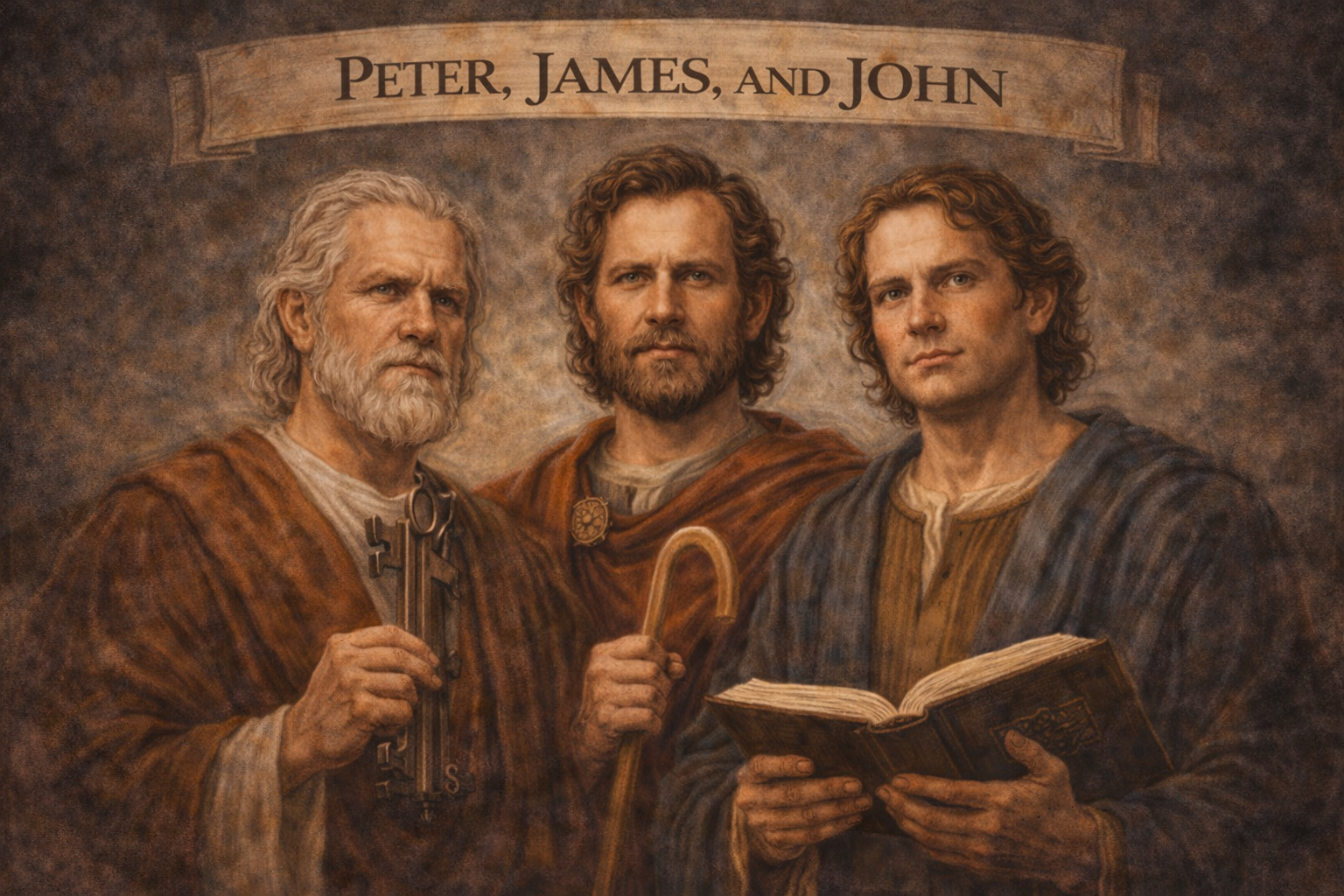
The argument rests on an “argument from silence”:- Because there is no detailed, dated narrative of Peter, James, and John’s visit written at the time it occurred,
- Therefore the event probably did not happen.
If applied consistently, this standard would undermine many core Christian claims:
- We do not know the exact day or year of Jesus’s birth.
- We do not know the exact dates for many of His miracles or for the Transfiguration.
- We do not know the precise date of Paul’s vision on the road to Damascus.
Lack of a same-day, fully detailed narrative does not disprove a claimed sacred event. Historians can only describe what sources say and when those claims enter the record; they cannot prove or disprove the miracle itself.
What the “History of the Church” Actually Is
To understand the record about Peter, James, and John, it helps to understand how the official history was created.
- Early Church leaders quickly realized they needed to tell their own story, not leave history entirely to hostile outsiders.
- John Whitmer was called as Church historian and began a history, but later apostatized and took his manuscript.
- John Corrill wrote his own history and also left the Church.
- In 1838–1839, the Church began a new comprehensive narrative. Multiple scribes worked on it; Willard Richards later became the main compiler and editor.
- Starting in 1842, parts of this history were published in the Times and Seasons.
This compiled narrative—later edited by B. H. Roberts—is what we now call History of the Church. It:
- Uses Joseph’s journals, letters, revelations, and other documents as a framework,
- Is much richer for Nauvoo-era events (where many documents survive), and
- Is relatively sparse for early years (where surviving documents are few).
For example, in the Joseph Smith Papers, Documents, Volume 1 (1827–June 1831) spans several years in one volume, reflecting how limited early documentation is compared to later periods.
The 1829–1830 Narrative Gap
In the manuscript history there is a clear gap in narrative coverage between:
- August 1829 – negotiations with E. B. Grandin to print the Book of Mormon, and
- March 1830 – where the history resumes with the revelation now known as Doctrine and Covenants 19.
We know important events took place in this timeframe, yet they do not appear in the official history. Two examples:
- Abner Cole and the Palmyra Reflector
Cole, a local lawyer and justice of the peace, published a paper using the same print shop as the Book of Mormon. On Sundays he re-set type from drying Book of Mormon sheets and printed portions in his paper, mocking the text.
Lucy Mack Smith records that Hyrum discovered this, confronted Cole, and Joseph was summoned from Pennsylvania to stop it. Issues of the Reflector and Lucy’s narrative confirm this episode, yet it does not appear in the compiled history because it falls in the narrative gap. - The Canadian copyright trip
During that same winter, Joseph and companions traveled to Canada to explore obtaining copyright for the Book of Mormon. This journey is also absent from the History of the Church, even though it is documented in other sources.
These cases show that significant events can be well attested in other records yet omitted from the official narrative because of gaps in documentation or editorial choices.
Likely Timing of the Melchizedek Priesthood Restoration
From the available evidence:
- John the Baptist’s visit (restoring the Aaronic Priesthood) is dated to May 1829.
- The Church is formally organized on 6 April 1830.
- The narrative in History of the Church jumps from August 1829 to March 1830.
- Doctrine and Covenants 27 (an 1830 revelation) later explicitly refers to Peter, James, and John already having ordained Joseph and Oliver as apostles.
Given this, it is very reasonable to place the visitation of Peter, James, and John in late 1829, between the Aaronic Priesthood restoration and the formal organization of the Church. The fact that the compiled narrative does not describe the event in detail simply reflects the broader documentary gap, not the nonexistence of the event.
Doctrine and Covenants 27 and the Role of Peter, James, and John
Although we lack a dated, first-person journal entry for the exact day of the visitation, we do have Joseph Smith’s revelations describing what took place.
In the expanded text of Doctrine and Covenants 27, the Lord lists heavenly messengers and their keys, including:
- Moroni, with the keys of the record of the stick of Ephraim.
- John the Baptist, who ordained Joseph and Oliver to the first priesthood after the order of Aaron.
- Elijah, with sealing keys to turn hearts of fathers and children.
- Patriarchs such as Abraham, Isaac, Jacob, and Joseph.
- Adam (Michael), “the father of all, the prince of all.”
The revelation then says Christ will drink of the sacramental cup with:
“…Peter, and James, and John, by whom I have sent unto you, by whom I have ordained you and confirmed you to be apostles and special witnesses of my name, and to bear the keys of your ministry and of the same things which I revealed unto them…”
This revealed text affirms that:
- Peter, James, and John were sent to Joseph and Oliver,
- They ordained and confirmed them as apostles and special witnesses,
- They conferred keys of the kingdom and of the dispensation of the fulness of times.
The earliest surviving manuscript of this longer text dates to 1834–1835, but the revelation itself is dated August 1830.
Joseph later refers again to Peter, James, and John in Doctrine and Covenants 128, connecting them with priesthood keys and apostolic authority. In the original Aaronic Priesthood account, John the Baptist also states he is acting under the direction of Peter, James, and John—so their role appears very early in the restoration narrative.
Developing Priesthood Terminology
At the beginning of the Restoration, priesthood vocabulary was not yet fixed in the precise way Latter-day Saints use it today. Early revelations speak of:
- “This first priesthood,” and
- Further authority yet to be explained,
before consistently using the labels “Aaronic” and “Melchizedek” in their modern technical sense.
Church offices and structure unfolded gradually:
- When Doctrine and Covenants 27 was revealed, there were no bishops in the modern sense.
- As more revelation came, priesthood offices were named, organized, and distinguished more clearly.
It is therefore anachronistic to demand that Joseph in 1829–1830 describe priesthood using fully developed terminology that only crystallized after years of further revelation and experience.
Brigham Young’s Reasoning About Apostolic Authority
After Joseph Smith’s death, some individuals (such as William McLellin) claimed superior authority based on earlier ordinations. Brigham Young argued that Joseph had to have been an apostle—with apostolic keys—before the Church was organized, because only someone with that authority could properly found the Church of Christ.
That reasoning presupposes a pre–April 1830 bestowal of higher priesthood and keys. It aligns with the statements in Doctrine and Covenants 27 and 128 and with early references to apostolic authority.
What Historians Can and Cannot Decide
Historians cannot empirically prove that a heavenly visitation occurred. What they can do is:
- Identify what Joseph Smith claimed.
- Show when those claims appear in documents.
- Trace how Church leaders understood and invoked those claims.
They cannot:
- Place Peter, James, and John under a microscope, or
- Empirically repeat the event.
By the same logic, historians cannot prove:
- That Jesus physically rose from the dead,
- That He forgives sins, or
- That He appeared to Paul.
These are articles of faith, supported by historical testimonies but not provable in laboratory terms.
Critics who insist that the lack of a contemporaneous 1829 narrative “disproves” the restoration of the Melchizedek Priesthood:
- Apply a stricter standard to Latter-day Saint claims than they do to central Christian claims, and
- Ignore Joseph’s own canonical revelations that describe Peter, James, and John giving him apostolic authority and keys.
For those who already reject Joseph’s calling as a prophet, no amount of documentation will be enough. Accepting the restoration of priesthood authority ultimately rests on spiritual conviction, not on perfect nineteenth-century paperwork.
Summary of Key Points
- There is no historical evidence that the Illuminati infiltrated the early Church or attempted to steal temple ordinances.
- Conspiracy theories appeal to emotion and suspicion, not to primary sources or careful method.
- The History of the Church is a nineteenth-century compilation with real gaps, especially in late 1829 and early 1830.
- Important events, including the likely timing of Peter, James, and John’s visit, fall into this documentary gap.
- Doctrine and Covenants 27 and 128 clearly affirm that Peter, James, and John were sent to Joseph and Oliver, ordained them as apostles, and conferred priesthood keys.
- Historical method can map what was claimed and when; belief in the reality of those claims is a matter of faith and the witness of the Holy Ghost.
FAQ
Q1: Did Joseph Smith teach that the moon was inhabited?
There is no contemporary evidence. The story comes from Oliver B. Huntington, written decades after Joseph Smith’s death.
Q2: Is Huntington’s account reliable?
It mixes memory, secondhand anecdotes, and devotional storytelling. Historians treat it as unreliable for precise quotations.
Q3: Did early Saints believe in life on other planets?
Some speculated, as did many 19th-century Americans. But speculation is not doctrine.
Q4: Would Joseph Smith’s private speculation invalidate his prophetic calling?
No. Prophets are not omniscient; they may express personal opinions that are not revelation.
Q5: Is the “moon men” idea official Church doctrine?
No. It was never canonized, taught officially, or supported by contemporary sources.