
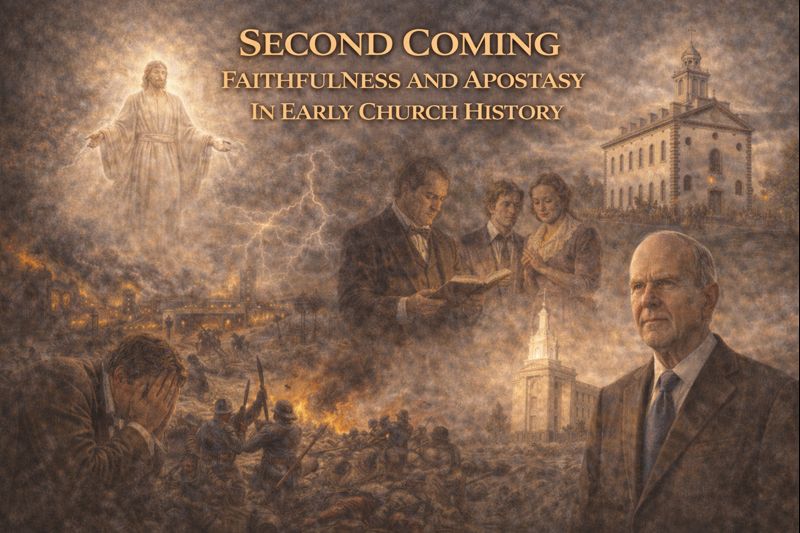
Faithfulness and Apostasy in Early Church History
Throughout the early decades of the Restoration, many Saints faced profound spiritual and emotional challenges as friends, family members, and even respected leaders left the Church. The episode recalls several stories illustrating how difficult such departures could be. Thomas B. Marsh—one of the original Twelve Apostles—left the Church during the Missouri conflict, creating a crisis of faith for many converts who had respected him. In contrast, Lewis and Ann Abbott remained steady and loyal despite the apostasy of the man who had first introduced them to the gospel.
Another example comes from the Kirtland period. Olive Boyington Hale watched her brother—also an early apostle—depart from the faith during the financial turmoil of the late 1830s. Although his decision could have shaken her own conviction, Olive remained firm, migrated to Nauvoo, and continued west with the Saints. She and her husband Jonathan Hale died in Iowa during the 1846 exodus, leaving a legacy of steadfast loyalty. These accounts remind modern readers that early Latter-day Saints frequently faced the heartbreak of seeing trusted leaders abandon the movement, yet many remained true to their covenants.
President George Albert Smith’s Public Warning
The conversation then shifts to the mid-twentieth century, when President George Albert Smith stood at the helm of the Church during the aftermath of World War II. The world was still reeling from the devastation of global conflict, and the Cold War was beginning to reshape politics, society, and the fears of ordinary people.
In the April 1950 General Conference, President Smith delivered a striking warning: “It will not be long before those who are scattered over the Earth by millions will die like flies because of what will come.” He urged the Saints to set their homes in order, repent, and share the gospel—not out of fear, but out of preparation for a world that was spiritually and morally drifting.
A Private Vision That Lacks Historical Foundation
Years later, a personal reminiscence surfaced—written in the 1980s by David H. Horne—claiming that President Smith had revealed a detailed private vision in the 1940s. The account described a catastrophic future war, missile silos, collapsed governments, nuclear exchanges, political upheavals, and specific prophecies about world leaders and geopolitical shifts. Yet unlike President Smith’s 1950 conference statement, none of these alleged prophecies appear in any contemporary journal, note, or official record.
When historians examined the claim, President Smith’s longtime secretary, Arthur Haycock, stated he had never heard of such a vision. Leonard Arrington and other Church historians likewise confirmed that no record exists. Though BYU archives preserve the reminiscence, they do so only as a document reflecting what its author remembered—not as evidence of an actual prophetic vision. Because of this, the Church does not treat it as doctrine or authoritative prophecy, and the episode emphasizes the importance of distinguishing between verifiable records and imaginative later recollections.
Scripture, Warnings, and the Pattern of Last-Days Expectations
The episode next considers scriptural descriptions of the last days, including the warnings in 3 Nephi 21 about the destruction of cities if the Gentiles reject the covenant. Early Latter-day Saints frequently interpreted contemporary events—wars, natural disasters, political upheavals—as signs of the approaching Second Coming. During the Civil War, many believed Christ’s return was imminent; the same tendency appeared during World War II, the Cold War, and various later crises. This pattern reflects a long tradition of believers interpreting their own times in the language of prophecy.
Prophetic Counsel from the Nineteenth Century
Nineteenth-century Church leaders also spoke deeply about preparing for divine judgment. In 1879, Wilford Woodruff declared that rulers who abused constitutional freedoms would face divine accountability. He taught that angels of destruction were held back only temporarily, and that protection would come to those who kept their covenants. In 1894, Woodruff again warned that calamities would increase, and he emphasized the necessity of temple work, which prepared both the living and the dead for the coming Millennium. These teachings centered on righteousness, covenants, and temple worship as essential spiritual safeguards.
Modern Prophetic Instruction: Temple Worship and Covent Faithfulness
The episode concludes by connecting these historic teachings to modern prophetic counsel. President Russell M. Nelson has repeatedly taught that consistent temple worship and covenant faithfulness are the greatest sources of protection in the challenging days ahead. Repentance, daily discipleship, and spiritual preparation are emphasized far more than speculative timelines or dramatic predictions. The Church directs members to rely on official prophetic guidance—not sensational claims, social media rumors, or unverified private visions.
Through these historical examples—whether from the early pioneers, Wilford Woodruff, George Albert Smith, or modern prophets—the message remains consistent: preparation for the Second Coming is rooted not in secrecy or fear, but in covenants, righteousness, and steady obedience to revealed doctrine.