
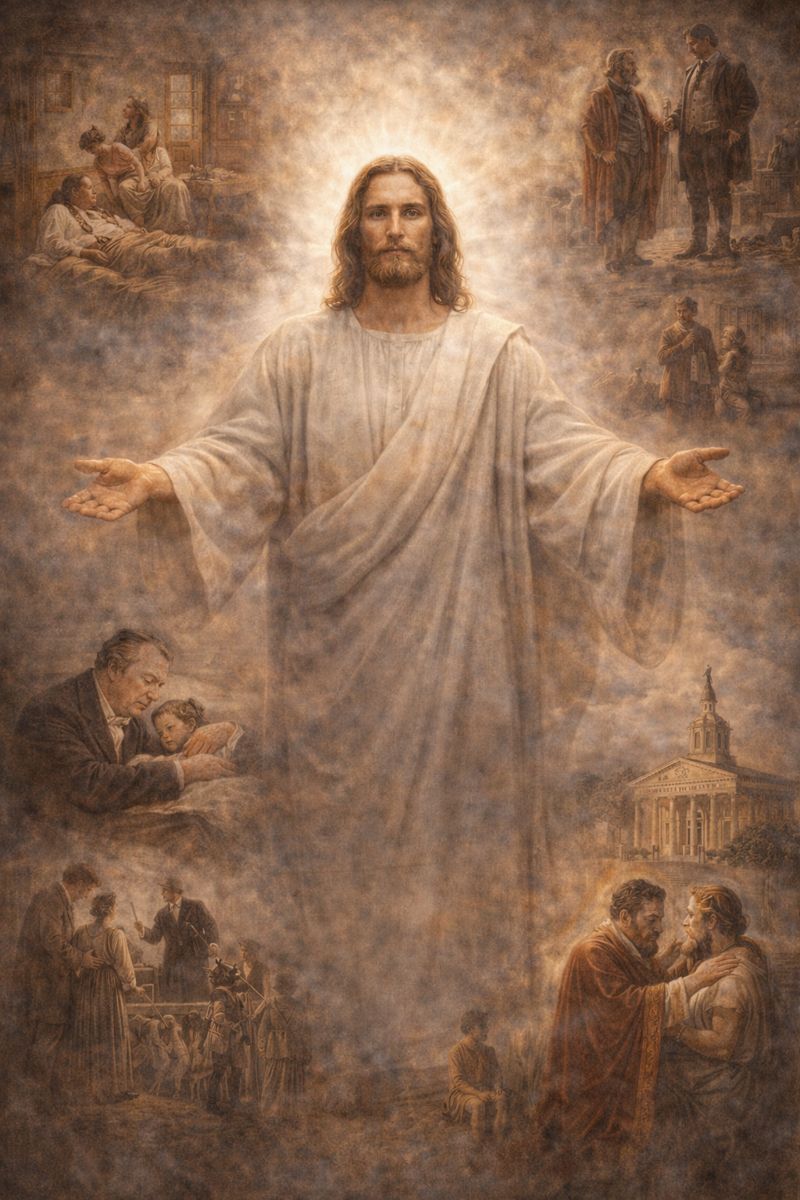
Old Testament Background: Suffering and Divine Punishment
In the Old Testament, suffering is frequently framed as a consequence of wickedness:
- The Kingdom of Israel (the Ten Tribes) was destroyed because of its wickedness.
- The Kingdom of Judah fell and was carried into Babylonian captivity for the same reason.
This creates a simple worldview:
- God directly rewards righteousness with prosperity.
- God directly punishes wickedness with suffering.
The book of Job stands as a deliberate challenge to this pattern. Job is described as righteous, yet he suffers catastrophic losses. His friends insist his suffering must be his own fault, but the narrative clearly shows:
- God allows Job to suffer without Job having sinned.
- Suffering is not always divine punishment.
The biblical record itself therefore contains both:
- Passages where suffering follows sin, and
- A major example (Job) where it does not.
Ancient Worldviews: Polytheism, Monotheism, and the Problem of Suffering
In the wider ancient Near Eastern and Mediterranean context:
- Gods were powerful but often immoral, unstable, or indifferent.
- People worshiped them to gain protection or avoid harm, not because the gods were morally good.
- Suffering was explained as the anger or neglect of various gods, or failure to perform the correct rituals.
With the shift to monotheism:
- There is only one God, who is all-powerful and good.
This raises a sharper question:
- If God is good and all-powerful, why does He allow evil and suffering?
Polytheism spread responsibility among many deities; monotheism centers it in one. This creates a theological tension that runs throughout Jewish, Christian, and later Protestant traditions.
Protestant Reformation Theology and the Sovereignty of God
Reformers such as Martin Luther and John Calvin emphasized:
- The absolute sovereignty of God over all things.
- Nothing happens outside the will or knowledge of God.
- Human free will in salvation is extremely limited or effectively nonexistent.
- People cannot save themselves; only God elects whom He will save.
In this worldview:
- Prosperity is often read as evidence that God has chosen and favored someone.
- Poverty, loss, or suffering can be interpreted as evidence of God’s disfavor or rejection.
These ideas shaped early American religious culture and helped create a cultural equation:
- Wealth and social success = signs of God’s approval.
- Poverty and misfortune = signs of God’s displeasure.
Historical Use of Prosperity as “Proof” of God’s Favor
In colonial and early American preaching, this logic was often used to justify inequality and oppression.
A 1742 Anglican sermon by Reverend James Bate illustrates this:
- He argued that slavery existed because it was God’s will; nothing happens outside God’s will.
- He taught that Africans were destined to be servants and that their suffering was divinely ordained.
- He invoked biblical narratives (Noah, Ham, Canaan) to defend racial subjugation.
- He claimed European domination of the Americas fulfilled prophecy.
This shows how a theology equating prosperity with divine favor and suffering with divine punishment could be used to:
- Justify slavery, racism, and empire.
- Present injustice as God’s plan rather than human sin.
Early Latter-day Saint Context: Poverty, Persecution, and Misjudgment
Early Latter-day Saints were generally poor. Critics pointed to their poverty as “proof” that:
- God had not favored them.
- Their new church was false or cursed.
Joseph Smith explained repeatedly that the Saints were poor because:
- Their lands and property had been violently and illegally confiscated in Missouri.
- They had suffered persecution, expulsion, and theft unrelated to their righteousness.
Their experience demonstrates:
- Righteousness does not guarantee protection from persecution or economic loss.
- Poverty and suffering can result from the agency and violence of others, not God’s displeasure.
Joseph and Emma Smith’s Suffering
Joseph and Emma Smith’s family life starkly contradicts any simplistic “good = prosperity / bad = suffering” model:
- Their first child died at birth during the translation of the Book of Mormon.
- Twin children they adopted (the Murdock twins) both fell ill after a mob attack; one died shortly thereafter.
- Their young son Don Carlos died in 1841.
- They endured poverty, legal harassment, imprisonment, and repeated displacement.
These losses occurred while Joseph was obeying revelations, translating scripture, organizing the Church, and preaching the gospel.
Their story underlines:
- Deep devotion and obedience can coexist with intense grief, poverty, and hardship.
- Their suffering cannot be attributed to secret wickedness or lack of faith.
Latter-day Saint Doctrine on Agency, a Fallen World, and Suffering
Latter-day Saint doctrine explicitly rejects the idea that:
- Every bad thing that happens is God’s direct will.
- All suffering is punishment for sin.
- Righteousness entails automatic temporal prosperity.
Agency Causes Real Consequences
- Humans are free to choose.
- People can and do harm others through their agency.
- Innocent people suffer because of another’s misuse of agency.
Mortality Is Fallen
- The world is in a fallen state.
- Illness, natural disasters, accidents, genetic disorders, and aging are part of mortality.
- Many forms of suffering arise from the conditions of a fallen world, not from personal sin.
God Does Not Routinely Override Agency
- God honors agency even when it leads to suffering.
- He often does not remove consequences simply to prevent pain.
- He works within mortal conditions rather than erasing all hardship.
Trials Are Not Proof of Wickedness
Scripture repeatedly portrays righteous suffering, including Jesus Christ Himself—perfectly righteous—who suffered more than any other being.
These teachings oppose the core assumptions of prosperity theology.
The Phrase “Prosper in the Land” in the Book of Mormon
The Book of Mormon often repeats:
“Inasmuch as ye shall keep my commandments, ye shall prosper in the land.”
Modern interpretation clarifies:
- “Prosper” does not primarily mean getting rich.
- It includes spiritual growth, divine guidance, covenant protection, and having sufficient for one’s needs.
- Collective prosperity does not erase individual trials.
Church leaders have taught that blessings are often spiritual, long-term, and eternal rather than immediate financial gain.
Prosperity Theology in Modern Christianity
In some modern Christian movements, prosperity theology teaches that:
- Strong faith leads directly to material abundance.
- Lack of wealth signals insufficient faith or hidden sin.
- Financial increase is a spiritual entitlement.
Although culturally influential, this theology:
- Conflicts with restored doctrine.
- Ignores scriptural examples of righteous suffering.
Latter-day Saint Doctrine Versus Prosperity Theology
Latter-day Saint teachings clearly contradict prosperity theology:
- Righteousness does not guarantee wealth or career success.
- Poverty or illness are not signs of unrighteousness.
- Material blessings are not the primary measure of God’s favor.
True prosperity includes peace of conscience, spiritual guidance, and the ability to serve God and others.
Dangers of Equating Wealth With Righteousness
This belief leads to serious errors:
- Blaming sufferers for their pain.
- Judging parents, missionaries, or nations by visible success.
- Assuming faithfulness guarantees comfort.
Scripture rejects these conclusions.
Jesus Christ’s Teachings on Wealth, Suffering, and True Treasure
Jesus taught that:
- God blesses both the righteous and the wicked temporally (Matthew 5:45).
- Wealth can be spiritually dangerous.
- True treasure is eternal, not earthly.
Key Parables
- The Rich Fool (Luke 12) – Wealth cannot prevent judgment.
- Lazarus and the Rich Man (Luke 16) – Justice is often realized after mortality.
These teachings show that eternal realities define true prosperity.
The Universal Reality of Mortality and the Promise of Consecrated Affliction
Scripture teaches that:
- Mortality is a testing ground.
- God can consecrate afflictions for good.
To Joseph Smith in Liberty Jail, the Lord declared:
“All these things shall give thee experience, and shall be for thy good.” (D&C 122)
This means suffering is not wasted when endured faithfully.
Historical Examples of Righteous Suffering Among the Saints
Joseph and Emma Smith
- Lost multiple children.
- Endured poverty, imprisonment, and expulsion.
Wilford and Phoebe Woodruff
- Lost several young children.
- Remained faithful amid constant hardship.
Stillman Pond
- Lost his wife and nearly all his children.
- Still gathered to Zion in faith.
These lives show that righteousness does not guarantee comfort.
Scriptural Interpretation of Affliction: Hardened or Softened Hearts
The Book of Mormon observes:
“Many were hardened… and many were softened because of their afflictions.” (Alma 62:41)
Affliction does not determine righteousness—response does.
The Central Promise of the Gospel: Resurrection, Restoration, and Ultimate Justice
The restored gospel promises:
- Resurrection.
- Restoration.
- Ultimate justice and healing.
Faithfulness may include suffering now, but leads to eternal joy.
Historical Method, Evidence, and “Bad Arguments” (Prosperity Theology Part 2½)
Basic Principles of Historical Method
- Evidence cannot be invented or ignored.
- Claims must rest on real documents.
- Context and bias must be evaluated.
Joseph Smith’s Journals and the “History of the Church”
- Journals were written by scribes.
- First-person histories were compiled posthumously using standard 19th-century methods.
Historical Evidence for Joseph Smith’s Teaching of Plural Marriage
- Multiple independent sources confirm Joseph taught and practiced plural marriage.
- No serious historian argues it was invented later.
Misuse of an 1843 Journal Entry
- Unauthorized public preaching was forbidden.
- This does not contradict evidence of private, authorized plural marriage.
Doctrine & Covenants 132 as a Historical Document
- Recorded July 12, 1843.
- Circulated before Joseph’s death.
- Multiple sources predate Brigham Young’s leadership.
Fringe Movements and Misuse of History
Such movements selectively distort evidence to justify new authority claims.
Doctrinal Safety and Prophetic Order
Latter-day Saint doctrine teaches:
- Only one prophet holds all priesthood keys at a time.
- Revelation for the Church comes through authorized leaders.
- Private individuals cannot rewrite Church history.
Members should seek truth through scripture, prophets, the Holy Ghost, and honest scholarship.