
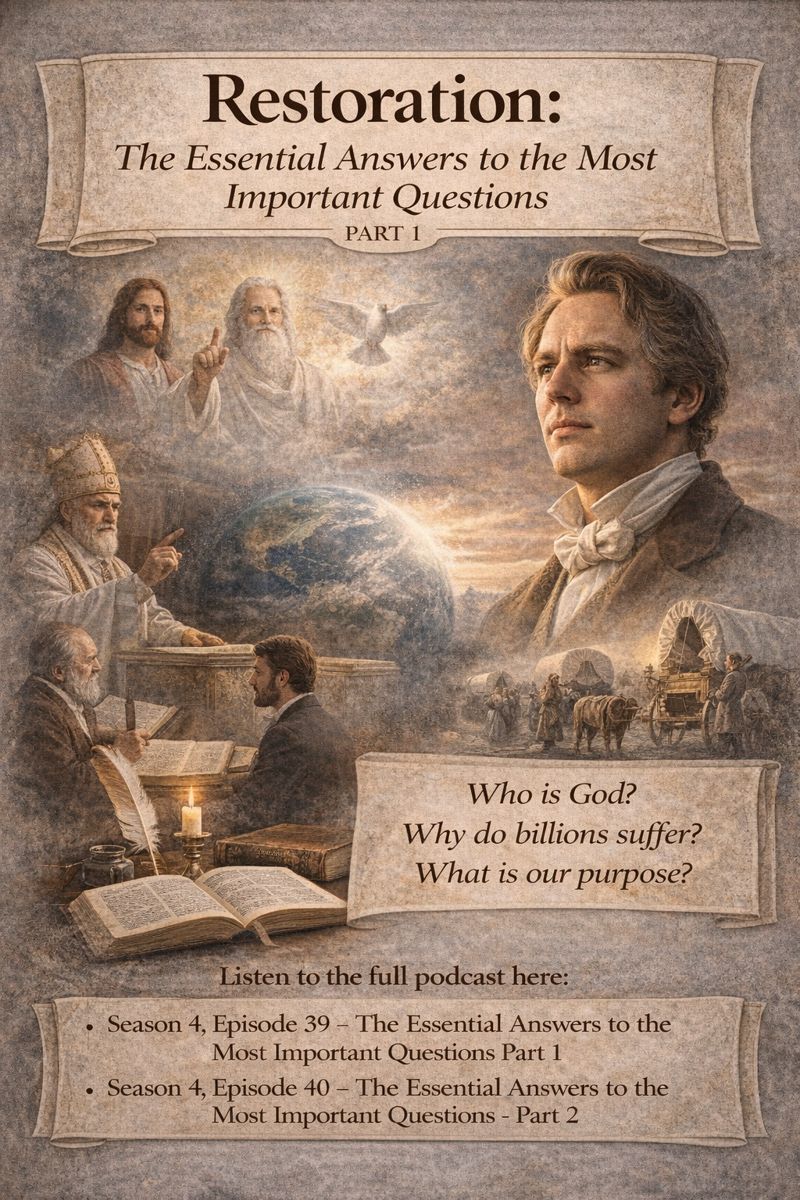
Restoration: The Essential Answers to the Most Important Questions Part 1
Historic Christian Struggles With Creation, God, and the Problem of Evil
For centuries Christian thinkers wrestled with profound questions about the nature of God, creation, human suffering, and salvation. Traditional theology maintained that God was omniscient, omnipotent, fully sovereign, and entirely self-sufficient. Classical Christianity also held to creation ex nihilo, the belief that God created all things out of absolute nothingness, meaning that nothing—not matter, not spirits, not intelligence—existed prior to God’s creative act. Within this framework humanity was not necessary for God’s existence or fulfillment; rather, humans were brought into being solely by His will.
In this worldview theologians were required to reconcile God’s goodness with the presence of profound evil. Christian tradition taught that Satan had once been a glorious angel who fell from heaven through rebellion, and that Adam and Eve, tempted by this fallen being, brought sin into the world. But the reasoning behind God’s allowance of Satan’s fall remained elusive. Over time the inability to supply a satisfying explanation came to be described simply as “mystery,” a term that covered not only the origin of evil but many difficult elements of divine sovereignty.
Biblical passages such as Romans 9 and Romans 11 were often invoked to insist that humans must accept God’s purposes even when they seem incomprehensible. Yet this left unresolved tensions: Why would an all-knowing God create beings whom He knew would fall? Why would He create a world in which billions suffer? And why would the majority of humanity remain unsaved simply because they never heard the name of Christ?
The Early Christian Councils and Theological Formulations
Such questions played into the long doctrinal debates of the first centuries. The ecumenical councils—Nicaea, Constantinople, Ephesus, and Chalcedon—established formal definitions concerning the Trinity and the Incarnation. These councils declared that God was one substance in three co-eternal persons, and that Jesus Christ was fully God and fully man. While central to mainstream Christian belief, these formulations were not presented in the New Testament as philosophical definitions; rather, they emerged gradually as theologians sought to articulate solutions to pressing doctrinal disputes.
But the councils did not solve every problem. Christians continued to describe divine sovereignty and human responsibility as coexisting truths, even when the mechanics of that coexistence defied rational explanation.
Joseph Smith’s Doctrinal Contributions and the Restoration’s Answers
Into this inheritance of unresolved theological tension came the teachings of Joseph Smith. His revelations approached the longstanding questions of evil, divine justice, and human destiny in ways that differed dramatically from the inherited traditions of Christian orthodoxy. Joseph taught that God comprehended all events—past, present, and future—before the creation of the earth. The Fall was not an unforeseen disaster but part of a foreknown plan designed to enable human progression. God understood every human weakness and sin, and His overarching purpose was the redemption of all His children.
Joseph rejected the ancient idea that souls who never heard the name of Christ would be eternally damned. He insisted that it would be unjust for God to condemn those who lacked opportunity. Instead he taught doctrines unknown to the Christian world of his day: salvation for the dead, vicarious ordinances, temple work for ancestors, and the preaching of the gospel in the spirit world. In Joseph’s teachings the supposed “mysteries” of earlier Christian theology became coherent components of a unified plan of salvation.
Premortal Existence and the Eternal Nature of Humanity
Another major difference between Restoration doctrine and traditional Christianity concerns the nature of the human soul. Joseph Smith revealed that all people lived as premortal spirits with Heavenly Parents, choosing to accept the divine plan before coming to earth. Mortality was presented not as a punishment but as a necessary stage in eternal progression. Agency, suffering, weakness, redemption through Christ—these elements worked together in a purposeful design rather than a tragic cosmic accident.
Spirits who rejected the plan followed Satan and were cast out before birth, explaining the adversary’s existence without requiring God to create an evil being. This teaching answered a theological question that Christian thinkers had described as insoluble for centuries.
God, Matter, and Eternal Intelligences
Joseph Smith further taught that God did not create spirits out of nothing. Matter, intelligence, and the human spirit are eternal; they were organized, not created ex nihilo. These doctrines, articulated in revelations and sermons such as the King Follett Discourse, established that humans and God are of the same species, differing only in degree of glory and progression. Mortality therefore became meaningful as a stage through which eternal beings gain experience necessary for exaltation.
This teaching resolved additional problems within traditional Christianity. If God created humans out of nothing and predetermined their destinies, then the existence of evil and the damnation of the unevangelized seemed ultimately attributable to God’s choices. But if human intelligence is eternal and individuals voluntarily enter into the mortal plan, agency and accountability become genuinely meaningful.
Joseph Smith’s Vision of Universal Redemption
Joseph Smith’s revelations presented a God who had prepared “ample provision” for every soul. Salvation extended not merely to the living but to the dead. The Savior’s ministry continued beyond the grave, and ordinances performed on earth could be accepted or rejected by spirits in the next life. With few exceptions—those who commit the unpardonable sin—all souls would eventually receive a kingdom of glory. This doctrine, later clarified in the visions recorded by Joseph F. Smith in 1918, provided structure and coherence to what earlier Christians could only describe as divine paradox.
Degrees of Glory and the End of Eternal Hell
Joseph’s teachings transformed the traditional concept of heaven and hell. All would be resurrected through Christ; all would inherit a degree of glory; only the sons of perdition would be eternally cut off. The telestial, terrestrial, and celestial kingdoms offered an ordered universe in which divine justice and mercy harmonized. Far from dismissing sin or punishment, Joseph taught that individuals who reject Christ must suffer for their sins—but not forever. Endless torment gave way to everlasting opportunity.
Through these doctrines the Restoration offered a comprehensive answer to questions that had troubled Christian theologians for nearly two millennia, presenting a view of God and humanity that resolved contradictions and restored agency, fairness, and purpose to the human experience.
Listen to the full podcast here:
Season 4, Episode 39 – The Essential Answers to the Most Important Questions Part 1
Season 4, Episode 40 – The Essential Answers to the Most Important Questions – Part 2