
Introduction
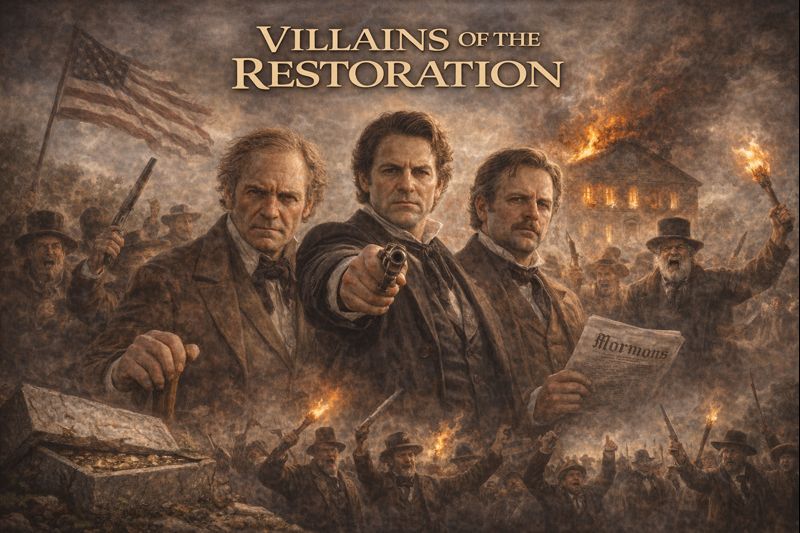
This episode explores several historical currents surrounding the early Restoration: sacrament practice in the 1830s and 1840s, the complex political relationship between Joseph Smith and Sidney Rigdon during the 1844 presidential campaign, late accounts of the Hill Cumorah stone box, and the aggressive national opposition that shaped federal policy toward the Latter-day Saints. Rather than focusing on a single villain, the episode reveals how cultural forces, political antagonists, and ideological movements worked collectively against the early Church.
Early Sacrament Practice Among the Saints
In the early decades of the Restoration, the Lord’s Supper was administered with greater flexibility than in later, standardized periods. Saints in Kirtland, Missouri, and Nauvoo held sacrament meetings not only on Sundays but during weekday gatherings, conferences, and special occasions. Even after the revelation now known as Doctrine and Covenants 59, which instructed the Saints to offer their sacraments on the Lord’s Day, midweek observances continued for years. Only gradually, as Church structure matured during the mid-19th century, did sacrament administration become uniform and tied almost exclusively to weekly Sunday worship. These early patterns demonstrate the organic development of Latter-day Saint ritual practice as the Church grew from a small body of new converts into a more regulated institution.
Joseph Smith, Sidney Rigdon, and the 1844 Campaign
The relationship between Joseph Smith and Sidney Rigdon by 1844 was complicated. Rigdon had served for years as first counselor in the First Presidency and was one of the most persuasive orators in the movement. But tensions had arisen in 1842, partly because Rigdon’s family became entangled in allegations connected to John C. Bennett and claims surrounding plural marriage. Despite this strain, Joseph selected Rigdon as his vice-presidential running mate when launching the 1844 presidential campaign. Rigdon’s Pennsylvania background made him politically useful in reaching eastern voters and broader national audiences.
The campaign itself involved unprecedented organizational work. Members of the Council of Fifty prepared “electioneering missions” in which elders traveled across the country preaching the gospel while simultaneously promoting Joseph Smith’s political platform. These missions reflected both religious zeal and the hope that political action might secure legal protection for the Saints after years of expulsion, mob violence, and governmental indifference.
Late Accounts of the Cumorah Stone Box
The episode also revisits late-19th-century recollections concerning the stone box in which the gold plates had rested. David Whitmer gave several interviews late in life describing how he had seen the stone box on the Hill Cumorah on more than one occasion. He spoke of the stones appearing as though they were cemented together, and in one account, he said the box had slid down the hill due to erosion but was still visible. Another late source, Edward Stevenson, wrote of a Palmyra resident who claimed to have seen the box shortly after public excitement erupted regarding Joseph’s discovery.
These recollections do not originate from the 1820s but from decades later. They are secondary and cannot be treated as contemporary documentation. Yet they show that by the late 19th century, a tradition had developed among some early Saints and Palmyra residents that physical remnants of the box had once been visible on the hill.
The Shifting American Political Landscape
To understand the growing national hostility toward the Latter-day Saints in the 1850s and 1860s, one must consider the transformation of American political parties. The Whig Party, long a home for northern evangelicals and a frequent source of anti-Mormon sentiment, collapsed after the Kansas–Nebraska Act of 1854, which opened new territories to the expansion of slavery. From its remains emerged the Republican Party. From its inception, the new party defined itself by opposition to what it called the “twin relics of barbarism”: slavery and Mormon polygamy.
Republican leaders frequently used strong language against the Saints. Sermons, newspapers, and political speeches portrayed plural marriage as a moral abomination and treated the Utah Territory as a threat to national virtue. These portrayals were amplified as national attention turned increasingly toward the West.
Stephen Foster and the Campaign to “Overwhelm” Utah
The 1860 speech delivered by Republican Congressman Stephen Foster, later distributed widely by the Republican Congressional Committee, demonstrates the intensity of the era’s hostility. Foster argued that ordinary legal measures could never eradicate polygamy because local judges and juries in Utah would not enforce federal anti-polygamy laws. His solution was not judicial but demographic. By promoting the Homestead Act and accelerating construction of a Pacific Railroad, he believed the government could flood Utah with non-Mormon settlers. Such settlers, he argued, would overwhelm the Latter-day Saint population, dismantle their political strength, and bring what he termed “Christian civilization” to the region.
The speech captured a wider Republican sentiment of the time: that Mormonism was a danger comparable to slavery and ought to be extinguished through federal intervention. Although plural marriage is the focus of the rhetoric, the underlying concern was often political power, territorial control, and the perceived threat posed by a cohesive religious community on the western frontier.
Conclusion
This episode highlights the many adversarial forces that confronted the early Latter-day Saints—not only individual antagonists such as Dr. Philastus Hurlbut or political agitators like Stephen Foster, but also shifting national ideologies, religious prejudice, and the political transformation of a nation moving toward civil war. Against this backdrop, the Saints continued to refine their worship practices, engage in national politics, defend the integrity of Joseph Smith’s revelations, and navigate the turbulent and often hostile world around them.