
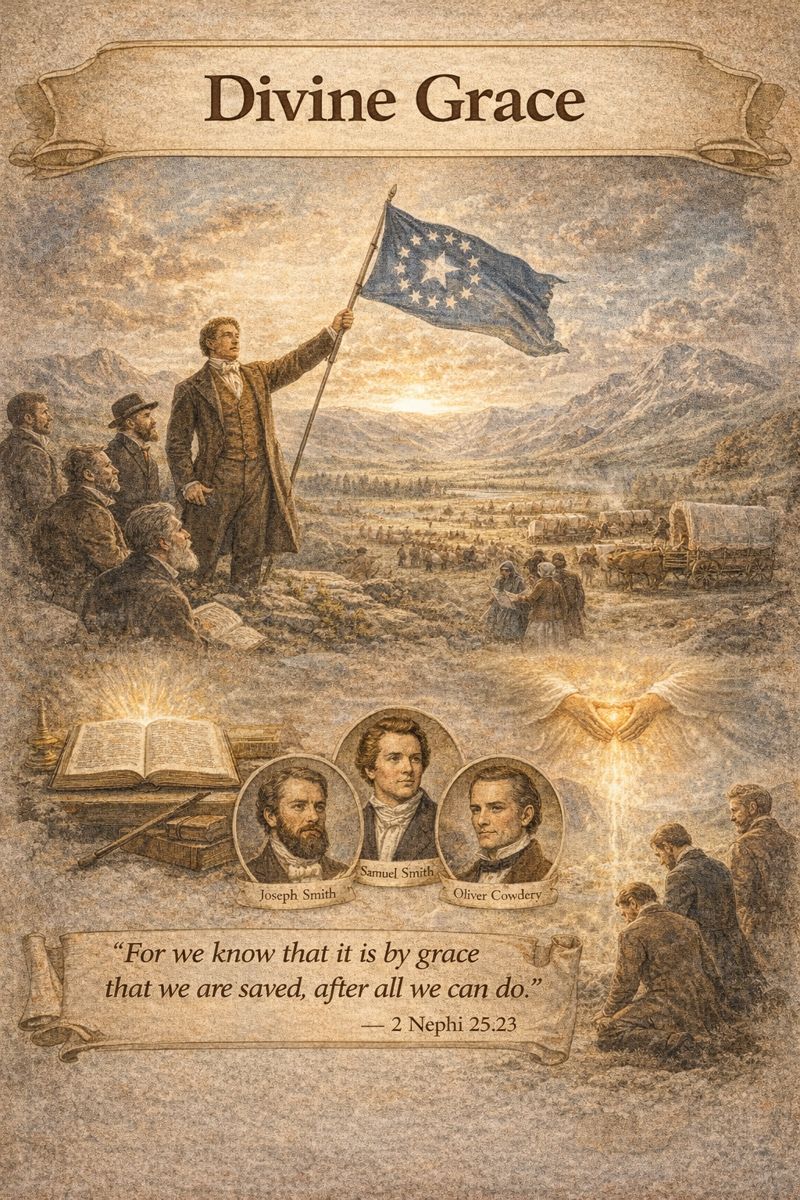
Early Latter-day Saint Migration and the Search for a Safe Homeland
By the mid-1840s, persecution, political hostility, and the murders of Joseph and Hyrum Smith made it clear that the Saints could no longer remain within the United States. Church leaders explored numerous relocation options while preparing for a permanent exodus.
One proposal considered settlement in American Indian Territory, where certain Cherokee groups expressed willingness to negotiate—but because the territory still belonged to the U.S. government, the plan was rejected. Another potential refuge was the Republic of Texas, and Joseph Smith even sent representatives to meet with President Sam Houston. But once Texas was annexed in 1845, it too became part of the United States, ending that possibility.
Ultimately, the Saints turned west toward Mexican territory, selecting an area with no established Mexican settlements. The region that would become Utah was then sparsely populated—visited mainly by trappers and enslavers—but entirely open for the Saints’ goal of creating an autonomous religious society, sometimes described as the Kingdom of God on earth.
The Council of Fifty and the Early Latter-day Saint “Flag”
During this period, the Saints developed a symbolic flag used in connection with the hope of establishing Zion. This blue-and-white flag displayed:
Twelve stars, representing the Twelve Tribes of Israel
A central larger star, symbolizing Jesus Christ
Though not a formal church flag in modern terms, it appeared in early Utah as pioneers raised it while surveying the valley from Ensign Peak. The flag represented covenant identity, divine gathering, and the dream of a new society built under God’s direction.
A Radical Doctrine in 1829: Ordinances, Authority, and Grace
In early 19th-century America, most Protestants preached salvation by grace alone, independent of baptism or ecclesiastical ordinances. Calvinist traditions emphasized predestination, where God decided before creation who would be saved and who would not. Baptism, for most Protestants, bore symbolic—not salvific—significance.
But as Joseph Smith and Oliver Cowdery translated the Book of Mormon in 1829, they encountered clear teachings in 3 Nephi:
Baptism is essential for salvation.
It must be performed by proper authority.
This led them to prayer—and to the appearance of John the Baptist on May 15, 1829, restoring the Aaronic Priesthood and granting authority to baptize.
Samuel Smith’s Struggle and Conversion
Samuel Smith believed in the gold plates, in angels, and in Joseph’s prophetic call. Yet when confronted with the idea that valid baptism required restored priesthood authority—and was necessary for salvation—Samuel hesitated. The doctrine was profoundly different from the Protestant Christianity surrounding him.
After prayer and spiritual reflection, Samuel accepted the revelation and was baptized on May 25, 1829, becoming one of the earliest members of the restored Church.
Grace in the Book of Mormon and Early Revelation
The Book of Mormon offers a rich and balanced theology of grace:
2 Nephi 25:23 affirms that salvation comes by grace, “after all we can do,” emphasizing both divine power and human discipleship.
Moroni 10:32–33 teaches that grace perfects the faithful as they deny ungodliness and follow Christ.
Jacob 4:7 explains that weakness reveals humanity’s need for divine strength.
The Doctrine and Covenants extends this theology.
In D&C 45, Christ stands as advocate, appealing not to human merit but to His own sacrificial righteousness.
In D&C 93, Joseph Smith recorded a profound doctrine: Christ Himself advanced “grace for grace” until He received a fullness—and humans progress the same way.
Universal Grace: Salvation for the Dead
Beginning in 1840, Joseph Smith unveiled one of the most expansive doctrines of the Restoration: vicarious ordinances for the dead.
This teaching established that:
Baptism is required for salvation.
Christ’s grace extends to all who have lived, whether or not they received the gospel in mortality.
Ordinances performed in temples make redemption universally available.
This shifted Christian grace from something limited to earthly opportunity into a divine plan ensuring every soul receives a full and fair chance.
Joseph Smith’s 1844 Letter on Rebaptism and Grace
In early 1844, Joseph and Hyrum Smith wrote to Abijah Tewksbury, encouraging him—after excommunication—to return through rebaptism and the reception of the Holy Ghost. Joseph added the memorable line:
“Grace for grace is a heavenly decree and union is power where wisdom guides.”
Here Joseph unites grace, progression, and unity—core themes of early Latter-day Saint theology.