
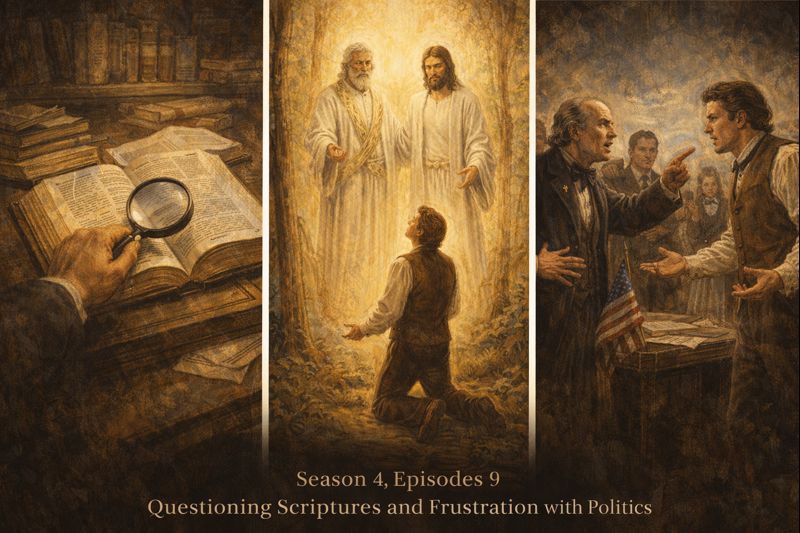
The episode opens with two heartfelt listener concerns—one centered on the nature of scripture and the complexity of biblical authorship, the other on the rising tension some Saints feel when politics enters Church discussions. Both questions reflect experiences Latter-day Saints have always faced: how to remain rooted in revealed religion while surrounded by scholarly debates, cultural conflict, and personal frustration
Scriptural Authorship, Pseudepigrapha, and Scholarly Doubt
A listener describes losing confidence after learning that many New Testament scholars believe certain epistles were written not by apostles but by later Christians using their names. The podcast explains why such conclusions arise: some New Testament writings use elegant Greek far above what scholars assume Galilean fishermen could produce; some letters attributed to Paul seem more theologically mature than those written earlier; and some passages appear to allude to later historical events.
Yet these claims, though common in academic circles, are not certainties. They rest on assumptions about what ancient apostles “should have known,” how quickly doctrine “should have developed,” and what kind of Greek they “should have been capable of writing.” Scholars also do not possess original manuscripts—only copies written decades or centuries later—which complicates confident conclusions. Much academic doubt stems from a worldview that excludes revelation from the outset.
For Latter-day Saints, however, revelation is the key. We do not believe the Bible is the final or infallible word of God, nor do we require perfect textual preservation or flawless authorship. The Joseph Smith Translation alone demonstrates that the scriptures we inherited were incomplete. An example discussed in the episode is John 6:44—whose King James wording seems deeply Calvinistic. The JST restores the principle of agency, showing how revelation clarifies ancient text and protects doctrine. Thus, concerns about pseudepigrapha cannot overthrow a faith whose foundation is not the manuscripts but the revelations God continues to give.
Revelation in Layers: Why Prophets Speak Differently Over Time
The hosts point out that revealed religion has always progressed “line upon line.” God rarely reveals the entire picture at once. Even within the Doctrine and Covenants, earlier revelations sometimes receive additional explanation years later. Scholars who deny revelation interpret such development as contradiction. Saints interpret it as divine clarification. Understanding this pattern dissolves many anxieties about why scriptural voices sound different at different times.
The Heart of the Restoration: Did Joseph Smith See God?
Amid all questions—academic, cultural, or political—the core issue remains unchanged: did Joseph Smith truly see the Father and the Son? If he did, the Restoration stands firm regardless of scholarly disputes about who wrote Ephesians or whether 2 Peter came from the apostle’s own hand. The Book of Mormon and the First Vision remain the clearest evidence of Christ’s reality and the Restoration’s truth. When faith becomes clouded by peripheral concerns, returning to those foundations restores clarity.
Politics Among Early Saints: Conflict, Passions, and Prophetic Counsel
Another listener asks about Joseph Smith’s prophecy of the Civil War, which leads to a broader question: how did early Latter-day Saints handle political division? The answer reveals that political friction is not a modern invention. In the 1840s at Council Bluffs, Orson Hyde—a strong Whig—clashed openly with Almon Babbitt, an equally committed Democrat. Their disagreements spilled into dueling newspapers, each attacking the other’s views.
Brigham Young, deeply frustrated, intervened with unmistakable clarity: never drag the priesthood into the warfare of political parties. Offending a fellow Saint over politics, he warned, was a far greater loss than seeing any political system collapse. Even then, Saints struggled with competing loyalties. Brigham insisted that discipleship must outrank ideology.
Remaining Steady in a Politically Divided Church
The podcast stresses that the Church of Jesus Christ is meant to welcome every soul—rich and poor, bond and free, male and female, black and white, and every political persuasion. What matters is not what party a person aligns with, but whether he or she is willing to change political ideas when prophetic direction contradicts them. A disciple’s loyalty belongs first to Christ and His servants.
One danger of modern life is the tendency to fuse political ideology with the gospel until they appear indistinguishable. The antidote is humility: focusing on the central doctrines of salvation rather than allowing policy debates to eclipse eternal truth.
Joseph Smith’s Civil War Prophecy and Historical Perspective
A listener wonders how secular historians interpret Joseph Smith’s prophecy that war would begin in South Carolina and spread across the nation. The hosts explain that most Civil War historians simply do not address it, as it lies outside their specialized field. Yet historians unanimously agree on one point—no one in the 1830s foresaw the scale and devastation of the coming war. Even Lincoln later admitted that no one imagined what the nation was about to endure.
This context highlights the striking nature of Joseph’s prophecy. And contrary to claims that Doctrine and Covenants 87 was inserted later, early manuscripts and publications preserve the 1832 text. If we possessed only the 1835 and 1876 Doctrine and Covenants, scholars today might assume the revelation was added later. But we have the original documents, and they testify to Joseph’s prophetic foresight.
Final Reflection: Returning to the Center
The episode concludes where it began—in the essential truth that political tension, scholarly debate, and social frustration cannot overturn. The Church stands because Christ restored it. Joseph Smith saw God. The Book of Mormon is true. In times of doubt, the safest and clearest path is always to return to those witnesses.
Listen to the full podcast here:
https://www.youtube.com/@standardoftruthpodcastllc
Season 4, Episode 9 – Questioning Scriptures and Frustration with Politics