A Church in Crisis After the Martyrdom
The deaths of Joseph and Hyrum Smith in June 1844 placed the Saints in a condition of profound grief and uncertainty. Nauvoo, filled with mourning, now faced an equally pressing question: who carried the authority to lead the Church forward? The Quorum of the Twelve Apostles returned to Nauvoo determined to complete Joseph’s work, yet they soon found that their greatest challenge would not only come from hostile mobs but from competing leadership claims within the Church itself. Among these, the most prominent was Sidney Rigdon, once Joseph’s close associate and a counselor in the First Presidency, who now asserted that he should serve as the Church’s “guardian.”
Brigham Young Defends the Keys of the Kingdom
In the weeks following Joseph’s death, Brigham Young spoke repeatedly to the Saints, reminding them that Joseph had conferred all priesthood keys upon the Quorum of the Twelve before he died. The authority to govern the Church, he taught, rested not with any single individual but with the united Apostles who carried Joseph’s final instructions. The Nauvoo Temple must be completed; the Saints must remain united; and no unauthorized individual had the right to lead groups away from Nauvoo, regardless of rumors that Joseph had privately granted such approval.
Young warned that scattering the Saints prematurely would destroy the temple project and prevent the Saints from receiving the endowment Joseph had introduced. Only by remaining together could they preserve the sacred work Joseph left for them. In this atmosphere of confusion and fear, the calls for unity under the Apostles became the foundation for maintaining order.
Sidney Rigdon’s Claim to Leadership
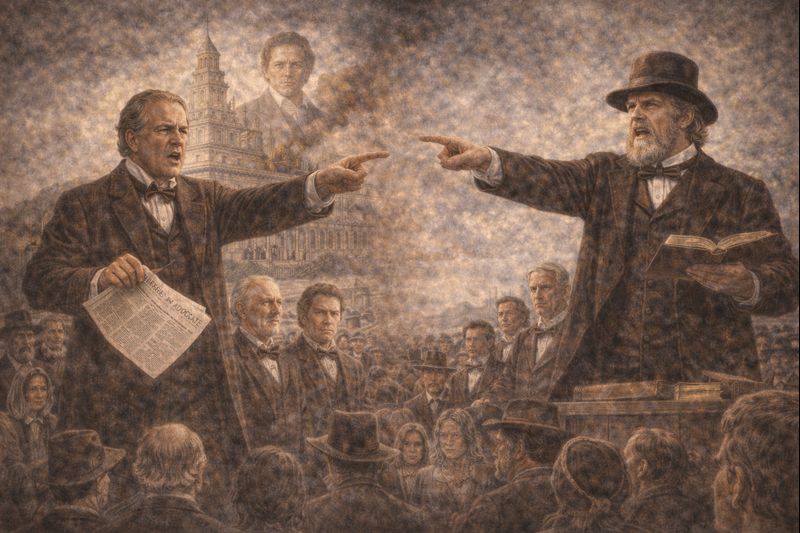
Sidney Rigdon returned to Nauvoo asserting that he possessed spiritual authority above the Twelve and insisting he should stand as the Church’s “guardian.” During intense meetings in early September 1844, Rigdon declared he did not recognize the authority of the Twelve and was not bound to follow their counsel. The Twelve were stunned when Rigdon added that the Church “had not been led by the Lord for a long time”—an unmistakable accusation that Joseph Smith’s later years contained false doctrine.
For Brigham Young and the Apostles, this statement crossed a line that could not be ignored. To claim that Joseph had ceased to teach true doctrine was to undermine the entire foundation of the Church. When Rigdon threatened to reveal “secrets of the Church,” the Twelve demanded his license. Rigdon refused and soon departed Nauvoo altogether.
A Rival Church Is Born
Soon after leaving Nauvoo, Rigdon relocated to Pittsburgh and revived a newspaper titled The Messenger and Advocate. Through this publication, he began constructing a rival church and attacking the authority of the Twelve. His early writings accused Church leaders of introducing corruption and leading the Saints astray. But as months passed, Rigdon’s criticisms became more direct—and more pointedly doctrinal.
Rigdon Denounces Plural Marriage and Joseph Smith
Rigdon’s newspaper soon began condemning what he called “spiritual wifeism” and “vile abominations,” which he alleged had corrupted the Church even before Joseph’s death. Though he avoided naming Joseph outright, his language implied that the doctrine of plural marriage originated with Joseph and that it had brought divine displeasure upon the Saints. By early 1845, Rigdon dropped the veil entirely.
In his January 1, 1845 editorial, “Carry Out the Measures of Joseph Smith,” Rigdon declared that Joseph had “departed from the living God,” had sinned, and had been “cut off” by the Lord. Joseph, he insisted, had introduced false doctrines in his final years, particularly plural marriage, and God had replaced him with “another”—a thinly veiled reference to Rigdon himself. This was no longer an argument about succession; it was a theological repudiation of Joseph Smith’s prophetic status.
Brigham Young’s Firm Response
The Church’s September 1844 conference addressed Rigdon’s actions directly. Brigham Young insisted that the Saints must openly choose whether they stood with Joseph Smith, the scriptures, and the temple—or with Sidney Rigdon and other claimants such as Lyman Wight or James Emmett. The Church would not tolerate secret opposition or veiled accusations that Joseph had fallen.
Young declared that a test of fellowship was the confession that Joseph Smith lived and died a prophet of God. Anyone teaching that Joseph had fallen, or that the Twelve no longer held divine authority, could not remain in communion with the Church. Young assured the Saints that the keys of the kingdom had not been lost and would not be lost as long as the Twelve remained united.
Rigdon’s Attacks Intensify as the Saints Prepare to Leave Nauvoo
As the Saints crossed Iowa in bitter winter conditions in 1846, Rigdon used their suffering as proof that God had abandoned them. In his newspaper, he insisted their hardships demonstrated the false leadership of Brigham Young and the punishment of God for plural marriage. Yet, despite Rigdon’s claims, the Nauvoo Temple had been completed and dedicated before the exodus—an undeniable contradiction to Rigdon’s predictions of failure.
The Collapse of Rigdon’s Movement
Rigdon attempted to establish a communal economic system among his followers, but internal conflict soon erupted. His own congregation eventually removed him from leadership. His movement, lacking cohesion and prophetic direction, dissolved. A convert named William Bickerton reorganized the remaining believers into a church that survives today as The Church of Jesus Christ (Bickertonite). This group retained the Bible and Book of Mormon but rejected all later revelations, Nauvoo-era doctrines, temple ordinances, and continuing prophetic leadership.
Meanwhile, under Brigham Young, the majority of the Saints completed the temple, preserved Joseph’s teachings intact, and began the journey west to establish a new center for the Restoration.
The Historical Legacy of Rigdon’s Apostasy
The conflict between Sidney Rigdon and the Quorum of the Twelve was not simply an administrative dispute—it was a battle over Joseph Smith’s legacy, doctrine, and the very nature of prophetic authority. Rigdon argued Joseph had fallen; the Twelve insisted Joseph had given them the keys to carry forward the Restoration. History shows that the movement led by the Twelve flourished, built temples, and grew into a global faith, while Rigdon’s splinter group fragmented and disappeared.
The episodes of 1844–1846 reveal enduring lessons: claims of secret authority, reinterpretations of prophetic history, and doctrinal revisionism often arise during leadership transitions, yet only unity under revealed priesthood keys preserved the Church Joseph Smith founded.
Listen to the full podcast here:
https://www.youtube.com/@standardoftruthpodcastllc
Season 4, Episode 43 – Sidney Rigdon’s Apostasy – Part 1