
Overview of Postmaster General Amos Kendall
Amos Kendall and Political Power in the Postal System
Amos Kendall served as Postmaster General under President Andrew Jackson. During the 19th century, the Postmaster General held vast national power because the postal system was one of the few large federal structures. Kendall became widely known for using the mail system for political manipulation, including delaying newspapers critical of Jackson while speeding up pro-Jackson publications.
He also restricted anti-slavery materials from being delivered into the South, creating a censorship regime without congressional approval. Later, Kendall participated in a conspiracy against Latter-day Saints alongside Alfred Grannis and Benson, attempting to pressure Brigham Young into signing away half of all future LDS-settled land for questionable “federal protection.” Young rejected the proposal, calling it a “covenant with death.”
Historical and Political Background
The federal government of the era was small, giving cabinet members—especially the Postmaster General—extensive influence. Before the telegraph (1840s), the mail system was the primary form of national communication. Kendall later helped finance Samuel Morse in building the telegraph.
Joseph Smith’s Prophecies About War
Joseph Smith prophesied repeatedly of future wars in America, including the prediction that a major conflict would begin in South Carolina—a prophecy fulfilled in the U.S. Civil War. Jedediah M. Grant described Joseph receiving a vision of the American continent covered in blood, filled with domestic violence and chaos, which caused Joseph to plead with the Lord to close the vision.
Context of Jedediah Grant’s Sermon
Grant’s sermon was delivered in the 1850s, during the Crimean War and shortly before the Civil War. He emphasized global conflict, the inevitability of further wars, and the fulfillment of ancient and modern prophecy. He taught that America would not escape divine judgments because of its treatment of the Saints and the murder of prophets.
Teachings on National Judgments
Grant taught that war and calamity follow when nations reject prophets. Treaties and peace conventions cannot stop prophesied destruction. The Saints should not rejoice in calamity; Christ died for all, including persecutors.
Wilford Woodruff’s Observations During the Civil War
Woodruff recorded that the Saints viewed the Civil War as fulfillment of prophecy. He believed it reflected God’s judgment on the nation for rejecting the restored gospel and for the murder of Joseph Smith. Woodruff taught that the wicked would destroy the wicked until the land was cleansed.
Missionary Work and Future Calamities
Brigham Young taught that before the final destructions, missionaries would be called home and the Lord Himself would “preach His own sermon” through natural disasters and judgments. He warned against seeking revenge and affirmed that individuals may repent even up to their final moments.
Scriptural Interpretation and Proof-Texting
Proof-texting refers to pulling isolated scripture passages out of context to support a predetermined argument. Examples include misinterpreting passages in Exodus or Revelation 22. Proper interpretation requires context, audience, and the principle of continuing revelation.
Teachings on the Second Coming
Christ taught that no person knows the day or hour of His return. Many groups historically misinterpreted signs and attempted predictions. Latter-day Saint leaders teach that the Church does not set dates, and independent predictions are unreliable.
Foreshadowing Millerism
The Millerite movement (1843–44) attempted to predict the exact date of Christ’s return—a topic planned for further discussion in the next episode.
SIGNS OF THE TIMES – PART 2
Early Latter-day Saint Missionary Work
Early missionaries were sent quickly after the Church’s organization, even during internal and external trials. Their message emphasized repentance, the imminent Second Coming, Zion, modern revelation, priesthood authority, and the Book of Mormon.
These teachings differed from mainstream Christian beliefs of the 1830s, which were predominantly postmillennial. Latter-day Saints taught premillennialism: Christ would return soon to cleanse the earth.
Historical Christian Beliefs About the Millennium
Postmillennialism expected the world to become progressively more righteous before Christ returned. European missionary expansion reinforced this belief. Some Christians held amillennial views, interpreting the Millennium symbolically. Latter-day Saints taught a literal premillennial return of Christ.
William Miller and Millerism
William Miller calculated prophetic dates using Daniel, interpreting “days” as years and predicting Christ’s return for 1843–1844. Millerite preachers set specific dates such as April 3 and October 22, 1844, creating widespread expectation.
Joseph Smith’s Response to Millerism
Joseph Smith repeatedly corrected Millerite interpretations. He taught that many prophecies remained unfulfilled and that Miller lacked essential knowledge. Joseph identified Millerite date-setting as false prophecy and recorded specific instances of Millerite failures.
The Great Disappointment
When the final predicted date (October 22, 1844) passed without Christ’s return, large numbers of Millerites lost faith. Some abandoned Christianity entirely. Historical accounts document widespread emotional and spiritual collapse.
Dangers of Date-Setting
Latter-day prophets teach that date-setting leads to fear and poor judgment. In a true emergency, the prophet will provide clear direction. Claims by private teachers or YouTube interpreters lack authority.
Doctrinal Standards and Church Authority
Church doctrine is established only by the united voice of the First Presidency and the Twelve. Individual teachers or authors cannot declare doctrine. A single early leader’s statement does not create doctrine.
Misuse of History in Apocalyptic Speculation
Historical misuse includes asserting prophecies not spoken by Christ, claiming America is explicitly named in prophecy, or cherry-picking early leader statements. Joseph Smith declared all the Americas to be Zion, not one specific nation.
Anti-Mormonism in American History
Hostility toward the Church has persisted throughout U.S. history. Modern vandalism of meetinghouses often receives little public attention.
Rejecting Prophetic Counsel
Some members accept prophetic authority only when it aligns with personal preferences. Examples include rejection of Gospel Topics Essays, Joseph Smith Papers, or teachings about Book of Mormon translation.
Prophetic authority requires accepting the prophet’s teachings even when they challenge personal assumptions.
Book of Mormon Translation and the Seer Stone
Historical sources—including those quoted by President Russell M. Nelson—confirm Joseph Smith used a seer stone in translation. Denying this contradicts prophetic authority and historical evidence.
SIGNS OF THE TIMES – PART 3
Early Latter-day Saint Doctrine on the Second Coming
Early Saints firmly believed in a literal and imminent Second Coming. Their message included repentance, gathering Israel, building Zion, and preparing for divine judgments. Unlike most Christians of the era, they rejected postmillennial optimism.
Historical Christian Views of the Millennium
Postmillennialism dominated American Christianity, teaching that righteousness would spread worldwide and usher in the Millennium before Christ’s return. Amillennialism interpreted prophecy figuratively. Latter-day Saints taught literal premillennialism.
Historical Pandemics Interpreted as Signs
Throughout history, pandemics have been viewed as signs of the last days:
- AIDS (40+ million deaths)
- COVID-19 (6.5+ million deaths)
- Spanish Flu (50+ million deaths)
People in every era interpreted their disasters as apocalyptic.
World War I and Collapse of Postmillennialism
World War I devastated Christian Europe, killing millions and shattering the belief in a coming Christian golden age. Immediately afterward, the Spanish Flu heightened apocalyptic expectations.
Prophetic Authority in Latter-day Saint Doctrine
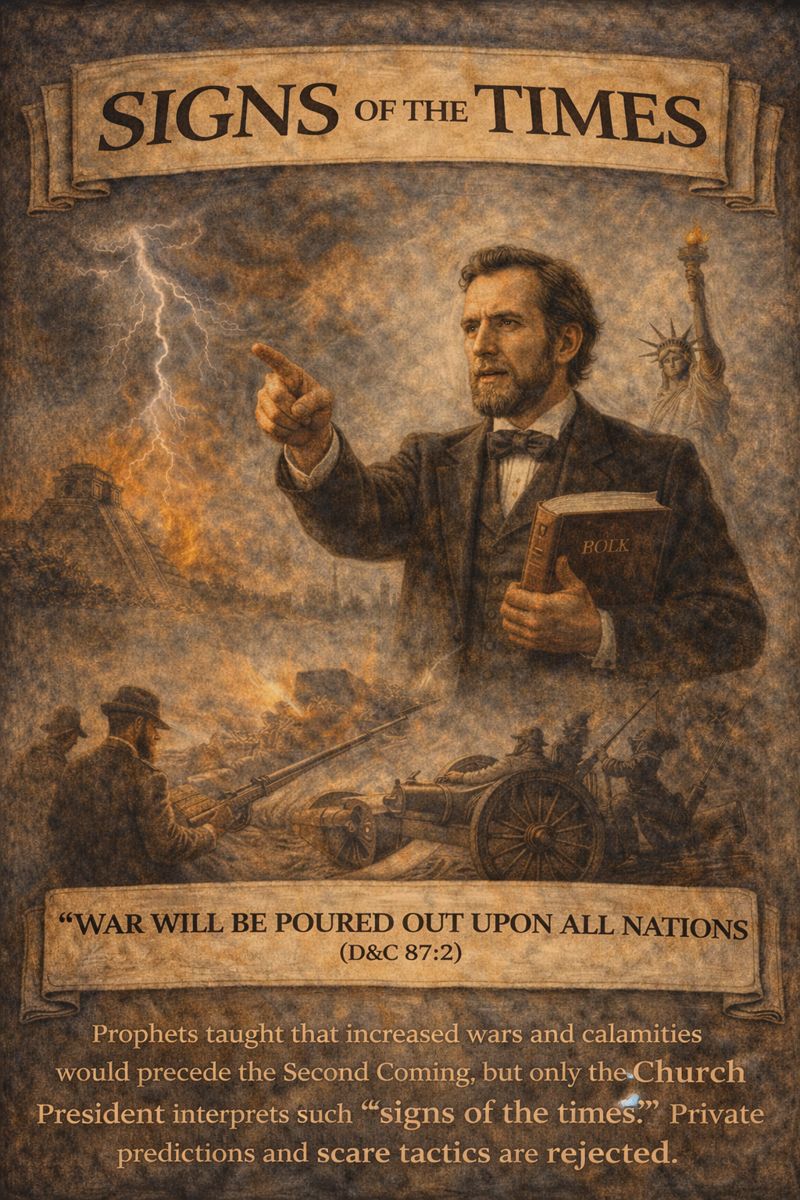
Only the President of the Church is authorized to interpret signs of the times for the Church. Personal visions or private teachings cannot declare prophetic timelines.
False Prophecy and Private Movements
Throughout history, individuals have claimed private visions predicting destruction or timelines. The Church rejects such teachings. No person outside prophetic structure may declare dates, locations, or sequences of prophesied events.
Warnings Against Speculation
Prophets counsel:
- No date-setting
- Avoiding fear-based apocalyptic interpretations
- Preparing spiritually rather than with anxiety
- Rejecting extreme survivalist rhetoric
- Trusting prophetic guidance
Warnings About Private Groups and New “Scripture”
Private writings mimicking scriptural style—claiming to describe future judgments or divine plans—are doctrinally inappropriate. Revelation for the Church does not come through independent groups, books, or predictions.
Misrepresentation of Prophetic Authority
Some individuals falsely claim endorsement by Church leaders. Such misrepresentation is spiritually dangerous. Official doctrine is declared openly, not privately.
True Preparation for the Second Coming
Preparation includes:
- Obedience
- Repentance
- Christlike living
- Service
- Keeping covenants
- Strengthening faith
- Following the prophet
Those who follow the prophet will not be deceived, and fear is not a gospel principle.