Six Days in August(The Aftermath of the Martyrdom)
When Joseph Smith and his brother Hyrum were murdered in June 1844, a profound darkness settled over Nauvoo. Those who had looked to the Prophet for spiritual direction suddenly felt abandoned. As Wilford Woodruff made his way back from the East, he later wrote that Nauvoo seemed covered by a “deep gloom,” its people wandering like “sheep without a shepherd.” Joseph and Hyrum were gone, and with them the familiar voice of prophetic guidance. Yet the machinery of the Restoration had not been left without direction, and within days the question of succession rose to dominate every conversation among the Saints.
The Apostles Return to Nauvoo
Upon hearing the tragic news, the Apostles—scattered on missions throughout the United States—hurried home. When Woodruff reached Nauvoo, he met with Willard Richards, miraculously uninjured at Carthage, and John Taylor, still recovering from his wounds. Soon afterward, Church leaders convened a meeting in the Seventies Hall. The Twelve, the Nauvoo High Council, the remaining members of the First Presidency, and numerous other priesthood officers were in attendance. At this gathering Sidney Rigdon presented himself as the rightful leader, declaring that he should act as the “guardian” of the Church. Woodruff noted dismissively that Rigdon’s claims amounted to little more than “a kind of second-class vision,” revealing that many present were unconvinced.
The Pivotal Day: August 8, 1844
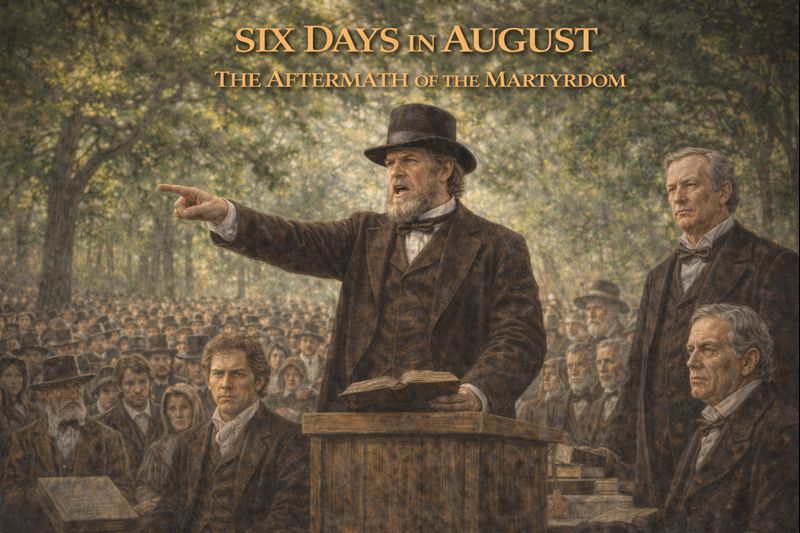
Two days later, on August 8, the Saints assembled in the Nauvoo Grove in what would become one of the most consequential meetings in Latter-day Saint history. The grove filled with priesthood quorums, Church officers, and thousands of ordinary members. At the center of their concern stood a simple question: Who now held the authority Joseph Smith possessed?
Sidney Rigdon repeated his claim, insisting that he alone should guide the Church. But when Brigham Young rose to speak, the tone of the meeting shifted instantly. Young reminded the Saints that Joseph Smith had conferred the full keys of the kingdom upon the Quorum of the Twelve Apostles, instructing them to carry the work forward in his absence. Since the President of the Church had died, the First Presidency could no longer function; only the Twelve, holding all necessary keys, could lead the people.
Young declared plainly that no man—not even Sidney Rigdon—could place himself between Joseph Smith and the Apostles:
“The Quorum of the Twelve have the keys of the Kingdom of God in all the world. You cannot appoint any man at our head; we would have to ordain him.”
Amasa Lyman’s Critical Witness
Following Brigham Young, Amasa Lyman—a counselor in the First Presidency—addressed the congregation. Lyman’s testimony carried particular weight, for Rigdon’s claim depended on the authority of the First Presidency. Yet instead of supporting Rigdon, Lyman voiced full confidence in the Twelve. He confessed that, although he too could attempt to claim leadership, doing so would endanger his salvation. He therefore stood firmly with Brigham Young, affirming the authority and keys of the Twelve in unmistakable terms. With this statement, Rigdon’s argument collapsed. The First Presidency, rather than standing apart from the Twelve, supported them.
The Voice of the Saints
When the time came to vote, the response was overwhelming. The Saints sustained the Quorum of the Twelve Apostles to govern the Church and acknowledged Brigham Young, its president, as the presiding authority. This moment—simple in form yet monumental in consequence—resolved the succession crisis. It ensured that the Church would be governed by those who held Joseph Smith’s keys and had received his final instructions.
The Road Forward Under the Twelve
In the years that followed, the decision of August 8 shaped the entire trajectory of the Restoration. Under the Twelve, temple ordinances Joseph Smith introduced were preserved and expanded. The Saints completed the Nauvoo Temple, received the ordinances essential for eternal salvation, and then, under Young’s leadership, journeyed west to the Salt Lake Valley. There they built new temples and established a thriving community that continued the work Joseph had begun.
Other claimants—Sidney Rigdon, James Strang, William Smith, and eventually the Reorganized Church—gathered followers. Yet none of these groups preserved the full temple ordinances or priesthood keys restored by Joseph Smith. The line of prophetic authority, according to the historical claims of the Church, passed securely from Joseph to the Twelve, and through them to all succeeding presidents of the Church down to the present day.