
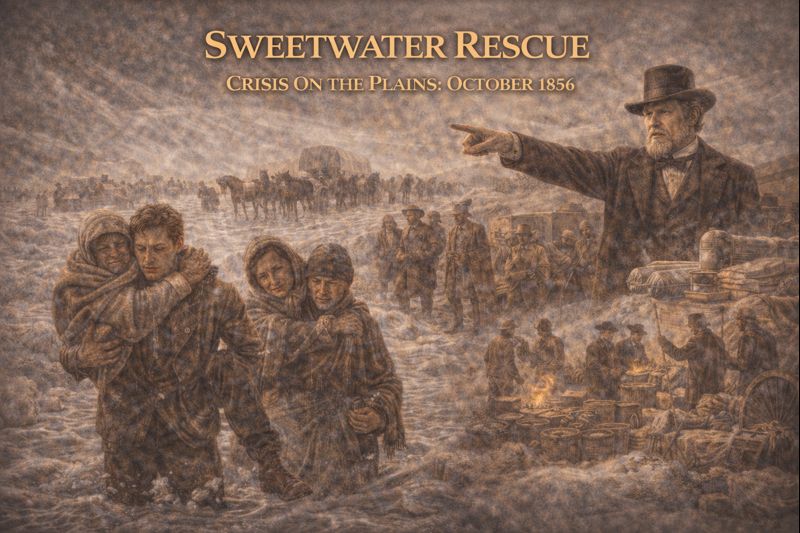
Crisis on the Plains: October 1856
In the early days of October 1856, word reached Salt Lake City—during General Conference itself—that hundreds of emigrants were stranded on the high plains of Wyoming. The Martin and Willie Handcart Companies, together with several wagon companies, had been overtaken by early winter storms. Between 500 and 600 Saints faced bitter winds, inadequate clothing, starvation, and exhaustion. Many were already dying as snow continued to fall across the high country.
On October 5, Brigham Young rose in the Tabernacle and spoke with unmistakable urgency. Assistance, he declared, must not wait for planning meetings or committee decisions—it must begin that very hour. He demanded:
Sixty good mule teams
Twelve to fifteen wagons
Twelve tons of flour
Forty strong teamsters
And above all, the rescue must be mounted with horses and mules, not oxen, because speed was everything. Young spoke sharply to the assembled Saints, insisting that religion meant far more than sermons or sentiment:
“Your faith, religion, and profession of religion will never save one soul of you… unless you carry out such principles as I am now teaching you. Go and bring in those people now on the plains.”
An Outpouring of Sacrifice in Salt Lake City
The response was immediate and overwhelming. According to Wilford Woodruff’s journal, the Saints began donating food, clothing, bedding, and equipment that very same day. By evening, the contributions included:
More than 26,000 pounds of flour
31 bushels of onions
Blankets, shawls, dresses, coats, vests, shirts, and hats
134 pairs of boots and shoes
Buffalo robes and winter bedding
Horses and wagons
Over fifty volunteer teamsters ready to depart
These provisions strengthened the advance rescue parties, who were already hurrying eastward toward the stranded Saints. The scale and speed of the effort remain unmatched in much of early Latter-day Saint history—an entire community mobilized within hours to save those still far away on the frozen plains.
A Precedent of Sacrifice: Brigham Young in 1847
This moment in 1856 becomes clearer when placed beside a lesser-known episode from 1847. During the first westward journey to the Salt Lake Valley, Brigham Young and a small vanguard company left the valley to return east and assist later emigrants. On their way back toward Winter Quarters, they eventually located the Jedediah M. Grant company, stranded after nearly all their oxen had stampeded and vanished.
The company was in grave danger, moving slowly and exposed to the worsening weather. Upon reaching them, Brigham Young issued a simple, costly directive: every man in his returning party was to surrender his own horse so that Grant’s company could continue toward the valley. Young’s men obeyed, and the rescuers walked the hundreds of miles back to Winter Quarters on foot.
This earlier sacrifice—rarely remembered today—sets the pattern for the Sweetwater Rescue of 1856. Brigham Young was not asking the Saints to do anything he had not already done himself. His call for immediate rescue was rooted in lived experience, forged across the plains years before.