
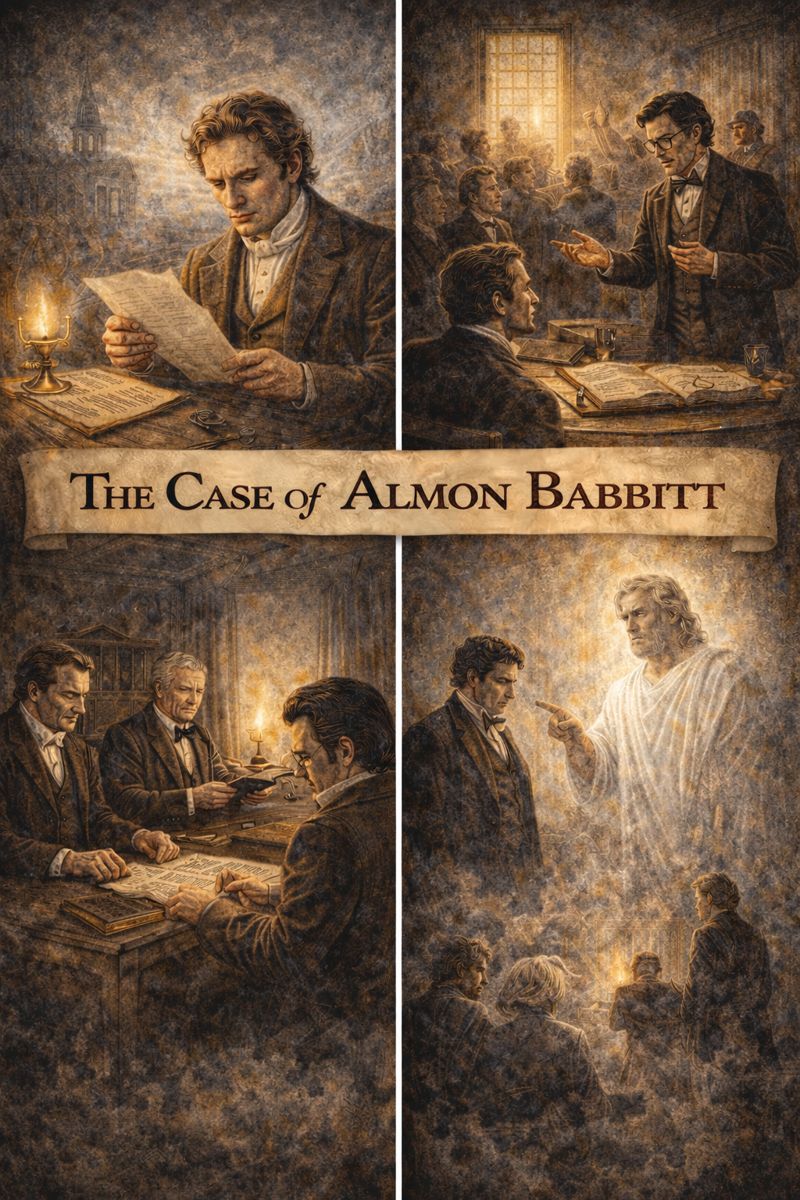
The Case of Almon Babbitt
A Rising Leader with a Troubled Pattern
Almon Babbitt entered early Latter-day Saint history as a capable missionary and influential convert from the New York–Ohio period. His preaching brought many into the Church, particularly throughout Canada, and he marched with Zion’s Camp in 1834. Joseph Smith later called him as one of the original members of the First Quorum of the Seventy in 1835. Yet alongside his early faithfulness ran a recurring pattern of instability and conflict. Babbitt alternated between dedication and defiance so frequently that his name appears repeatedly in disciplinary records. Leaders disfellowshipped and reinstated him more than once, showing both his capacity for good and his constant struggle to remain aligned with prophetic direction.
Growing Trouble in Kirtland
By 1840, the main body of the Saints had gathered in Missouri and then Nauvoo, yet a sizable number remained in Kirtland, Ohio. It was among these remaining Saints that Almon Babbitt’s behavior became increasingly concerning. Letters reached Joseph Smith describing distrust, secrecy, and subtle rebellion. Babbitt was reportedly discouraging the Saints from gathering to Nauvoo as the Lord had commanded. He held private meetings within the Kirtland Temple, excluding faithful men such as Oliver Granger and inviting instead those who supported him. He promoted alternative leadership arrangements and spoke critically of revelations Joseph had received. Such actions suggested an attempt to reshape Church leadership and doctrine by drawing sympathies away from the Prophet.
Joseph Smith’s Sorrow and Warning
When Joseph Smith wrote to Oliver Granger in July 1840, the pain behind his words was clear. He had suffered repeated betrayals from former allies, and the rumors circulating from Kirtland wounded him deeply. Joseph warned that the Church could not thrive if pride, contention, and envy were allowed to grow among its leaders. Those who undermined the Presidency weakened confidence in revelation and threatened unity at a critical moment, as the Saints were still recovering from the Missouri persecutions. He reaffirmed that the keys of the kingdom had been given to him by revelation, and that elevating personal counsel above ordained leadership placed the entire Church at risk.
False Claims and Disruptive Actions
Reports continued to reach Nauvoo accusing Babbitt of spreading sensational stories about Joseph Smith’s supposed behavior in Washington, D.C., including claims of expensive clothing purchases or boasts of personal wealth—claims entirely inconsistent with the Prophet’s known financial burdens. Babbitt was also said to have locked faithful Saints out of the Kirtland Temple while conducting unauthorized meetings inside. These behaviors seemed deliberately crafted to weaken confidence in Joseph Smith and to direct followers toward Babbitt’s own preferred structure of leadership.
A Disciplinary Hearing and an Unexpected Forgiveness
In September 1840, Babbitt traveled to Nauvoo to defend himself before Church leadership. Testimony against him was serious, yet Joseph Smith, with his characteristically generous heart, withdrew the charges when Babbitt expressed reconciliation. Fellowship was restored, and in a remarkable act of confidence, Babbitt was soon appointed Stake President of Kirtland in October 1840. Joseph’s willingness to forgive and restore opportunity was consistent with his lifelong pattern of giving wayward individuals repeated chances to correct their course and serve faithfully.
A Direct Rebuke from the Lord
Despite Joseph’s mercy, Almon Babbitt did not reform. In Doctrine and Covenants 124, the Lord rebuked him for promoting his own counsel over divine authority, declaring He was “not well pleased” and comparing Babbitt’s actions to setting up a “golden calf.” By encouraging the Saints to resist revelation and misuse the temple, Babbitt led them away from their appointed path.
Continuing Concerns Raised by Church Leaders
At the October 1841 General Conference, Church leaders again voiced concerns about Babbitt’s teachings and influence. They reported that he promoted doctrines contrary to revelation and discouraged Saints from gathering to Nauvoo, undermining unity and weakening the Saints’ progress. His actions showed a persistent conflict between his personal ambitions and the revealed direction given through the living Prophet.
The Doctrinal Weight of Babbitt’s Story
The historical rebukes directed at Almon Babbitt highlight essential doctrines that guided—and still guide—the Church of Jesus Christ of Latter-day Saints. The narrative emphasizes the need for loyalty to the living Prophet and the importance of aligning personal opinions with revealed instruction. It warns against private dissent, secrecy, or councils aimed at altering prophetic leadership, for such things fracture spiritual harmony. Babbitt’s life also demonstrates the remarkable patience the Lord and His Prophet extended toward those who struggled. Joseph offered forgiveness again and again, reflecting the divine desire for repentance and reconciliation. Yet persistent opposition eventually brought divine correction, reminding all that revelation—not personal aspiration—is the foundation upon which the Lord builds His Church.
Babbitt’s story is therefore more than a historical footnote. It is a doctrinal mirror, a cautionary tale, and a testament that God’s house must be governed by His voice rather than human ambition.
Listen to the full podcast here:
Season 5, Episode 5 – Great Rebukes from Church History: Almon Babbitt