
Word of Wisdom Part 1
Introduction to the Word of Wisdom
The Word of Wisdom is an essential part of Latter-day Saint history and doctrine, offering guidance for physical and spiritual health.
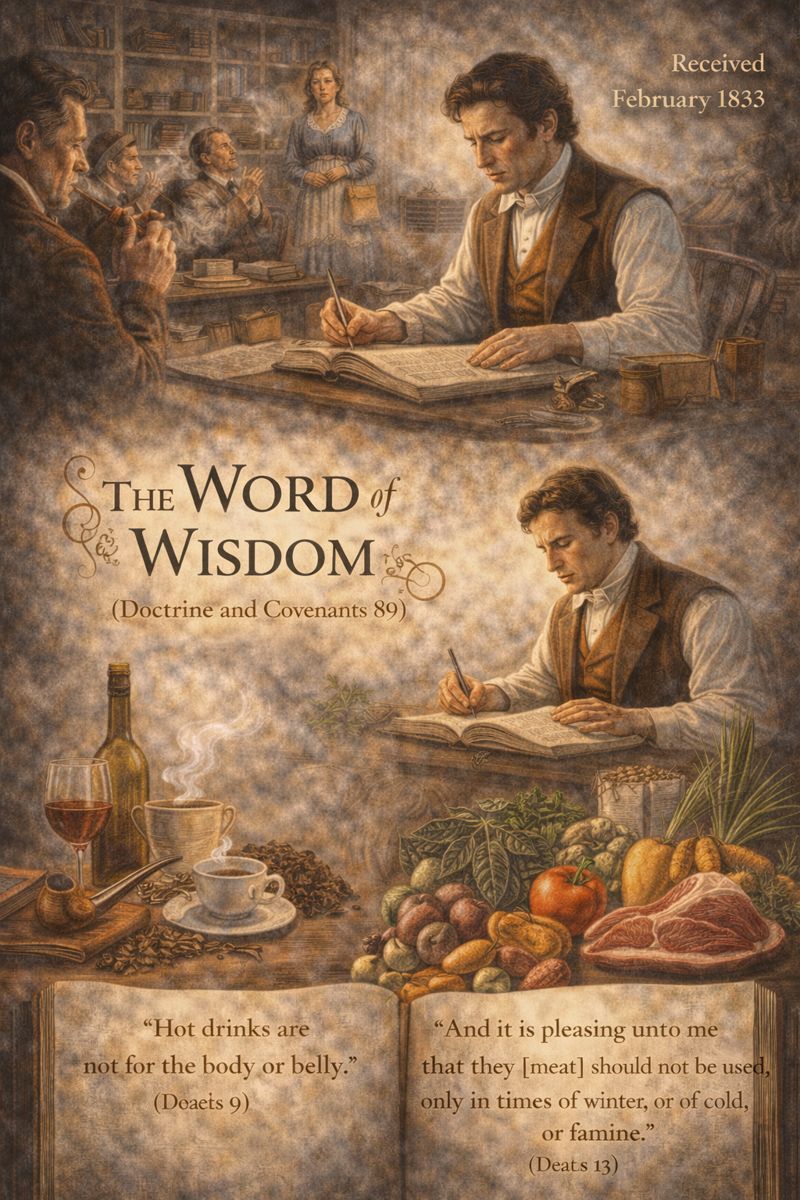
The Word of Wisdom (Doctrine and Covenants 89) was received in February 1833, in Kirtland, Ohio. Prior to this, in late 1832, Joseph Smith had been instructed by revelation to organize the School of the Prophets, which met in the upper room of Newel K. Whitney’s store in Kirtland. This small room often held many men, and during meetings it became heavily filled with tobacco smoke. Many participants also chewed tobacco, which created significant mess on the floors, contributing to concerns raised by Emma Smith and others responsible for cleaning.
Brigham Young later described the conditions reported by those present: pipes and tobacco were used extensively, producing smoke dense enough to obscure vision across the room. Chewing tobacco resulted in spit accumulating on the floor. These conditions prompted Joseph Smith to inquire of the Lord regarding tobacco use among the elders.
Historical Background of the Word of Wisdom
The revelation known as the Word of Wisdom emerged from this context. It aligned in part with contemporary movements such as the Temperance Movement, which sought to reduce alcohol consumption in the United States during the 1820s–1830s. While the temperance movement focused mainly on alcohol, there were occasional but limited criticisms of tobacco. Criticism of coffee and tea as stimulants existed only in small minority circles; most temperance advocates did not oppose them.
Section 89 begins by stating that the Word of Wisdom is given “not by commandment or constraint” but as a principle with promise, specifically for the last days. Early Latter-day Saints used the terms “commandment” and “revelation” almost synonymously, making this opening unusual. Initially, the Saints did not understand the revelation as requiring total abstinence.
Interpretation of Verses in the Word of Wisdom
Wine and Strong Drink (Verses 5–7)
Verses 5–7 address the use of wine and strong drink. Wine was still used for the sacrament in Joseph Smith’s day. Although Doctrine and Covenants 27 (1830) stated that it “mattereth not” what was used for the sacrament, Joseph Smith and the early Saints continued to use wine throughout the 1830s and 1840s, except when it was unavailable, in which case they pressed fruit to produce fresh juice. Water was not regularly used for the sacrament until the early 20th century.
“Strong drink” in early 19th-century American usage referred primarily to distilled spirits such as whiskey. The revelation counseled that strong drink was not for consumption but had limited uses such as washing.
Tobacco (Verse 8)
Verse 8 states that tobacco is not for the body, which stood in contrast to the widespread use of tobacco in the 19th century and predates modern scientific recognition of tobacco’s health dangers. This teaching within the Word of Wisdom was ahead of its time.
Hot Drinks (Verse 9)
Verse 9 declares that “hot drinks are not for the body or belly.” Early church leaders, including Hyrum Smith, defined “hot drinks” as coffee and tea, the common hot beverages of the time. Discussion about the meaning of “hot drinks” occurred both in the 19th century and afterward. This remains one of the most discussed aspects of the Word of Wisdom today.
Dietary Principles in the Word of Wisdom
Verses 10–17 discuss grains, herbs, fruits, and meat, stating that meat should be eaten sparingly and preferably only in times of winter, cold, or famine. Early Latter-day Saint practices varied, and while some leaders promoted limited meat consumption, everyday members generally continued their normal dietary habits. Later church leaders have referenced these verses but have not formally codified specific meat-consumption standards. These teachings form an important portion of the Word of Wisdom dietary guidance.
Promises of the Word of Wisdom
Verses 18–21 give the promises of the Word of Wisdom: health, wisdom, hidden treasures of knowledge, physical strength, and protection symbolized through the comparison to the Passover, where the destroying angel “passed by” households marked with lamb’s blood.
Development of the Word of Wisdom Over Time
The development of the Word of Wisdom from counsel to commandment was gradual. In the 19th century, moderate use of alcohol, coffee, tea, and tobacco was common among members, though leaders increasingly encouraged stricter observance. The shift toward treating complete abstinence as a requirement for full church participation occurred progressively in the late 19th and early 20th centuries, culminating in its status today as a baptismal and temple-recommend standard.
References
- https://www.churchofjesuschrist.org/study/history/topics/word-of-wisdom
- https://www.britannica.com/topic/temperance-movemen