
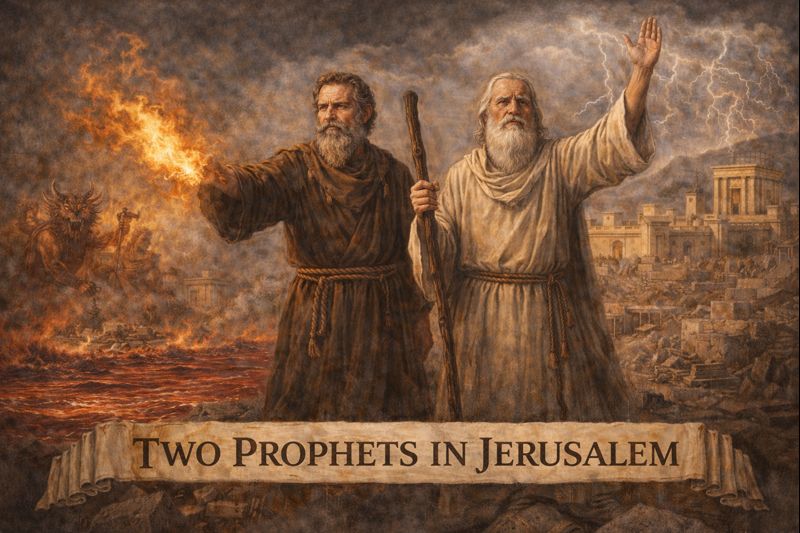
Revelation 11: Summary of the Prophecy
Revelation 11 describes two special witnesses who will appear in Jerusalem in the last days:
The city is under hostile control for 42 months (three and a half years).
Two prophets prophesy there for 1,260 days, clothed in sackcloth.
They demonstrate power reminiscent of ancient prophets:
Calling down fire,
Withholding rain,
Turning water to blood,
Striking the earth with plagues.
Eventually, they are killed by a hostile power described symbolically as “the beast.”
Their bodies lie unburied in the street for three and a half days, visible to people from many nations.
The world rejoices over their death.
After three and a half days, they are resurrected and ascend to heaven.
A great earthquake follows, associated with end-time judgments.
In many Christian traditions—especially premillennial ones—this passage is understood as predicting two literal individuals who will minister in Jerusalem shortly before the Second Coming.
Early Christian Tradition: Enoch and Elijah
In early Christian apocalyptic writings, a widespread interpretation emerged:
The two witnesses are Enoch and Elijah.
These two figures, according to the biblical record, did not experience normal death:
Enoch: “walked with God: and he was not; for God took him” (Genesis 5).
Elijah: taken to heaven in a chariot of fire (2 Kings 2).
A major witness to this interpretation appears in an early Christian text historically known as the Acts of Pilate, later incorporated into the Gospel of Nicodemus:
This non-canonical writing portrays resurrected saints conversing in Paradise with two men who identify themselves as Enoch and Elijah.
They explain that they have been preserved alive, that they will return before the final manifestation of evil (often identified as the Antichrist), will perform mighty works, will be killed in Jerusalem, will lie unburied for three and a half days, and will then be raised and taken up.
Though not part of the New Testament, this narrative deeply influenced medieval Christian imagination and reinforced the Enoch-and-Elijah identification.
Enoch and Elijah in Latter-day Saint Scripture
Within Latter-day Saint revelation:
Elijah
Appears in Doctrine and Covenants 110, where he confers sealing keys on Joseph Smith and Oliver Cowdery in the Kirtland Temple.
Is closely linked to Malachi’s prophecy of turning hearts of fathers and children.
Enoch
Receives extensive attention in the Book of Moses (Joseph Smith’s revision of Genesis).
Is depicted as a prophet who builds a city of Zion taken up into heaven.
Latter-day Saint teachings hold that Enoch and his city will return to the earth and unite with the latter-day Zion.
These scriptural roles show both figures as central to Latter-day Saint eschatology, though they are not explicitly identified by name with the Revelation 11 witnesses in canonized LDS scripture.
Joseph Smith’s Interpretation in Doctrine and Covenants 77
Doctrine and Covenants 77 records a series of questions and answers about the book of Revelation. Concerning Revelation 11, the Prophet Joseph Smith asked specifically:
“What is to be understood by the two witnesses in the 11th chapter of Revelation?”
The revealed answer states:
They are two prophets who will be raised up to the Jewish nation in the last days, after the Jews have been gathered and have built the city of Jerusalem.
Key points
The answer confirms the literal existence of two prophets.
They are raised up “to the Jewish nation” in the context of the latter days.
The text does not name them.
The wording suggests their calling and ministry occur in the last days rather than simply identifying them with ancient figures by name.
Traditional Christian vs. Latter-day Saint Views
The contrast can be summarized as follows:
Traditional Christian (especially medieval) view
Often identifies the two witnesses as Enoch and Elijah.
Bases this on non-canonical writings and the biblical fact that these two did not die.
Sees their future ministry and martyrdom as fulfilling Revelation 11.
Latter-day Saint scriptural position
Accepts the future ministry of two actual prophets in Jerusalem as literal.
Defines them only as “two prophets” called to the Jewish nation.
Does not provide names in canonized revelation.
Leaves their specific identity open.
Modern LDS Speculation and Official Doctrine
Some modern Latter-day Saint authors and commentators (for example, in the 20th century):
Have suggested that the two prophets could be Apostles or members of the Quorum of the Twelve assigned to labor in Jerusalem.
These ideas are presented as personal opinion, without claim of new revelation.
Official doctrine, however, remains:
The two witnesses are two prophets raised up to the Jewish nation in the last days.
Their ministry will take place in a rebuilt or reestablished Jerusalem.
Their identity beyond this is not specified in scripture.
Summary Conclusion on the Two Prophets
From a historical and doctrinal standpoint:
Early Christian tradition—influenced by apocryphal literature—commonly identified the two witnesses as Enoch and Elijah.
Joseph Smith affirmed the reality of two latter-day prophets in Jerusalem but did not endorse that specific identification nor provide their names.
Doctrine and Covenants 77 is the key Latter-day Saint text and restricts itself to stating that they are two prophets raised up to the Jewish nation after the gathering and rebuilding of Jerusalem.
Official Latter-day Saint doctrine does not go beyond what is revealed in scripture, leaving further details unconfirmed.