
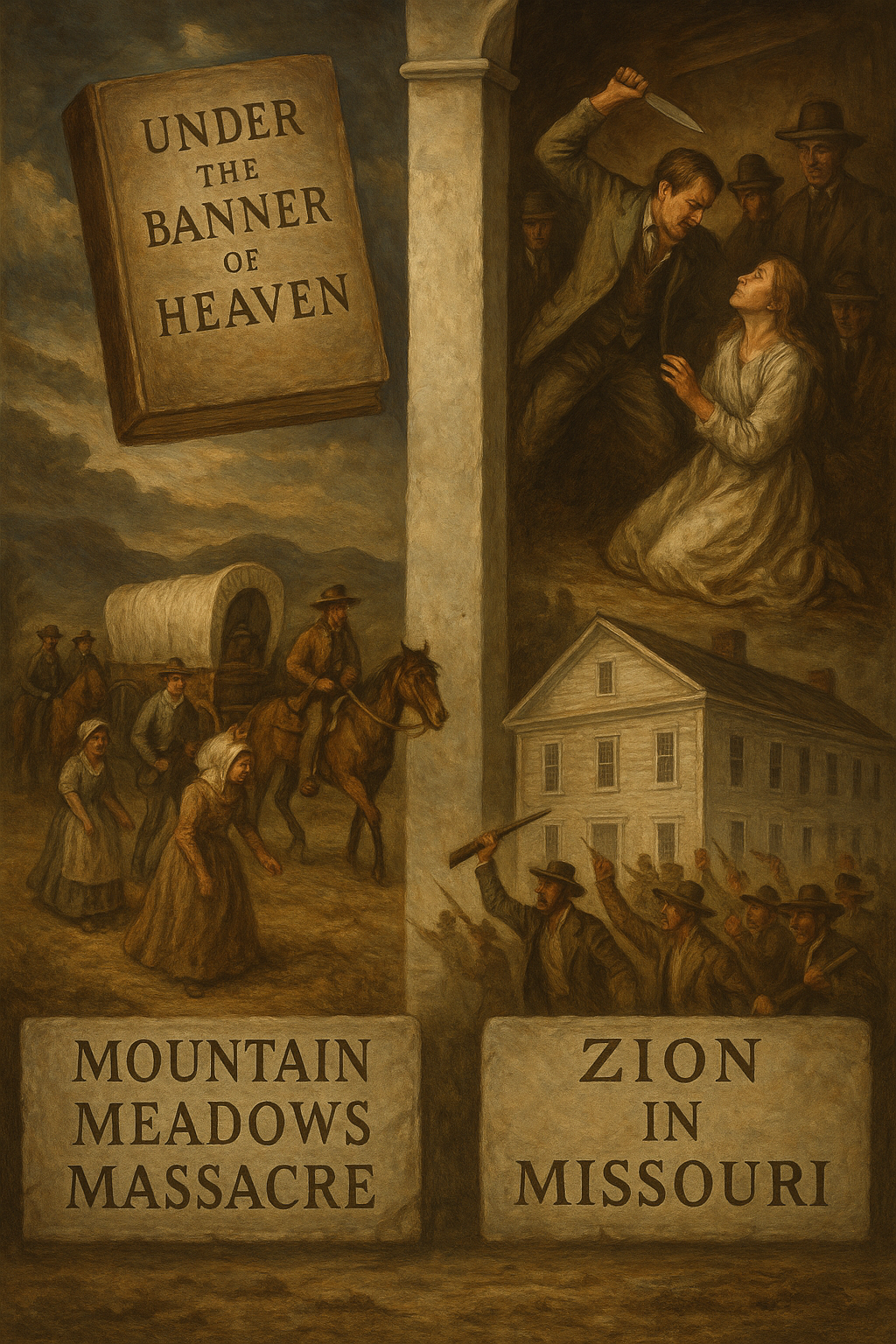
Under the Banner of Heaven
The FX/Hulu series Under the Banner of Heaven is based on Jon Krakauer’s book, whose subtitle, A Story of Violent Faith, signals the central argument that religious belief—specifically Latter-day Saint belief—contains elements that can lead to violent extremism.
The Lafferty Murders (1984)
Krakauer’s narrative centers on the 1984 murders of Brenda Wright Lafferty and her infant daughter:
- The Lafferty brothers had been excommunicated.
- They created a splinter group called the School of the Prophets.
- They believed they were receiving revelations.
- They attempted unauthorized plural marriage.
- They targeted family members who resisted their movement.
These murders became a major national true-crime case.
Krakauer’s Historical Claims
Krakauer, an investigative journalist—not a historian—used LDS history to argue that religious extremism is inherently violent and that Latter-day Saint history encourages violence. He claims faith is “the antithesis of reason” and often relies on older critical works, particularly Fawn Brodie, without modern academic support.
Mountain Meadows Massacre
Introduction
To draw links between the Lafferty murders and LDS history, Krakauer discusses the Mountain Meadows Massacre (1857). Understanding that event requires knowledge of Utah territorial history, the slavery crisis, the Mexican–American War, and national tensions of the 1850s.
Mexican–American War and the Mexican Cession (1846–1848)
When the Saints migrated west in 1846–47, the Salt Lake Valley was part of Mexico. After the Treaty of Guadalupe Hidalgo, the region became U.S. territory, suddenly placing the Saints again under U.S. jurisdiction. The lands transferred included present-day California, Nevada, Utah, Arizona, New Mexico, and parts of Colorado and Wyoming.
Slavery Expansion Crisis and the Compromise of 1850
The new western lands reopened the national slavery conflict:
- California entered as a free state.
- The slave trade ended in Washington, D.C.
- Utah and New Mexico became territories with slavery determined later by popular sovereignty.
This meant slavery was technically legal in Utah Territory.
Creation of Utah Territory (1850)
Utah Territory was created with Brigham Young appointed governor. Many federal appointees resented serving in Utah and viewed their roles as stepping-stones. Tensions grew between outsiders and Latter-day Saints.
Tensions Between Federal Officials and Utah Leadership
Conflicts arose because:
- Brigham Young held both religious and civil authority.
- Federal officials viewed themselves as superior to local leadership.
- Many officials left Utah and reported negatively to Washington.
Investigations often contradicted their accusations, but relations deteriorated.
Bleeding Kansas (1854–1858)
Violent conflict in Kansas over slavery heightened national tensions. These events influenced how Americans viewed the Latter-day Saints during the same period.
James Buchanan and the Decision to Send the Army (1857)
President Buchanan sent 2,500 troops to Utah to install a new governor after receiving unreliable reports of rebellion. Crucially, he never informed Brigham Young of his removal. Saints learned only through newspapers that the U.S. Army was marching toward Utah.
Lead-Up to Mountain Meadows
The Utah War, memories of Missouri and Nauvoo expulsions, and national conflict created an atmosphere of deep fear. The Mountain Meadows Massacre occurred in this environment of military threat, poor communication, and political instability.
Under the Banner of Heaven – Part 2
Federal–Mormon Tensions in the 1850s
By 1857, the Saints learned through newspapers that Brigham Young had been replaced as governor and that the U.S. Army was on its way to Utah. One-fourth of the U.S. Army marched westward.
Statements from Senator Stephen A. Douglas (1857)
Former LDS ally Stephen Douglas delivered a speech claiming that:
- Utah residents were “aliens” bound by secret oaths.
- They were subverting the U.S. government.
- Latter-day Saints were allied with Native Americans.
- The government must “cut out this loathsome ulcer.”
These extreme accusations reflected older anti-Mormon rhetoric.
Utah War Context (1857)
Amid military threat:
- Brigham Young declared martial law.
- Saints prepared for evacuation.
- Selling goods to emigrants was restricted.
Federal officers believed they were marching to destroy the Saints.
The Baker–Fancher Emigrant Company (1857)
An Arkansas emigrant party entered Utah during the crisis:
- They were denied supplies due to martial law.
- Conflicts occurred in Cedar City.
- A boy died after touching an animal hide (cause uncertain).
Local leaders feared that emigrants would report Mormon hostilities to the Army.
Initial Armed Confrontation
John D. Lee and Paiute Indians attacked the emigrants. Once identified, Lee feared exposure.
Failed Attempt to Seek Guidance
Local leaders sent to ask Brigham Young for instructions but withheld key details. Young’s reply: “Let them pass in peace.” The message arrived too late.
Decision of Iron County Leadership
Local militia leaders decided to eliminate the emigrant company out of fear of federal retaliation.
Mountain Meadows Massacre (September 11, 1857)
Militiamen approached under a white flag, promised safety, disarmed the emigrants, separated them, and then executed the massacre:
- 120 people were killed.
- Only about 17 children under eight survived.
It remains the darkest event in LDS history.
Aftermath
- Local leaders falsely blamed the Paiutes.
- Brigham Young initially accepted these reports.
- John D. Lee was later executed for his role.
Historical Writing
Professional historians agree:
- The massacre was not ordered by Brigham Young.
- Local leaders acted under fear, misinformation, and wartime panic.
- Massacre at Mountain Meadows (Oxford University Press) is the standard scholarly work.
Zion – Part 3
Law of Consecration and Land Ownership
Early Mormon Settlement in Missouri (1831)
Joseph Smith declared Missouri the site of the New Jerusalem. Missouri newspapers responded immediately:
- Saints were rapidly migrating.
- They were selling property in the East.
- Claims of miracles were circulated.
- Many locals viewed them as undesirable neighbors.
Missouri Newspaper Reports (1832–1833)
Articles portrayed the Saints as:
- Fanatics
- Miracle workers
- Socially disruptive
- Dangerous to local order
These reports fed public fear.
Consecration and Stewardship
A February 1833 apostate letter accused leaders of:
- Claiming divine authority
- Requiring property consecration
- Reassigning stewardships
In reality, these were accurate descriptions of early consecration practices under Doctrine and Covenants 42.
Missouri Concerns Over Mormon Settlement
Growing anxieties centered on:
- Cultural difference
- Communal economic practices
- Fear of political takeover
- Slavery tension
Most Saints were from the North; Missourians feared they opposed slavery or would influence enslaved people.
Slavery in Missouri
Missouri’s laws strictly prevented free Black immigration. Slaveholders feared:
- Abolitionist influence
- Religious preaching to enslaved people
- Interracial religious gatherings
These fears were projected onto the Saints.
Zion – Part 4
Early Violence in Missouri
Missouri’s Racial Laws and Fears
Missouri law prohibited free Black people from settling without citizenship documents. Violators faced expulsion, jail, or whipping.
Phelps’ Article on “Free People of Color” (July 1833)
W. W. Phelps advised Black Church members about Missouri’s laws. Missourians interpreted it as an invitation for Black immigration—an explosive issue in a slave state.
Context of Slave Revolts
Nat Turner’s (1831) rebellion and Denmark Vesey’s (1822) plot fueled fears that:
- Free Blacks
- Outside religious groups
- Abolitionists
could spark revolts.
The July 1833 “Secret Constitution”
Missourians issued a manifesto declaring the Saints:
- Fanatics
- Blasphemers
- Promoters of slave rebellion
- Unfit neighbors
They vowed to expel the Saints “peaceably if we can, forcibly if we must.”
Consequences
- The printing press was destroyed.
- Homes were vandalized.
- Violence escalated.
By November 1833, the Saints were violently expelled into Clay County.
Zion – Part 5
Mob Action and Expulsion
The Mob Ultimatum (July 1833)
A mob of 300 men demanded the Saints leave immediately, abandon property, and shut down the printing office.
Destruction of the Printing Office
The mob destroyed the Evening and Morning Star press and the Phelps home.
The Rollins Sisters Rescue
Mary Elizabeth and Caroline Rollins saved scattered pages of the Book of Commandments while pursued by the mob.
Assaults on Leaders
Edward Partridge and Charles Allen were tarred and feathered. Church leaders, under threat, agreed to leave within months.
Escalation and Forced Expulsion
Armed conflict followed. Andrew Barber was killed. Saints fled across the Missouri River into Clay County as refugees.
Joseph Smith’s Response
Joseph expressed grief, confusion, and faith that Zion would one day be redeemed “after much tribulation.”
Plat of Zion
The city design included:
- 24 temples
- A grid layout
- Numbered streets
This pattern influenced later LDS city planning.
Continued Appeals for Redress
Saints sought justice from:
- Missouri courts
- The governor
- Congress
- The President
All efforts failed, and Missouri persecution resurfaced violently in 1838.