
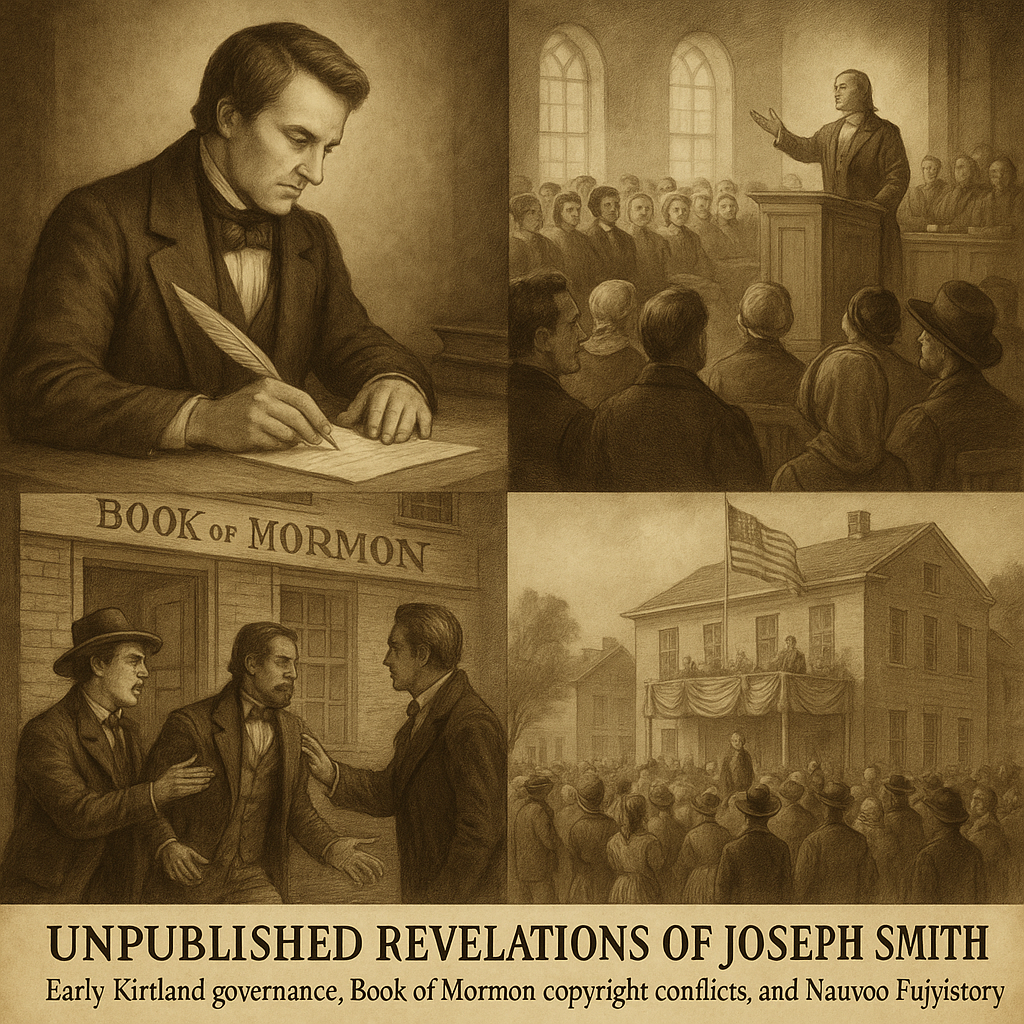
Early Uncanonized Revelations of Joseph Smith (1830–1843): Historical Overview
Early Latter-day Saints understood that more revelations existed than those published in the 1835 Doctrine and Covenants. Church members knew Joseph Smith received numerous revelations recorded in journals, letters, manuscript books, and loose documents kept by scribes. These uncanonized revelations were treated as genuine, publicly read, acted upon, and accepted as authoritative—whether or not they were printed.
Canonization of Revelations in the Early Church
The 1835 Doctrine and Covenants openly stated that it contained only selected revelations. Early members recognized that many divine instructions were not included in the printed book. Unpublished revelations circulated among leaders and branches and played a key role in Church governance, missionary work, and administrative decisions.
Revelation on the Creation of Stakes (January 12, 1838)
Amid growing instability and apostasy in Kirtland, a revelation answered whether local branches could organize their own stakes without First Presidency approval. The revelation declared that stakes must be appointed by the First Presidency, dedicated by proper authority, and sustained by vote of the members—because the First Presidency was appointed to “lay the foundation” of the Church. This clarified that Church structure required central, not local, authorization.
Revelation to John E. Page (November 25, 1843)
A letter from Joseph Smith and the Quorum of the Twelve included a revelation directing Apostle John E. Page:
– He was to leave Boston immediately.
– Travel directly to Washington, D.C.
– Preach diligently and with humility.
– Promise of success if faithful.
Leaders instructed Page to read the revelation to Church members in Boston to gain financial support for the mission. Though never canonized, the revelation was treated as binding and authoritative.
The Canadian Copyright Revelation (Early 1830)
One of the earliest uncanonized revelations, “Commandment No. 23,” concerned securing copyright protection for the Book of Mormon outside the United States. It instructed the Saints to obtain rights “upon all the face of the Earth.” Oliver Cowdery, Joseph Knight, Hiram Page, and Josiah Stowell were appointed to travel to Kingston, Canada, to secure copyright in the “four provinces.”
The group went, but the copyright office was in York (farther away). Given distance and harsh winter travel, they abandoned the effort. Even had they succeeded, enforcing British copyright in Canada would have been difficult.
Abner Cole and Unauthorized Publication of the Book of Mormon (1829–1830)
During printing at E. B. Grandin’s shop, pages of the Book of Mormon lay drying throughout the building. Abner Cole, who used the shop on Sundays to print the Palmyra Reflector, began publishing passages from the Book of Mormon without permission under his pseudonym “Obadiah Dogberry.”
Hyrum Smith discovered this and alerted Joseph Smith, who traveled from Harmony to confront Cole. Joseph invoked U.S. copyright law, and Cole stopped. This incident reinforced Church concerns about unauthorized reprinting and contributed to efforts to secure additional copyright protections.
Context of the 1838 Kirtland Revelations
The 1838 revelations occurred during the collapse of the Kirtland Safety Society, intense apostasy, armed threats, and the planned relocation to Missouri. Revelations addressed abandonment of Kirtland, the future of Church headquarters, personal instructions to leaders, and organizational governance. Many were later preserved but not canonized.
Significance of Uncanonized Revelations
Early Saints accepted many revelations that were not included in the Doctrine and Covenants. These revelations guided missionary assignments, administrative decisions, printing operations, land purchases, and Church governance. Some were canonized only decades later (such as D&C 137 and 138).
4th of July Extravaganza – The Latter-day Saint Relationship with America
Early Patriotism and Independence Day Celebrations
Throughout the 1830s and early 1840s, Latter-day Saints held patriotic Fourth of July celebrations:
– A major 1838 Missouri celebration featured speeches and military events.
– In 1841 in Nauvoo, thousands attended Independence Day festivities.
Joseph Smith publicly expressed loyalty to the United States and affirmed his willingness to give his life for the country. These events countered public suspicion and emphasized the Saints’ American identity.
Increasing Political Conflict (1842–1844)
Relations deteriorated due to:
– Missouri attempts to extradite Joseph Smith over the Boggs assassination attempt (unsupported by evidence).
– Anti-Mormon publications and political agitation.
– Joseph Smith’s 1844 presidential campaign calling for constitutional reform, abolition of slavery, and equal protection under the Declaration of Independence.
Joseph Smith became the first U.S. presidential candidate to be assassinated.
Collapse of Legal Protection in Illinois
After Joseph Smith’s death:
– The Illinois legislature revoked the Nauvoo Charter in January 1845.
– Nauvoo lost its municipal government and legal authority.
– Mob intimidation escalated.
Sheriff Jacob Backenstos documented growing lawlessness against the Saints.
The Saints Refuse to Celebrate the Fourth of July (1845)
On July 4, 1845, Nauvoo was silent.
George A. Smith noted no gunfire, no celebrations.
Irene Haskell wrote that liberty and independence had been “trampled upon.”
The Nauvoo Neighbor explained that:
– The Saints had been expelled from Missouri.
– Joseph and Hyrum Smith were murdered with no justice.
– The Nauvoo Charter had been revoked.
It compared the United States to “a poor weak old man” who could no longer uphold its ideals.
Newspapers Criticize the Saints
The St. Louis New Era accused the Saints of calling the Fourth “despotism.”
The Galena Gazette warned they were politically dangerous.
Critics used the Saints’ silence as proof of disloyalty.
The Latter-day Saint Response
Saints argued that:
– Their cannons and arms had been confiscated.
– Celebrating under persecution was impossible.
– The nation repeatedly failed to uphold their constitutional rights.
They noted similar persecution of other minorities, including Catholics and African Americans, showing a wider pattern of majority tyranny.
Decision to Leave the United States
By 1844, Church leaders were planning to move outside U.S. borders after finishing the Nauvoo Temple. Following Joseph Smith’s murder and increasing mob violence, Brigham Young declared the Saints must relocate “beyond the jurisdiction of the United States” and “erect the standard of liberty” elsewhere. This decision led directly to the 1846 exodus and the eventual settlement in the Rocky Mountains.