
Introduction
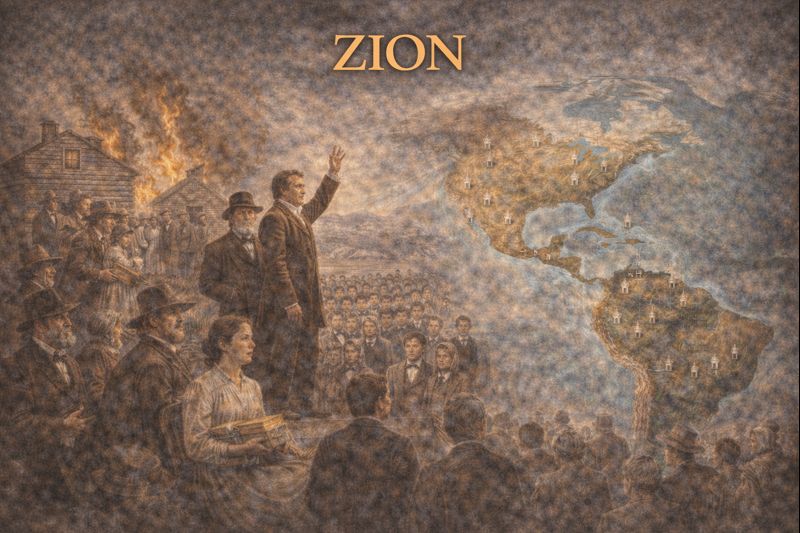
The question of Zion—its location, its purpose, and the destiny it represents for the Latter-day Saints—has shaped the history of the Restoration from the earliest revelations Joseph Smith received until the final sermons he delivered in Nauvoo. This episode traces the Saints’ attempts to establish Zion in Missouri, their repeated expulsions, the doctrinal expansion Joseph unveiled shortly before his death, and the way Church leaders understood Zion amid persecution, migration, and the broadening vision of a promised land that encompassed entire continents.
Early Attempts to Establish Zion in Missouri
In the 1830s the Saints believed they were witnessing the unfolding of prophecy when Joseph Smith declared that the land of Zion—and the site of the New Jerusalem—lay in Jackson County, Missouri, as taught in Doctrine and Covenants 57. Converts gathered, purchased land, and began building a community they hoped would become the center of God’s kingdom on Earth.
That hope, however, collided with intense opposition. In 1833 mobs violently expelled the Saints from Jackson County. Forced northward into Clay County and later Caldwell County, the Saints established new settlements—most notably Far West—but conflict intensified rather than diminished. The 1838 Missouri War brought devastating events: the Haun’s Mill Massacre, the Extermination Order issued by Governor Boggs, and the imprisonment of Joseph Smith and other leaders. By early 1839 the Saints were driven completely out of Missouri.
They rebuilt once more in Nauvoo, Illinois, but opposition rose again. The murders of Joseph and Hyrum Smith in June 1844 and the forced exodus of 1846 completed a decade of violent dislocation.
Pronunciation of “Missouri” in the Historical Record
The episode briefly highlights a linguistic curiosity from the 19th century: the pronunciation of “Missouri” as “Missoura.” Contemporary documents—including the 1850 census listing a woman named Albertine Missoura Bundy—show that families sometimes spelled names phonetically, reflecting regional dialects. Such details illustrate how widely vocabulary and pronunciation varied during the period when early Latter-day Saint history unfolded.
Early Latter-day Saint Perspectives on Zion and Book of Mormon Geography
For many early Saints, the identity of Zion was straightforward. Revelations declared Missouri to be the center place, and the United States—young, constitutional, and unique among nations—appeared the obvious stage for millennial prophecy. The New Jerusalem, they believed, would rise in Jackson County, and the Saints would gather there as part of God’s unfolding work.
Yet as Joseph Smith continued to receive revelations, the concept of Zion expanded significantly beyond the fixed geographic boundaries first imagined in the early 1830s.
Joseph Smith’s Final Conference Teaching: All the Americas Are Zion
In April 1844, during his final General Conference before his death, Joseph Smith delivered one of the most sweeping doctrinal statements of his ministry. He declared that Zion was not confined to Jackson County but consisted of all of North and South America. This was not a metaphor but a theological claim: the entire Western Hemisphere was the land designated for the gathering of Israel and the building of God’s kingdom.
Joseph taught that the “mountain of the Lord’s house” would rise in the central region of these continents, and that after the Nauvoo Temple ordinances were administered, endowed elders were to go forth across the entire hemisphere to establish the Church. Stakes of Zion, he explained, were to spread throughout the Americas. This represented a dramatic expansion from earlier geographical assumptions.
Brigham Young’s Response to Joseph’s Vision of Zion
The next day, April 9, 1844, Brigham Young responded to Joseph’s proclamation. Calling it a “sweepstakes,” Young emphasized the extraordinary scope of Joseph’s declaration. He reaffirmed that endowed elders were responsible for carrying the gospel across all of North and South America, building branches and preparing Zion wherever they were sent. Zion, therefore, was not a point on a map but a continental mission.
National Opposition to the Saints and the Widening View of Zion
The episode also explores how experiences with the federal government shaped Latter-day Saint thinking. Long after the Missouri expulsions and Nauvoo persecutions, the Saints encountered new pressures: anti-polygamy legislation such as the Morrill Act, the Edmunds Act, and the Edmunds-Tucker Act; imprisonment of Church members; confiscation of Church property; and even the disenfranchisement of women in Utah in 1887 after they had held voting rights for seventeen years. These events deepened the Saints’ ambivalence toward federal authority, even as they continued to express devotion to the U.S. Constitution.
Such pressures led many 19th-century Saints to see Zion not as a single protected refuge, but as a vast promised land spreading across the Americas.
Brigham Young’s Teachings on Salvation for All Nations
Brigham Young taught that God’s love extended to every people—Christians, Muslims, Jews, and those of any or no religion. He declared that those who lived according to the light they possessed, doing good and avoiding harm, would be blessed in the next life. Temple work, he explained, would provide every soul with the opportunity for exaltation. In this sense the expansive geography of Zion mirrored an equally expansive theology of universal salvation and divine fairness.
Universal Salvation and the Missionary Vision of Zion
The episode concludes with the reiteration of core Restoration teachings: God is no respecter of persons; every soul born into the world will receive a fair and full opportunity to receive the gospel; Zion encompasses all the Americas; and the Saints, as covenant disciples, bear responsibility for carrying the gospel throughout this far-reaching promised land.