
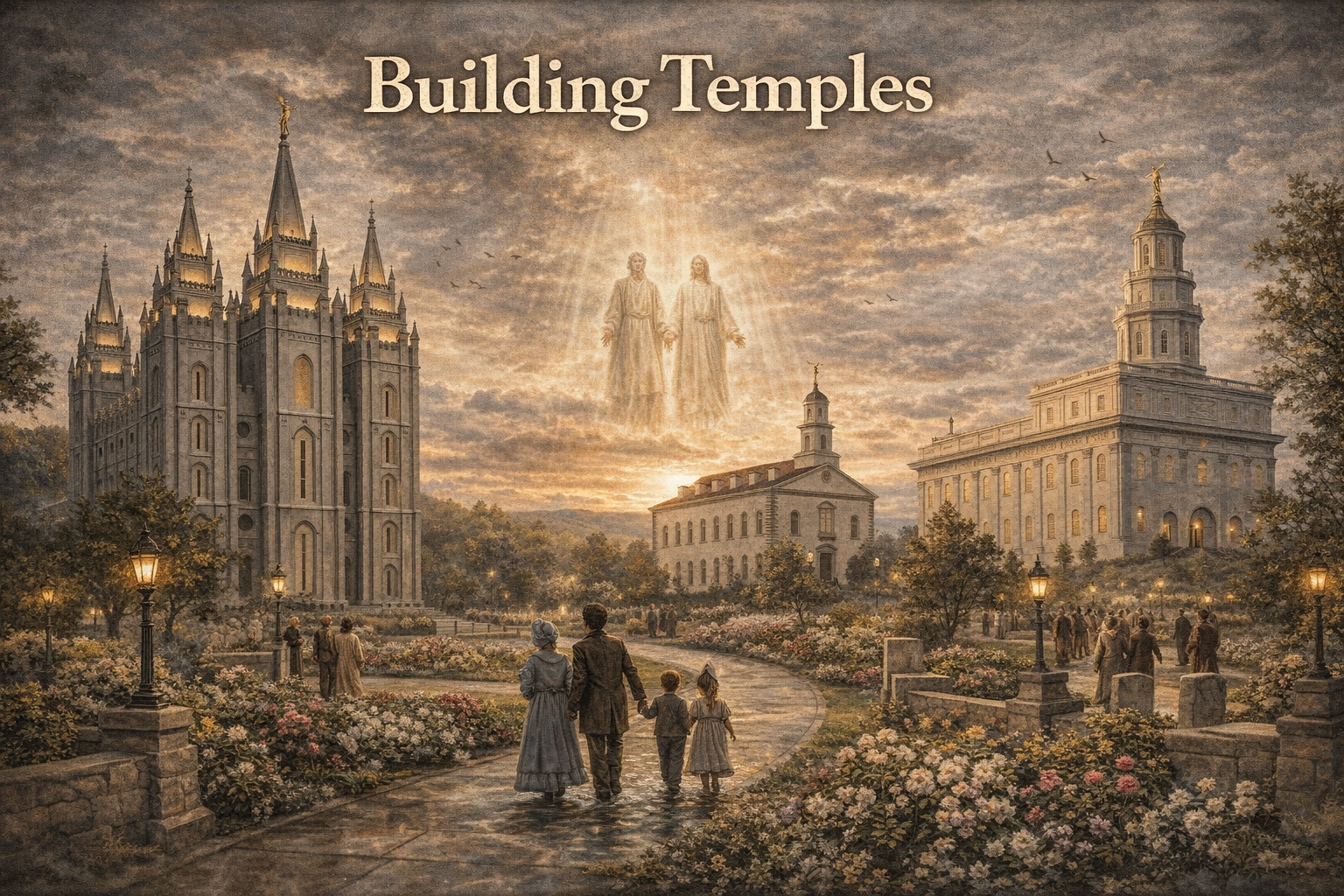
Building Temples
Introduction: Questions About Temples, Documents, and Early Christianity
This episode addresses several interconnected doctrinal and historical issues raised by listeners, ranging from the purpose and use of the Joseph Smith Papers and the Brigham Young Papers, to broader questions about the presence of temple worship in early Christianity, the meaning of New Testament passages about temples, and the timeline of Joseph Smith’s understanding that temples would be essential to the latter-day work. Each of these topics ties together in a larger pattern: temples are fundamental to the Restoration, they have ancient roots, and they reappear in modern revelation with clarity and divine intentionality.
The Joseph Smith Papers: Nature and Purpose of the Project
The Joseph Smith Papers Project is a scholarly initiative by the Church History Department aimed at compiling every document related to Joseph Smith. This includes letters, revelations, sermons, journals, council minutes, legal documents, and financial papers. The project involves precise transcription, extensive historical annotations, and publication in print and online formats. Its goal is to provide the most complete and academically rigorous documentary record of Joseph Smith’s life and ministry, enabling both scholars and Latter-day Saints to study his prophetic work in detail and context.
Differences Between the Printed Volumes and the Website
The printed volumes of the Joseph Smith Papers are carefully edited and annotated, organized into series such as Documents, Journals, Revelations and Translations, Histories, and Administrative Records. They include thousands of scholarly footnotes that provide insights into people, places, and events in Joseph Smith’s life. The website, JosephSmithPapers.org, contains all printed material and additional documents, including minor items like property deeds and notes. Regularly updated, the site offers high-resolution images of original manuscripts and advanced search features. While the website is the most comprehensive resource, the printed volumes are easier to study systematically due to their curated structure and extensive commentary.
How Latter-day Saints Can Use the Joseph Smith Papers
Members do not need to be historians to use the Joseph Smith Papers effectively. A common way to engage with the Papers is by reading the historical introductions to each revelation in the Doctrine and Covenants, which explain the context, key figures, and significance of each revelation in Joseph Smith’s prophetic mission. The project also serves as a reliable source for verifying quotes or historical claims, allowing members to confirm or refute assertions about Joseph Smith’s writings. Additionally, his journals and letters provide insights into his spiritual growth, struggles, and devotion to God, making the Papers a valuable resource for personal study and faith-building.
The Brigham Young Papers and Related Document Projects
Separate from the Joseph Smith Papers is the Brigham Young Papers Project, operated by the Brigham Young Center Foundation. This effort, still in its early stages, aims to produce multiple volumes of Brigham Young’s writings and related documents. The collection is vast—approximately 100,000 documents—far larger than the Joseph Smith corpus. The first volume, publishing Brigham Young’s Nauvoo journals, is underway. Similarly, the Wilford Woodruff Papers Project is transcribing Woodruff’s extensive journals and documents, which span decades and are among the richest sources for nineteenth-century Latter-day Saint history. Although not operated directly by the Church History Department, these projects complement the Joseph Smith Papers by enlarging access to the lives and ministries of later Church leaders.
Why Latter-day Saints Build Temples and the Meaning of New Testament Passages
A listener asked why Paul and Stephen’s statements in Acts that God “dwelleth not in temples made with hands” do not contradict modern temple building. Paul’s sermon in Acts 17 addressed Greeks, stressing that the true God is not confined to physical structures and critiquing Greek paganism, not divine temple worship. Similarly, Stephen’s declaration in Acts 7, referencing Isaiah, emphasizes that God is greater than any building and criticizes the corruption of the temple by Israel’s leaders. Isaiah’s prophecy about the Lord’s house in the last days indicates a critique of misuse, not of temples as divine institutions. Thus, neither Paul nor Stephen condemns temple worship, but both denounce false worship and misuse of sacred space.
Temples in Early Christianity and the Loss of Temple Worship
The destruction of the Jerusalem temple in AD 70 meant that Christians, like Jews, lost access to a physical temple for worship. Both groups had to reinterpret prophecies and adapt to new circumstances. Over time, Christianity moved further from temple-related rites. Some scholars, like Margaret Barker, argue that early Christianity retained temple theology but lost temple practice due to the absence of the sacred structure. Latter-day Saints believe temples have always been part of God’s covenant, lost through apostasy and restored by Joseph Smith. This belief links the Restoration to ancient Israel, early Christianity, and prophetic expectations in scripture.
Joseph Smith’s Early Understanding of Temple Building
Joseph Smith learned early that temples would need to be built in the last days. The Book of Mormon (1829–1830) prophesied the Lord’s coming to His temple and the establishment of His house. Moroni’s visits in 1823 quoted Malachi about Elijah’s return and temple ordinances. In October 1830, Oliver Cowdery wrote a covenant for missionaries to establish a witness for the New Jerusalem’s temple. By 1831–1833, revelations in the Doctrine and Covenants commanded temple building, leading to constructions in Kirtland, Independence, Far West, and Nauvoo. Thus, temple building was central to early prophecy and revelation from the start of Joseph Smith’s ministry.
Why Modern Temple Ordinances Do Not Need to Appear in the New Testament
Doctrine and Covenants 124 teaches that God would restore things “kept hid from before the foundation of the world.” This means not every ordinance presently practiced in temples must be found explicitly in ancient scripture. Divine revelation, not the absence or presence of ancient documentation, determines modern temple practice. The principles of covenant-making, sacrifice, sacred space, consecration, and symbolic progression are ancient, while specific forms of ordinances may change according to divine instruction. The Restoration recovers both lost ancient practices and new ordinances revealed for the latter days.
Conclusion
The New Testament does not deny the legitimacy of temples; rather, it condemns idolatry, corruption, and misuse of sacred structures. Isaiah, quoted by Stephen, prophesies the establishment of a latter-day temple, and the Book of Mormon reinforces this expectation. Joseph Smith was commanded from the earliest days of the Restoration to build temples, and modern temple worship is grounded in biblical prophecy, Book of Mormon prophecy, and continuing revelation. Temples stand at the center of God’s covenant work in every dispensation, and the Restoration restores the fullness of temple worship through restored priesthood authority and modern revelation.