
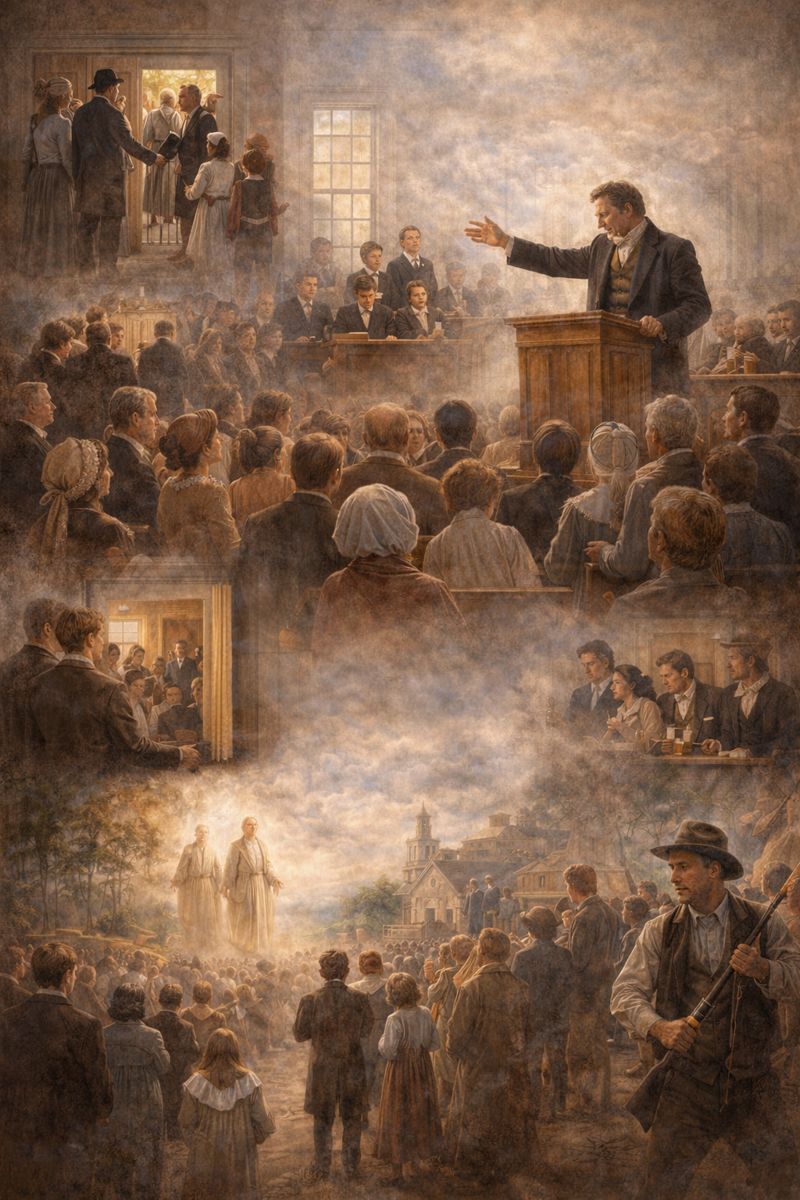
A Moment of Transition in Early Latter-day Saint Worship
By early 1831, the Church of Jesus Christ of Latter-day Saints had moved from New York to Ohio, where a surge of new converts created questions about how worship should be conducted. Many of these converts were previously unknown to church leaders, and the rapidly growing congregations needed divine guidance regarding who should be admitted to meetings, who should participate in ordinances, and how the Saints should balance reverence with openness. It was in this context that Doctrine and Covenants 46 was received—a revelation that dramatically reshaped early American expectations for public worship.
Closed Communion: The Dominant Christian Model in Early America
In 19th-century American Christianity, most Protestant denominations practiced what was known as closed communion.
Presbyterians, Congregationalists, and many Baptists restricted the Lord’s Supper to baptized, disciplined members only. Their belief was grounded in Paul’s warning against unworthy participation in 1 Corinthians 11, which they interpreted as justification for strict exclusion. Even the Catholic Church required members to be in good standing before receiving the Eucharist.
These restrictions extended beyond the sacrament. In many congregations, even attendance at communion services was regulated. Outsiders, unbaptized individuals, and those judged unworthy were expected to stay away. For early 19th-century Christians, this was not unusual—it was the norm.
A Radical Departure in Doctrine & Covenants 46
Against this backdrop, the revelation in D&C 46 presented a strikingly different vision of Christian worship. Instead of exclusion, the Lord commanded the early Saints to open their doors widely and to welcome all who sincerely sought the truth.
Public Worship Must Remain Open
The revelation begins with a direct instruction that the Church must never cast anyone out of public worship meetings. This openness was revolutionary for its time. Where other denominations drew boundaries, early Latter-day Saint worship was to be marked by invitation and hospitality.
Sacrament Meetings for Seekers of Truth
D&C 46 further instructed that even sacrament meetings—typically closed in other churches—were to remain open.
Members who had trespassed could be restricted from partaking of the sacrament until repentance, yet they were not barred from attending. Most strikingly, non-members who earnestly sought the kingdom were also to be welcomed, not excluded.
Confirmation Services Also Embrace Openness
Even confirmation meetings, considered sacred gatherings in the early Church, were not closed. Anyone sincerely seeking the truth was permitted to attend. This open-door approach made the Restoration a religious space unlike anything else in Protestant America.
Sacrament Frequency in the Early 1800s
During this period, the sacrament was not yet a weekly ordinance for Latter-day Saints—that practice developed later. In the surrounding Christian world, the Lord’s Supper was often reserved for special occasions, sometimes only a few times a year. D&C 46 thus addressed not only who could attend but how the Saints would begin shaping their evolving worship patterns.
Historical Roots of Membership Restrictions
The strict boundaries in other Christian groups came from older traditions such as:
The Half-Way Covenant in New England, where individuals without a dramatic conversion experience could attend worship but could not partake of communion.
Similarly, Presbyterians and Baptists limited participation to those whose conversion and worthiness were validated by church leadership.
These traditions demonstrate how deeply American Protestantism linked salvation, worthiness, and access to ordinances—precisely the structures the Lord overturned in His revelation to Joseph Smith.
A New Religious Identity Grounded in Inclusion
Doctrine & Covenants 46 reshaped early Latter-day Saint worship into something profoundly welcoming. It emphasized that seekers—even if unbaptized, unsure, or from another faith—were to be included. Excommunicated members were not shunned from worship. Visitors of other denominations were invited to learn. The doors of the Church were to remain open.
This inclusiveness reflected not only a departure from the surrounding Christian culture but a deeper theological vision: worship was a place for all who desired to know God, regardless of prior status or spiritual condition. That principle became a hallmark of Latter-day Saint worship services, enduring in the global church today.
Listen to the full podcast here:
Season 5, Episode 21 – Worship Services and the Omnipotence of God