
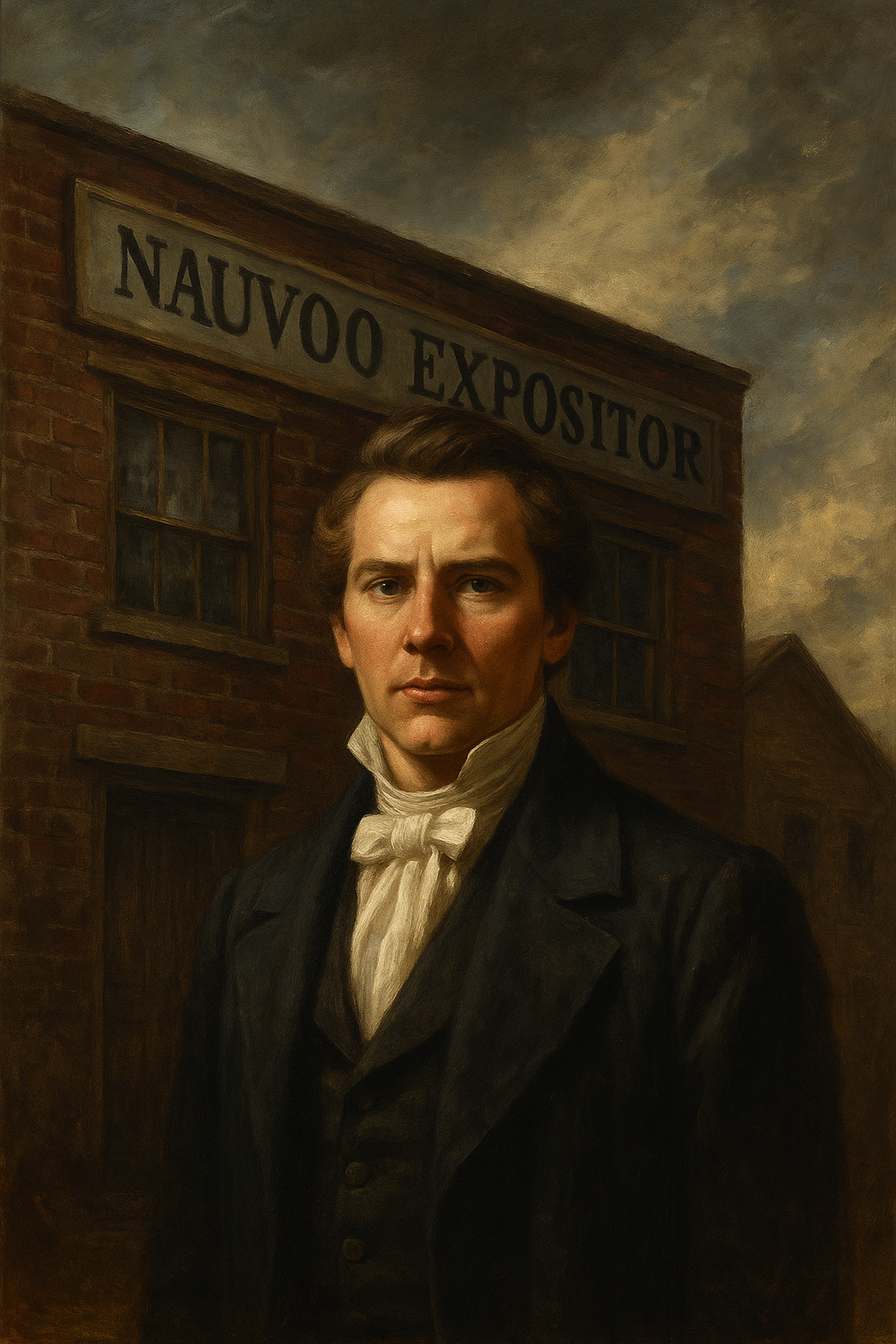
The Nauvoo Expositor: Expulsion from Missouri and the Rise of Nauvoo
After the expulsion of the Latter-day Saints from Missouri in 1838–1839, thousands of refugees crossed the Mississippi River into Illinois. The citizens of Quincy offered critical early support, and the Saints eventually purchased land upriver in Commerce, which would later be renamed Nauvoo.
The Illinois legislature—controlled at the time by the Democratic Party—granted Nauvoo a broad city charter. Although each component of the charter had precedents elsewhere, the combination made Nauvoo unusually powerful.
The charter’s provisions included a municipal court, a university, and, most notably, a city militia known as the Nauvoo Legion.
The political context helps explain this generosity. Illinois Democrats welcomed thousands of reliable new Democratic voters at a moment when the state’s political balance was narrow.
Whigs, however, feared that block voting by the Saints would weaken their electoral prospects. As the Latter-day Saint population expanded, surrounding communities such as Carthage and Warsaw felt increasingly overshadowed economically, politically, and demographically, which fueled growing resentment.
Doctrinal Developments and Internal Tensions in Nauvoo
Tensions also developed within Nauvoo itself. During this period, Joseph Smith introduced doctrines that many Christians considered radical, including baptism for the dead, eternal marriage, and the eternal progression of humankind.
Plural marriage was introduced privately as early as 1841 to a limited circle of trusted members. These teachings remained largely unknown to the broader public.
In 1841–1842, John C. Bennett, an influential Nauvoo leader and former member of the First Presidency, secretly promoted an illicit system he called “spiritual wifery.” This practice involved sexual relationships without commitment and had no connection to Joseph Smith’s teachings.
When Bennett’s misconduct was discovered, he was excommunicated. He later published sensational exposés that blended fabrications with fragments of truth, significantly inflaming public suspicion and hostility toward Nauvoo.
National Politics and Joseph Smith’s Presidential Campaign
National political developments further intensified the crisis. In 1843, Joseph Smith sought assurances from potential candidates in the upcoming 1844 U.S. presidential election.
He wrote to prominent figures such as John C. Calhoun, Richard M. Johnson, Lewis Cass, and Henry Clay, asking whether they would support federal intervention to redress losses suffered by the Saints in Missouri.
Every response was negative. Henry Clay’s reply, in particular, deeply disappointed Joseph Smith.
In response, and out of political necessity, Joseph announced his own candidacy for president of the United States. Although he did not expect to win, the campaign aimed to draw national attention to constitutional abuses and force the major parties to address the Saints’ grievances.
This decision alienated Democratic leaders in Illinois and angered Whigs who had briefly hoped for Nauvoo’s political support.
William Law, Internal Dissent, and the Nauvoo Expositor
Internal dissent reached a breaking point in early 1844. William Law, formerly second counselor in the First Presidency, became increasingly disaffected.
His opposition appears to have stemmed from disagreements over plural marriage and concerns about what he viewed as Joseph Smith’s political and religious overreach.
In June 1844, Law and several associates founded a rival church and launched a newspaper called the Nauvoo Expositor. In its only issue, the paper accused Joseph Smith of combining civic, political, and religious power.
The publication denounced plural marriage, attacked new doctrinal teachings about the nature of God, and warned that Nauvoo’s leadership was corrupt.
While the paper described some doctrines that were genuinely being taught privately, it deliberately labeled plural marriage as “spiritual wifery.” This invoked memories of Bennett’s earlier scandal and implied widespread sexual immorality.
The controversy surrounding the Nauvoo Expositor became a central factor in the events leading to the martyrdom of Joseph Smith.
Suppression of the Nauvoo Expositor and the Legal Crisis
The Nauvoo City Council debated whether the Nauvoo Expositor posed a threat to public peace. The council included both supporters of Joseph Smith and non–Latter-day Saints.
Drawing on legal precedents from other American cities, where presses deemed libelous public nuisances had been destroyed, the council concluded that the paper posed a danger to Nauvoo.
They voted to suppress the publication and remove the press as a public nuisance. The city marshal carried out the order by destroying the press and burning the remaining papers.
Although Nauvoo leaders believed they were acting within their legal authority under the city charter, the destruction of the Nauvoo Expositor ignited a political and legal firestorm across Illinois.
Opponents characterized the action as tyrannical suppression of free speech and argued that Nauvoo was no longer governed by law but dominated by Joseph Smith.
Final Events Leading to Carthage and the Martyrdom
The suppression of the Nauvoo Expositor directly triggered a series of arrests, militia mobilizations, and political pressures.
These events culminated in Joseph and Hyrum Smith surrendering at Carthage Jail, where they were killed on June 27, 1844.
The martyrdom marked one of the pivotal tragedies in Latter-day Saint history and represented the culmination of complex political, theological, and social conflicts surrounding Nauvoo in the early 1840s.
References and Further Reading
For additional discussion on prophetic authority and revelation, see the article on revelation and false revelation.
Further historical context is available through official Church history resources.
02.cloudwayssites.com/revelation-prophets-and-false-revelation/https://www.churchofjesuschrist.org/study/history