Martyrdom of Joseph and Hyrum Smith
After the destruction of the Nauvoo Expositor press on June 10, 1844, public outrage spread rapidly through Hancock County and surrounding Illinois communities. Anti-Mormon newspapers such as the Warsaw Signal and the Quincy Whig condemned Joseph Smith and urged decisive action against Nauvoo. Although press destruction had precedent in frontier America, the intense political and social hostility toward the Saints made this event a catalyst for the crisis that followed.
Legal Proceedings in Nauvoo
Joseph Smith and several Nauvoo leaders were first arraigned before Daniel H. Wells, then a non-Latter-day Saint justice of the peace, who dismissed the charges after reviewing Nauvoo’s charter and legal precedents regarding public nuisances. Although the Expositor’s publishers could have sought civil damages, the criminal complaint was dismissed.
However, Illinois Governor Thomas Ford soon intervened, declaring that Nauvoo’s municipal court could not serve as the venue for the case and ordering Joseph and the accused to appear at the Hancock County seat in Carthage. Joseph objected, arguing that the U.S. Constitution prohibited being “twice put in jeopardy” for the same offense and warning that mob violence made Carthage unsafe. His written response to Governor Ford (June 22, 1844) emphasized the danger of being moved from court to court under threat of assassination, based on his earlier experiences in Missouri.
Decision to Leave Nauvoo and Return
Anticipating violence, Joseph Smith, Hyrum Smith, and several others crossed the Mississippi River into Iowa Territory with plans to move west. Joseph had already sent representatives to explore settlement options in the Republic of Texas, among Indian nations, and in western territories.
When Nauvoo residents learned Joseph had left, fear spread rapidly. Memories of the 1838 Missouri persecutions—including killings, property destruction, and the governor’s extermination order—made many believe that Nauvoo would be attacked if the governor arrived and Joseph was absent. Messages from Nauvoo leaders and Emma Smith urged Joseph to return. Joseph and Hyrum ultimately decided to go back, concluding that their absence might provoke greater suffering for the people.
Surrender at Carthage and New Charges
After returning to Nauvoo, Joseph supervised the surrender of state-issued arms held by the Nauvoo Legion and then traveled to Carthage. There he and the others were arraigned on the original charge of riot and released on bail.
Before they could leave Carthage, however, Joseph and Hyrum were immediately rearrested and charged with treason against the State of Illinois, based on claims that Joseph had illegally mobilized the Nauvoo Legion. Treason was a non-bailable offense, ensuring that the brothers would remain in Carthage Jail.
Conditions in Carthage Jail
In the days preceding the attack, Joseph, Hyrum, John Taylor, and Willard Richards were held in an upstairs room of Carthage Jail. They spent their time gathering affidavits to demonstrate that the Nauvoo Legion had not been mobilized and that the destruction of the Expositor was conducted in an orderly and legal manner.
Governor Ford pledged protection but departed Carthage on June 27 to visit Nauvoo, taking several militia companies with him and dismissing others. This left the prisoners guarded largely by the Carthage Greys, a local militia unit known for strong anti-Mormon sentiment. Visitors such as Cyrus Wheelock were eventually barred. Just before leaving, Wheelock gave Joseph a small six-shot pepperbox pistol, which Joseph kept concealed.
Events of June 27, 1844
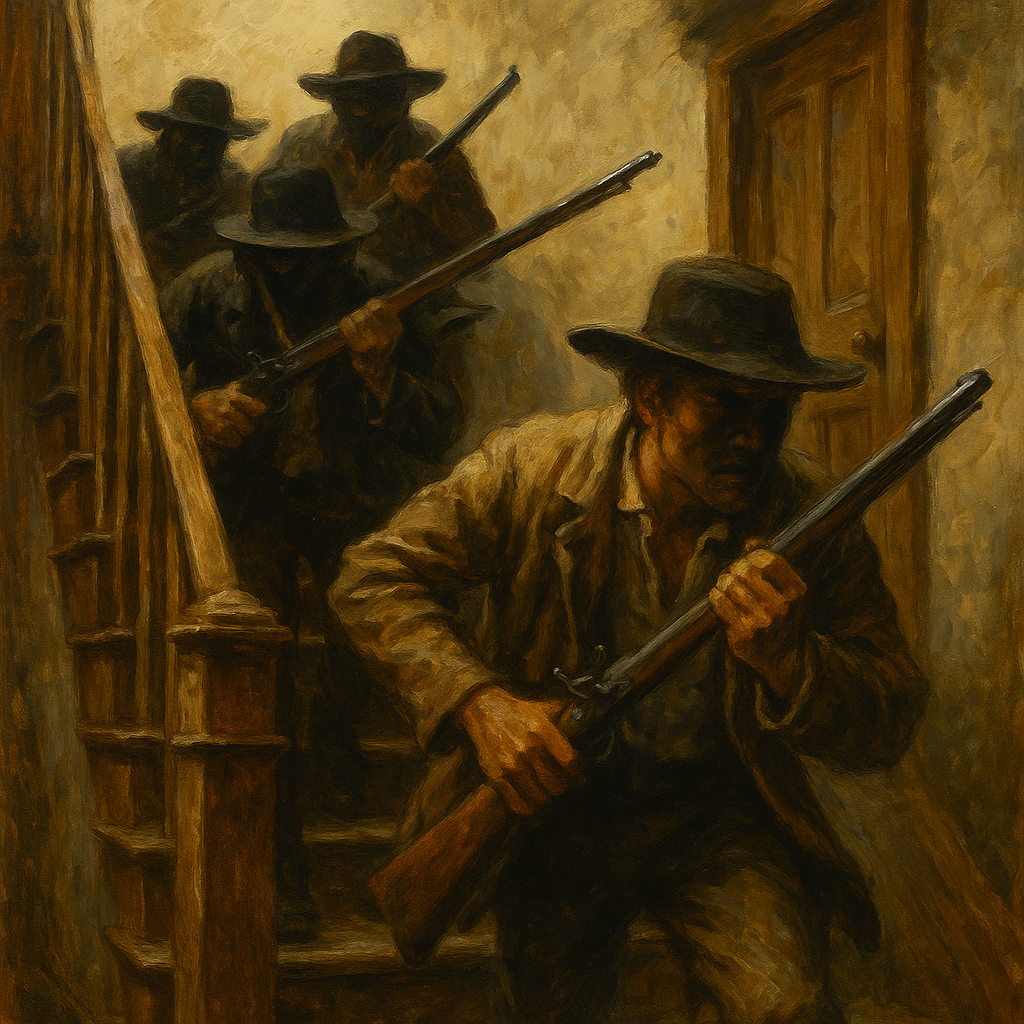
On the afternoon of June 27, the men in the jail felt unusually depressed. At Hyrum’s request, John Taylor sang the hymn A Poor Wayfaring Man of Grief. Shortly afterward, a group of armed men with blackened faces approached the jail, rushed up the stairs, and began firing through the door.
The first shot through the keyhole struck Hyrum in the face, killing him instantly.
Joseph returned fire through the partially opened door with the small pistol, discharging three of its six barrels. A heavy volley of gunfire then poured into the room. John Taylor attempted to flee toward the window but was shot multiple times before falling. Richards pulled him into the adjoining cell for safety.
Realizing defense was impossible, Joseph attempted to leap from the window. As he fell, he was shot from both outside and inside the jail. He landed on the ground below and died shortly after.
Aftermath of the Martyrdom
Willard Richards, uninjured except for a grazed ear, tended John Taylor, who survived despite severe wounds. Joseph’s body lay outside the jail, while Hyrum’s remained inside.
The martyrdom of Joseph and Hyrum Smith ended the leadership of the founding prophet and patriarch and deepened the Saints’ distrust of Illinois authorities. Violence continued through 1845–46, contributing to the Saints’ eventual migration westward.
Sources
https://app20602.cloudwayssites.com/nauvoo-expositor-joseph-smith/
https://www.churchofjesuschrist.org/study/history/topics/martyrdom-of-joseph-smith