
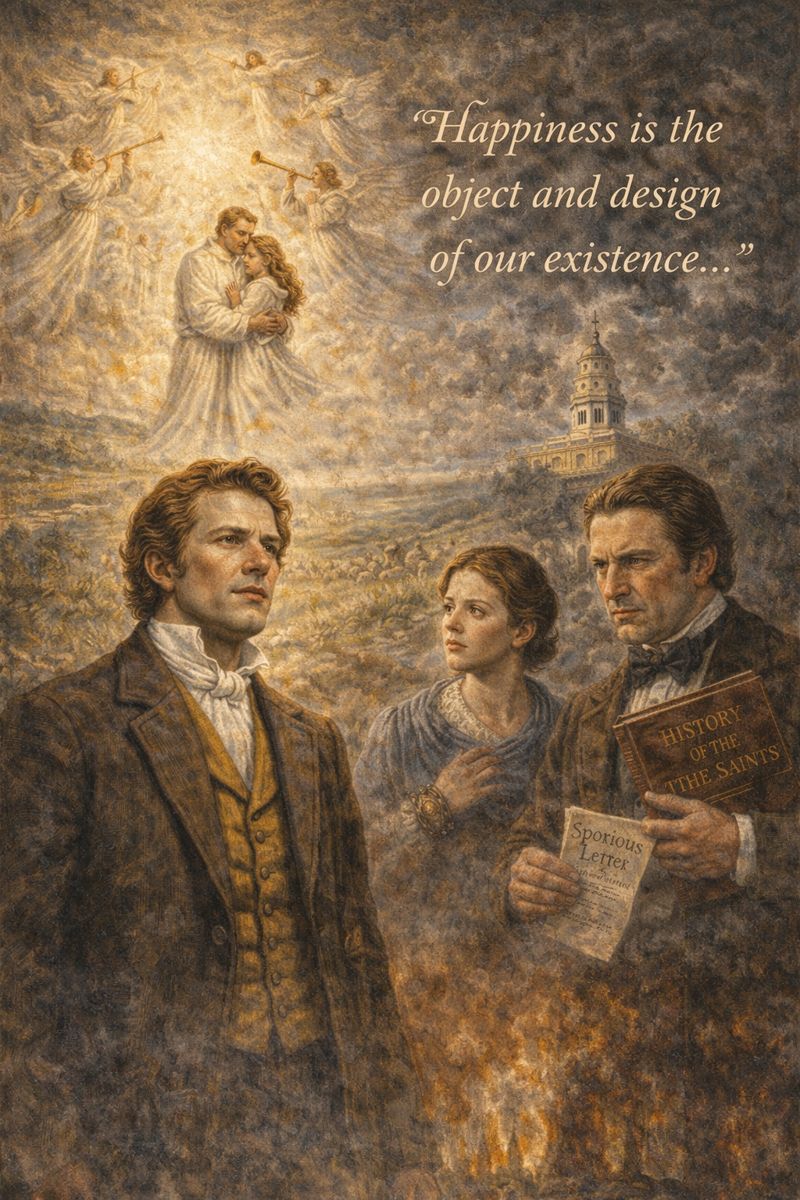
The Main Issue: The “Happiness Letter”
The episode centers on a very well-known quote often attributed to Joseph Smith:
“Happiness is the object and design of our existence, and will be the end thereof, if we pursue the path that leads to it; and this path is virtue, uprightness, faithfulness, holiness, and keeping all the commandments of God.”
This line has been:
Quoted frequently in lessons, talks, and even, in the past, in General Conference.
Included in History of the Church and then picked up by Church manuals.
More recently, it has largely disappeared from official Church usage, which leads to the historical question:
Did Joseph Smith actually write this?
This statement comes from what is commonly called “the happiness letter”, a letter supposedly written by Joseph Smith to Nancy Rigdon, daughter of Sidney Rigdon, trying to persuade her to accept plural marriage.
Our only source for this letter, however, is John C. Bennett, one of the most notorious apostates in early Church history.
Who Was John C. Bennett?
Historically, John C. Bennett:
Came to Nauvoo and quickly rose in influence.
Helped secure the Nauvoo City Charter.
Became mayor of Nauvoo.
Became a leading Church figure (a counselor in the First Presidency / high-ranking leader).
However, Bennett also:
Taught and practiced what he called “spiritual wifery”—essentially illicit sexual relationships disguised by false religious claims.
Claimed that certain Latter-day Saints could have sexual relations outside normal marriage without lasting commitment.
Was exposed, disciplined, and excommunicated for adultery and this false teaching.
At first, after his excommunication, Bennett:
Publicly confessed his sins and acknowledged wrongdoing.
Later, however, he:
Withdrew his confession,
Claimed he had confessed only under duress,
Turned against Joseph Smith and the Church, and
Began publishing attacks on Joseph Smith and the Saints.
He wrote:
A series of inflammatory letters in newspapers.
A book titled History of the Saints, using much hostile material, including reusing earlier anti-Mormon works and adding his own accusations.
In these writings, he:
Claimed Joseph Smith was secretly practicing plural marriage.
Took fragments of truth (Joseph was, in fact, beginning to introduce plural marriage by revelation) and mixed them with exaggerations, distortions, and outright falsehoods.
Background on “Sealing” and Plural Marriage in Nauvoo
To understand the context:
Joseph Smith did teach and begin practicing plural marriage in Nauvoo, under commandment from God.
But early “sealing” practices were more complex than our simplified modern usage.
Today, when we say someone is “sealed,” we almost always mean:
A man and woman sealed in marriage, or
Children sealed to parents.
In the 1840s, however, sealings could include:
Marital sealings (husband and wife, including plural wives).
Child-to-parent sealings.
Dynastic or adoptive sealings—individuals or families being sealed into the family line of a prominent leader (e.g., being sealed into the family of a Church leader with no biological connection). These were intended to join families into an eternal priesthood network.
Later revelation to Wilford Woodruff discontinued these “adoption”-type sealings in favor of a more direct biological / legal lineage approach.
So when historians see an 1840s record that, for example, “Joseph was sealed to X,” it is not always immediately clear:
Whether that sealing is a full marital relationship,
Or a dynastic/adoptive relationship,
Or some mixture.
However, in some of Joseph’s plural marriages, the women themselves later clearly describe the relationship as a real marriage in the full covenant sense.
This is the doctrinal backdrop in which Bennett claims to expose Joseph, while at the same time misrepresenting and exploiting those teachings for his own agenda.
The Alleged Letter to Nancy Rigdon
Bennett claimed that:
Joseph Smith approached Nancy Rigdon (Sidney Rigdon’s daughter),
Proposed to her that she enter into a plural marriage,
She resisted,
And Joseph then supposedly wrote her a letter to persuade her.
In Bennett’s anti-Mormon publications, he prints this letter, which contains the famous statement:
“Happiness is the object and design of our existence…”
The key problem: Our only source for this letter is John C. Bennett, whose credibility is deeply compromised.
Bennett’s Contradictions About His Own Conduct
To assess Bennett as a source, it matters that he contradicted himself about the very events around his excommunication.
At first, he claimed that his excommunication was completely unjust, that he had done nothing wrong, and that charges of adultery were fabricated to discredit him because he had turned on Joseph.
Later, in a public lecture reported by a non-LDS newspaper, he admitted:
He had indeed been “expelled for some indiscretions with a sister” in Nauvoo.
He continued to insist that Church leaders were worse than he was, but he no longer denied that his own misconduct led to discipline.
So, minimally, even by Bennett’s own later words, he is:
Not a consistently truthful narrator,
Shifting his story depending on his audience and purpose.
This is important when deciding whether to accept as genuine a document he alone supplies.
Denials from Joseph Smith and Sidney Rigdon
Significantly, Joseph Smith and Nancy’s own father, Sidney Rigdon, both denied that Joseph authored the letter Bennett published.
Sidney Rigdon’s Public Statement
Sidney Rigdon published a statement about the letter that appeared in the Sangamo Journal (an Illinois newspaper) as part of Bennett’s attack series:
He said, in substance:
The letter printed by Bennett, purporting to be from Joseph Smith to Nancy, was unauthorized by her.
Nancy had never said to Bennett or anyone else that the letter was written by Joseph Smith.
She had never claimed it was in Joseph’s handwriting.
Sidney stated that Joseph Smith denied to him that he was the author of the letter.
So Nancy’s own father, a leading Church officer, publicly affirmed:
Joseph told me he did not write that letter.
Church Newspaper Denial
In the Church’s newspaper The Wasp (edited by William Smith, Joseph’s brother), a response also appeared:
It described the alleged letter as undated, with no name, and no proof of authenticity.
It highlighted that the only basis for accepting it was Bennett’s word.
It explicitly concluded:
“Joseph Smith is not the author.”
So:
Sidney Rigdon: Joseph denied authorship.
Church paper: Joseph is not the author.
Only Bennett: claims the letter is Joseph’s.
From a historical and doctrinal standpoint, that is a very weak basis on which to attribute the letter to Joseph.
How Did the “Happiness Letter” Get Into History of the Church?
Given these denials, the next historical question is:
If Joseph did not write this letter, how did the text (including the “happiness” line) end up in the official History of the Church and then spread through Church culture?
Brief outline from this episode
Beginning in 1842, Joseph authorized the creation of a “History of Joseph Smith”, to be published serially in Church newspapers.
Willard Richards, a member of the First Presidency and Joseph’s clerk, was the main person compiling and drafting this history.
He used:
Joseph’s journals,
Official documents,
Letters,
And his own firsthand knowledge (he was often present).
When Richards reached the time period involving the Nancy Rigdon / Bennett controversy, he:
Did not insert the “happiness letter” into the draft.
Instead, he simply wrote a note in the draft, something like:
“See Sidney Rigdon’s letter on account of his daughter Nancy.”
In other words:
Richards knew the issue existed,
Knew Sidney had published a statement about it,
And chose not to copy Bennett’s alleged letter into the history.
Later:
Willard Richards died before the history project was completed.
After his death, others continued the project without his firsthand guidance.
It is after his death that the full text of the so-called “happiness letter” is inserted into the history, treated as if it were Joseph’s own writing.
The detailed mechanics of who inserted it and exactly how are left for the next episode in the series, but the important doctrinal/historical point from this episode is:
The letter’s inclusion in History of the Church does not go back to Joseph himself nor to the original Nauvoo compiler (Willard Richards), and Joseph and Sidney both denied Joseph wrote it.
Doctrinal Takeaway
The doctrinal idea that happiness is linked to virtue, obedience, and holiness is certainly consistent with the restored gospel.
However, the famous sentence:
“Happiness is the object and design of our existence…”
comes from a document whose authorship is highly doubtful.
Because:
Joseph denied writing it,
Sidney Rigdon supported that denial,
The Church’s own paper stated Joseph is not the author, and
The text comes to us only through John C. Bennett, a deeply compromised witness,
it is not reliable to attribute that specific letter—or that line—to Joseph Smith as a genuine, authored statement.
That is why:
Recent Church materials and leaders are much more cautious and generally do not quote this line as Joseph Smith’s, even though older sources and manuals did.
Happiness Part 2
Recap and Context
The previous discussion introduced the “Happiness Letter,” a text long attributed to Joseph Smith, containing the well-known statement:
“Happiness is the object and design of our existence…”
This letter is associated with the claim that Joseph Smith allegedly wrote to Nancy Rigdon, daughter of Sidney Rigdon, attempting to persuade her to accept plural marriage. The only historical source for this letter is John C. Bennett, a prominent Nauvoo dissenter.
Part 2 examines:
Why many past Church manuals quoted the “Happiness Letter”
How it entered the History of the Church
Why modern Church sources no longer use it
Historical problems with its authenticity
Part I — Doctrinal Question About Women Sealed to Multiple Men
A listener asked how to interpret the practice of sealing deceased women to multiple husbands when doing temple work, and whether in eternity a woman “chooses” which husband she will be with.
Official Doctrine
The Church teaches:
“The precise nature of these relationships in the next life is not known, and many family relationships will be sorted out in the life to come.”
(Plural Marriage in Kirtland and Nauvoo, Gospel Topics Essay)
This means:
We do not know how every sealing relationship will ultimately be resolved.
We perform ordinances for all lawful marriages, trusting God to sort them properly.
Nearly all marital relationships throughout human history will have to be resolved after resurrection, not during mortality.
Agency is Eternal
Prophets taught that agency continues forever.
Brigham Young taught (Wilford Woodruff Journal, 2 June 1857):
“There is no law in heaven or earth that would compel a woman to stay with a man either in time or eternity.”
Thus:
Eternal marriages require mutual choice, righteousness, and sealing “by the Holy Spirit of Promise.”
No person will be forced into an unwanted eternal relationship.
All eternal family relationships will be resolved justly, respecting agency.
Summary of the Doctrinal Segment
We do not know how every multi-sealing situation resolves.
God will ensure perfect justice, perfect agency, and perfect happiness.
Eternal marriage is based on covenant, worthiness, agency, and divine sealing—not on fear or speculation.
Nearly all marriages in history will be organized in the resurrection, not here.
Part II — The Historical Investigation of the Happiness Letter 2.
Background: Bennett’s Claim
John C. Bennett claimed:
Joseph Smith proposed plural marriage to Nancy Rigdon.
She resisted.
Joseph then wrote a persuasive letter (the “Happiness Letter”).
However:
Joseph Smith denied authorship.
Sidney Rigdon denied Joseph wrote it, affirming Joseph explicitly told him so.
Nancy Rigdon denied ever saying Joseph wrote it.
The Church newspaper (The Wasp) publicly stated:
“Joseph Smith is not the author.”
Thus the only person claiming Joseph wrote it is John C. Bennett, whose credibility is highly compromised.
How the Letter Entered the History of the Church
Willard Richards’ Role
Willard Richards, Joseph Smith’s secretary, worked for years compiling the official Nauvoo-era history.
When he reached April 1842—the period when Bennett claimed the incident occurred—Richards:
Made no entry describing any such letter.
Added only a note:
“See Sidney Rigdon’s letter on account of his daughter Nancy.”
Did not copy Bennett’s alleged letter.
Did not include Joseph’s supposed text.
Richards clearly did not intend to include the Bennett letter.
After Richards’ Death
After Richards died in 1854:
New clerks who lacked his personal knowledge continued the project.
A young scribe, Leo Hawkins, was assigned to fill gaps.
Hawkins inserted a note:
“See addenda to page 3.”
In the addenda, Hawkins copied the full text of the “Happiness Letter.”
Critical Detail
The version he copied matches the version printed in Bennett’s book History of the Saints, not an original letter by Joseph Smith.
The inserted text:
Has no heading
Has no author listed
Has no date
Gives no explanation that it comes from Bennett
Simply appears as floating text
Publication in 1855
When this portion of the history was printed in the Deseret News (Dec. 12, 1855), it likewise:
Appeared without attribution
Appeared without explanation
Appeared without context
Was not clearly identified as a letter
Was not connected to Bennett
It was simply printed in the body of the history as if it were Joseph’s words.
Thus later readers assumed:
“It is in the History of the Church, so Joseph must have written it.”
This assumption was based on a copying error and lack of context, not on actual evidence.
Why It Became Popular in the 20th Century
When B.H. Roberts edited the History of the Church (early 1900s):
He retained the letter because it appeared in earlier manuscripts.
He cautiously speculated that it might relate to early plural marriage teachings.
From there, Latter-day Saint teachers and speakers began quoting it widely.
It appeared in manuals, lessons, and even General Conference sermons.
Why Modern Church Materials No Longer Use It
Once scholars examined:
Its origin in Bennett’s hostile publications
The multiple contemporary denials
The fact that Richards did not include it
How it appeared later through a copying assumption
The lack of an original Joseph Smith document
…the Church became much more cautious.
For over a decade, it has not appeared in:
General Conference
Church manuals
Official publications
Not because its message is untrue, but because its authorship cannot be reliably traced to Joseph Smith.
Summary: The Historical Conclusion
The “Happiness Letter” does not have reliable provenance.
Joseph Smith did not claim it.
Joseph denied authorship.
Sidney Rigdon denied it.
Nancy Rigdon denied it.
The Church newspaper denied it.
Its source is solely John C. Bennett.
It was added to the history unintentionally decades later.
Its message is uplifting, but it cannot be used to prove Joseph Smith taught it.
Final Doctrinal Takeaway
The core teachings of Joseph Smith about:
Eternal happiness,
Obedience,
Divine law,
Agency,
Eternal marriage
are well-established elsewhere in his authenticated sermons and revelations.
Whether or not Joseph wrote these specific words, the doctrine that God intends His children to experience eternal happiness through eternal covenant is abundantly taught in scripture and revelation.