
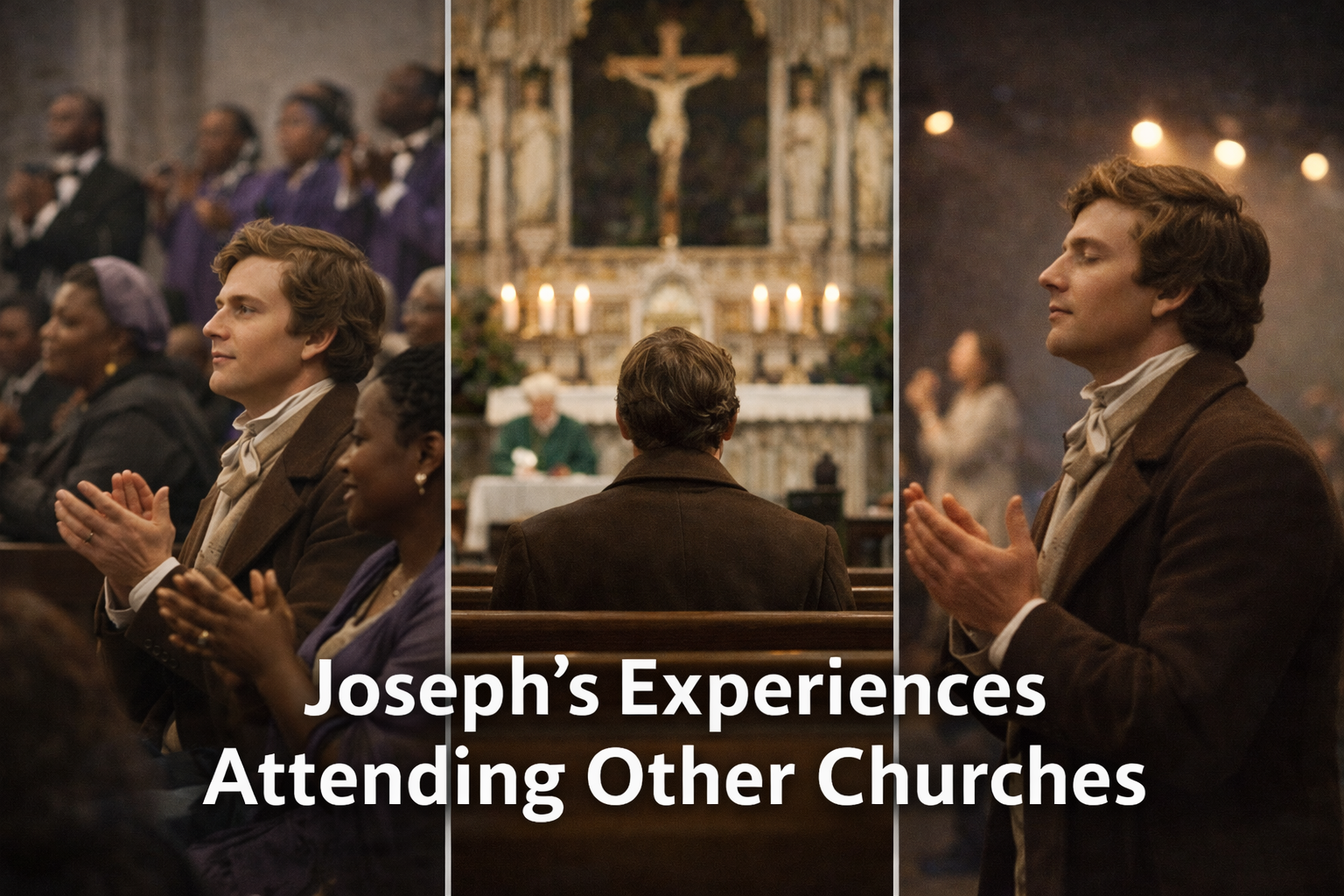
Joseph Smith’s Relationship with Local Churches After the First Vision
After the religious excitement surrounding the revivals in Manchester, a local preacher attempted to unify the denominations. Lucy Mack Smith recorded that members of the family were inclined to join, but Joseph would not. She recounted him saying he felt no desire to attend meetings and preferred instead to take his Bible into the woods, where he believed he learned more in two hours than he could from listening to sermons for years. These remarks occur in her recollection of the years following Alvin Smith’s death in 1823, during a period when Joseph had already received repeated visits from the Angel Moroni.
Joseph did not isolate himself from religious teachings, however. He occasionally listened to preachers and sometimes offered corrections when a sermon contradicted truths he had received by revelation. In 1843, William Clayton described Joseph listening to a Methodist minister expound Genesis, after which Joseph quietly clarified doctrinal points. The minister expressed interest in further conversation and possibly visiting Nauvoo. Joseph often allowed ministers of other denominations to preach in Nauvoo, confident that his people would embrace greater light wherever it appeared.
The Allegation That Joseph Joined Methodism in Harmony
A late antagonistic account printed in the Amboy Journal in 1879 claimed that Joseph Smith briefly joined the Methodist Episcopal Church while living in Harmony, Pennsylvania. According to this source, Joseph’s name appeared on a class list for three days before he was confronted and withdrew to avoid disciplinary inquiry. Yet the story emerged more than fifty years after the supposed event and contains errors about Joseph’s life and the practices of Methodism in that period.
In early Methodist structure, appearing in a class book did not constitute full membership, and nothing contemporary corroborates the idea that Joseph ever formally joined. Most historians regard the claim as unreliable, noting its hostility, lateness, and factual inaccuracies.
Joseph Smith’s Own Accounts of Sharing the First Vision
Joseph Smith’s official history states that after the First Vision he told a Methodist preacher, who responded sharply and dismissed the idea that visions continued. Joseph wrote that prejudice soon spread “among all the sects,” and that even though he was a boy of little consequence, many people of standing united to oppose him. This suggests the account was shared beyond a single minister.
Joseph’s 1832 narrative describes his joy after the vision and his sorrow that he “could find none that would believe” him. The phrasing implies multiple attempts to tell his story. In his 1843 interview with David Nye White, Joseph explained that once he declared he had seen a vision and that the churches were all corrupt, persecution followed quickly.
Family Awareness of Joseph Early Persecution
Lucy Mack Smith wrote that from the moment Joseph reported his vision he experienced opposition from various denominations, a pressure that continued until the angel appeared again in 1823. This indicates that the family was aware early on that Joseph was being singled out for claims he refused to abandon.
Joseph’s brother William, though inconsistent in some late reminiscences, stated that the family believed Joseph from the beginning and that they themselves were respected until he began reporting divine manifestations. Their persecution, he said, “began with Joseph’s vision.”
Joseph Smith’s Reputation in Contemporary Records
Hostile later accounts often portray Joseph as untrustworthy before the First Vision, yet the only contemporary legal record involving his testimony presents a very different picture. In an 1819 court case, Joseph was permitted to testify and was treated as a credible witness. This contradicts the claim—common in antagonistic literature—that he was publicly known as dishonest or unstable before he reported his vision.
Conclusion
Joseph Smith did not participate regularly in other churches after the First Vision, preferring to seek truth privately through scripture and prayer, though he occasionally listened to ministers and interacted respectfully with them. The claim that he joined Methodism in Harmony appears in a late hostile source and lacks historical foundation. Joseph insisted throughout his life that he told several people about the First Vision and that this disclosure brought real and lasting persecution. His family’s writings support his claim, and surviving contemporary records show no evidence that he or his family were disreputable before those events.
Listen to the full podcast here:
https://www.youtube.com/@standardoftruthpodcastllc