
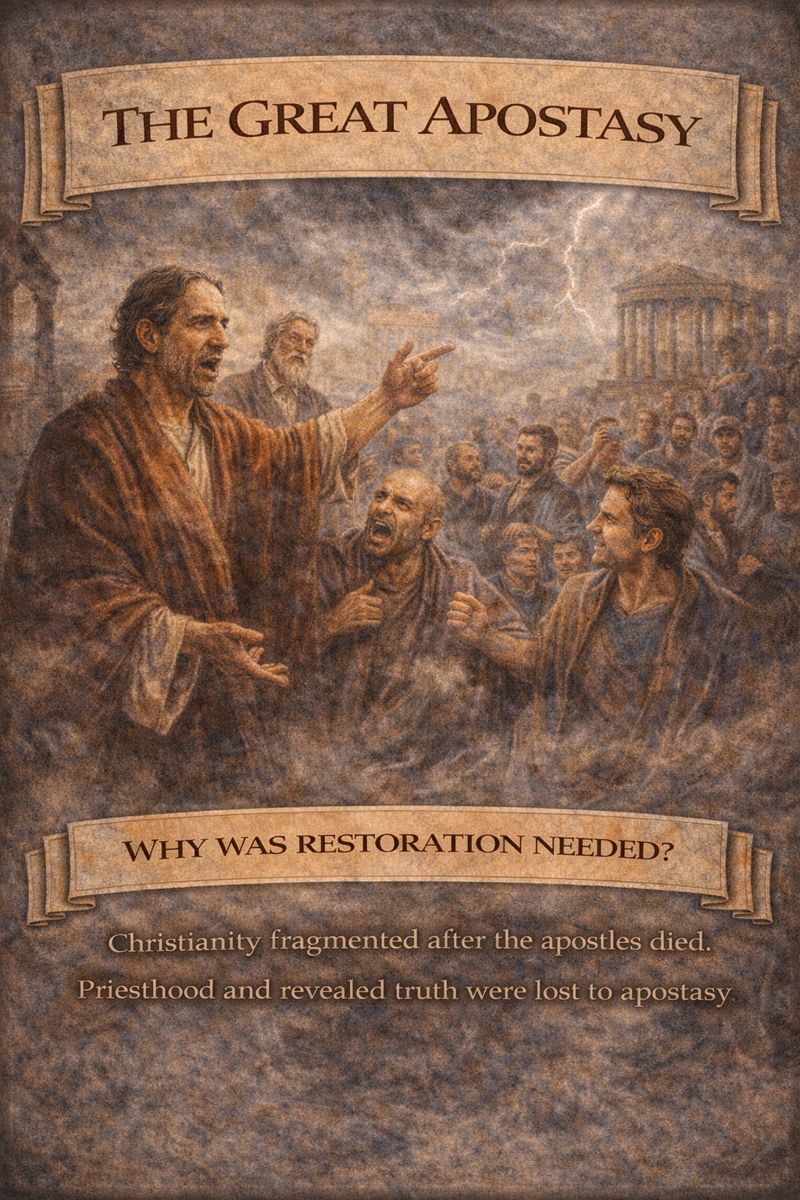
Great Apostasy
The importance of effective communication cannot be overstated in fostering understanding and collaboration across diverse groups. It serves as the foundation for building strong relationships and achieving common goals.
Mission Preparation: The Apostasy and the Need for Restoration
Purpose of the Episode
This episode, originally recorded as part of a “Joseph Smith and the Restoration” series, introduces missionaries to the doctrine of the Great Apostasy and explains why understanding apostasy is essential to explaining the Restoration.
Why Begin with the Apostasy?
Key missionary question
What exactly was restored through Joseph Smith?
To answer this, missionaries must understand:
What was lost after the time of the New Testament.
Comparative Christian perspectives
Many Protestants accept some form of apostasy, claiming the Catholic Church departed from true doctrine.
Catholics deny a full apostasy and assert continuous authority and tradition.
Latter-day Saints teach a universal apostasy:
Priesthood authority and prophetic leadership were lost.
Key doctrines and ordinances were altered or corrupted.
A complete restoration—not just reform—was required.
Doctrines Unique to the Restoration
The episode highlights truths restored through Joseph Smith that are not found in other Christian traditions:
Premortal existence of human spirits.
God as an embodied, exalted being.
Necessity of priesthood authority for saving ordinances.
Celestial marriage and sealing for eternity.
Three degrees of glory.
Salvation and ordinances for the dead.
The existence of these doctrines underscores:
The inadequacy of simply “reforming” existing churches.
The need for new revelation and restored authority.
The Central Issue of Priesthood Authority
Different Christian views
Protestant – ordinances do not save; authority is less central.
Catholic/Orthodox – authority and apostolic succession are vital; they claim an unbroken line back to the apostles.
Latter-day Saint –
Saving ordinances must be performed by proper priesthood authority.
That authority was lost through apostasy.
It was restored through angelic messengers (e.g., John the Baptist; Peter, James, and John) to Joseph Smith.
For missionaries, explaining why authority matters is crucial to explaining why the Restoration matters.
Evidence of Apostasy in the New Testament
The episode uses Paul’s own letters to show that apostasy began during the lifetime of the apostles.
Galatians 1
Paul marvels that the Saints have “so soon” departed from the true gospel.
He condemns those preaching “another gospel.”
This shows doctrinal corruption already taking root quickly.
1 Corinthians 15
Some Corinthian Christians are denying the Resurrection, a core doctrine Paul had taught personally.
Paul insists that without the Resurrection, the entire Christian faith collapses.
This demonstrates early doctrinal fragmentation, even in communities Paul founded.
Conclusion from Paul’s Letters
Apostasy was already happening while apostles were alive.
After their deaths, doctrinal drift and fragmentation naturally accelerated in the absence of living prophets and apostles.
Early Christian Diversity
Modern historians (Latter-day Saint and non–Latter-day Saint) recognize:
Early Christianity was highly diverse, not doctrinally uniform.
Different communities developed distinct beliefs and practices.
There was no single, fully correlated, centrally controlled church as later imagined.
This historical reality supports the Latter-day Saint understanding that:
Over time, doctrine, authority, and ordinances were altered or lost.
Councils and creeds were attempts to respond to disputes, not indications of seamless continuity.
Components of the Great Apostasy (LDS Perspective)
According to Latter-day Saint doctrine, the Apostasy included:
Loss of priesthood keys and authority.
End of continuous prophetic revelation.
Changes to ordinances and church structure.
Introduction of non-apostolic doctrines and philosophies.
Partial loss or alteration of scriptural texts.
This created conditions in which:
God’s children still received light according to their faith.
But the fulness of truth and authority was absent from the earth.
Why the Restoration Was Necessary
Joseph Smith’s experience mirrors the confusion Paul described:
Competing churches and doctrines, all claiming biblical authority.
No consensus on key doctrines or practices.
A sincere seeker goes directly to God for guidance.
The First Vision revealed that:
No existing church possessed the fulness of truth and authority.
A complete restoration was required, not mere adjustment of an existing denomination.
Missionary Application
For missionaries, understanding the Apostasy:
Explains why new scripture (Book of Mormon, Doctrine and Covenants, Pearl of Great Price) is needed.
Clarifies why priesthood keys restored through Joseph Smith are essential.
Helps them answer questions such as:
“Why your church and not mine?”
“If God is all-powerful, why allow an apostasy?”
Shows that the Apostasy is not an insult to sincere Christians, but a recognition that:
Many good people followed Christ with the light they had.
God prepared the world for a later restoration of fulness.
Summary
The Apostasy began in New Testament times and unfolded over centuries.
It led to loss of authority and fragmentation of doctrine.
The Restoration through Joseph Smith reintroduced priesthood keys, ordinances, and truths not found elsewhere.
Missionaries who grasp this framework can explain the uniqueness of The Church of Jesus Christ of Latter-day Saints with clarity, respect, and conviction.
🎧 Listen to the full podcast here:
https://www.youtube.com/@standardoftruthpodcastllc