
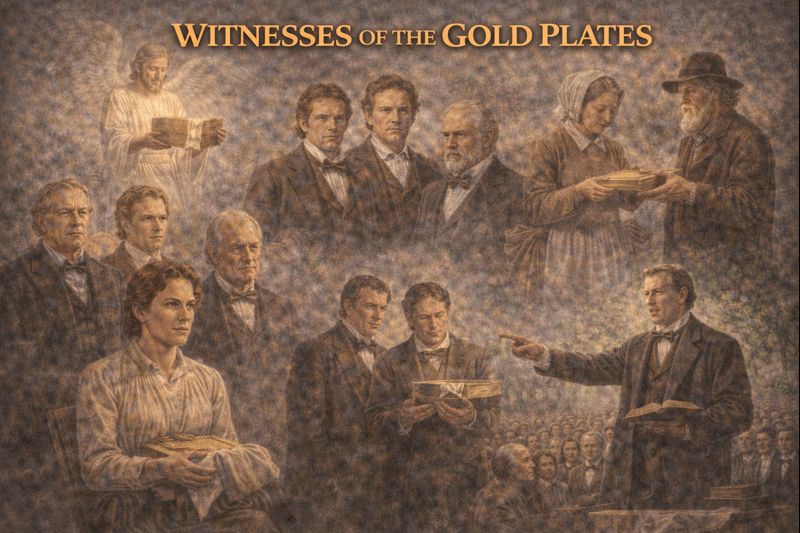
Witnesses of the Gold Plates
Introduction
From the spring of 1829 through the turbulent years of early missionary preaching, the history of the Restoration produced a wider circle of Book of Mormon witnesses than the formally recognized Three and Eight. These lesser-known accounts—some involving angels, others involving brief glimpses of the plates, and still others emerging from domestic burdens or spiritual aspirations—extend the chain of testimony far beyond what appears in the published witnesses’ statements. Together, these narratives provide a richer understanding of the environment in which the translation unfolded and highlight the diversity of individuals who encountered the plates in various ways.
The Translation Moves to the Whitmer Home
As persecution in Harmony, Pennsylvania intensified in the spring of 1829, Joseph Smith and Oliver Cowdery sought refuge and stability to continue the translation. Joseph asked David Whitmer, through Oliver, to bring a wagon and transport Joseph and Emma to the Whitmer homestead in Fayette, New York. The request came at the height of agricultural work, making the journey a serious sacrifice for the Whitmer family, who depended on every hand during planting season.
The Whitmer household was already large, and the addition of Joseph, Emma, and Oliver increased Mary Musselman Whitmer’s domestic responsibilities dramatically. The home became the center of translation, prayer, and growing spiritual expectation, but also a place where the burdens of ordinary labor intensified as sacred work unfolded inside its walls.
The Mysterious Messenger on the Road to Fayette
During the journey from Harmony to Fayette, David Whitmer later recalled an event that stood out for the rest of his life. In an 1878 interview with Joseph F. Smith and Orson Pratt, he described how he, Joseph, and Oliver met an elderly man walking beside their wagon. He greeted them with courtesy, declined an offer to ride, and stated that he was “going to Cumorah”—a name unfamiliar to David at the time. Joseph signaled David not to question further, and the man vanished instantly from sight. Only afterward did Joseph explain that this messenger had custody of the plates during that period. The event became one of several early accounts of angelic guardianship surrounding the record.
Mary Musselman Whitmer and Her Personal Witness of the Plates
Amid the heavy daily labor intensified by the presence of boarders, Mary Musselman Whitmer found herself near the breaking point. According to both her son David and her grandson John C. Whitmer, heavenly help came in an unexpected form. While on her way to milk the cows, she encountered the same elderly messenger her son had described. He told her her diligence had been seen, that the work in her home mattered profoundly, and that she deserved encouragement. He opened a bundle—sometimes described as a knapsack—and showed her the plates, turning the leaves and displaying the engravings. The vision strengthened her and removed any inclination she had felt to complain. She later recounted the experience many times, remaining faithful to the Restoration until her death.
Timing of Mary Whitmer’s Experience
Although accounts were recorded decades later, the incident appears to have taken place in mid-1829, likely before or around the period when the Three and Eight Witnesses received their formal manifestations. Her experience stands as the only known independent, open-vision female witness of the plates.
Emma Smith and the Testimony of Doctrine and Covenants 25
Emma Smith participated deeply in translation, acting sometimes as scribe and constantly as emotional support. She handled the covered plates, lifted them, and described feeling the weight and the edges beneath the cloth. Yet she affirmed throughout her life that she never saw them openly. In Doctrine and Covenants 25, given in July 1830, the Lord told Emma not to murmur for what she had “not seen,” promising that a future time would reveal His wisdom. Her steadfast testimony—affirming Joseph’s prophetic calling despite never receiving a visual witness—remains a central example of devotion grounded in spiritual conviction rather than visual proof.
Josiah Stowell’s Partial Glimpse of the Plates
Josiah Stowell, one of Joseph Smith’s earliest supporters in New York, later testified that he was present when Joseph returned home with the plates. As the record was passed through a window, the covering slipped momentarily, revealing a portion of the plates. Stowell reported seeing the golden leaves and engraved characters. Though not a formal witness, his recollection adds another early thread to the historical tapestry of testimonies.
The Principle of Witnessing and Unbelief
Doctrine and Covenants 5 teaches that those who reject God’s word will not believe even if shown miracles. The historical pattern affirms this principle. Early members experienced visions in the School of the Prophets, yet dissent persisted. Even the Three Witnesses—Oliver Cowdery, David Whitmer, and Martin Harris—later separated themselves from the Church but never denied their testimonies. Increasing the number of witnesses did not increase belief among critics, reinforcing the scriptural teaching that spiritual conviction demands more than visible proof.
Early Missionary Testimony and Lyman Johnson’s Vision
By 1832 missionaries were spreading the Restoration’s message far beyond New York. A newspaper report by Benjamin Stokely describes Lyman Johnson, later one of the original Twelve Apostles, preaching boldly that an angel had brought him the gold plates and laid them before him. He claimed this heavenly experience testified of the Book of Mormon’s truth and fulfilled the prophecy of the angel in Revelation 14:6. This stands as the earliest published reference to a vision involving an angel and the plates outside the circle of the formal witnesses.
The Johnson Family and the Crisis of Apostasy
Lyman and Luke Johnson came from a family whose conversion was linked to Elsa Johnson’s miraculous healing. Both brothers became apostles in 1835, yet the financial collapse surrounding the Kirtland Safety Society in 1837 contributed to their disaffection. Lyman, charged in 1838 with stirring legal persecution, insulting Church councils, circulating falsehoods, assault, and questionable property dealings, was excommunicated alongside fellow apostle John Boynton. Yet despite their separation they traveled to Nauvoo on a Church steamboat, purchased property, and expressed warmth toward Joseph Smith. Their complex relationship with the Church shows Joseph’s openness even toward former opponents.
Lyman Johnson’s Vision Reaffirmed Through Later Accounts
Multiple later accounts, including statements by Brigham Young, confirm that Lyman Johnson prayed earnestly for the same manifestation granted to the Three Witnesses. According to Brigham Young, an angel appeared, displayed the plates, and allowed Lyman to handle them. Although he later doubted this experience after apostasy, Lyman reportedly lamented the loss of his earlier faith, saying he would give his right hand to recover the peace he once had. His life illustrates that a miraculous witness does not guarantee enduring discipleship.
Luke Johnson’s Return and Later Service
In contrast to his brother, Luke Johnson eventually repented and returned to full fellowship, becoming the first bishop of Tooele, Utah—the only former apostle ever to later serve as a ward bishop. His journey underscores the Restoration’s principle that apostasy need not be permanent.
The Tragic End of Lyman Johnson
Lyman Johnson died in 1856 after falling through the ice of a river and drowning. Despite his early apostolic calling and his angelic witness of the plates, he never rejoined the Church before his death. His story remains a cautionary chronicle of lost spiritual light and the fragility of testimony.
Conclusion
The additional witnesses of the gold plates—from the Whitmer family to early missionaries, from domestic burdens relieved by divine manifestation to visions sought through fervent prayer—extend the historical record far beyond the published statements of the Three and Eight. These narratives, preserved through diaries, interviews, sermons, and firsthand recollections, form a wide circle of testimony surrounding the translation of the Book of Mormon and reveal the depth of early spiritual experiences in the Restoration.
Listen to the full podcast here:
https://www.youtube.com/@standardoftruthpodcastllc
Season 4, Episode 48 – Additional Witnesses of the Gold Plates – Part 1
Season 4, Episode 48 – Additional Witnesses of the Gold Plates – Part 2