
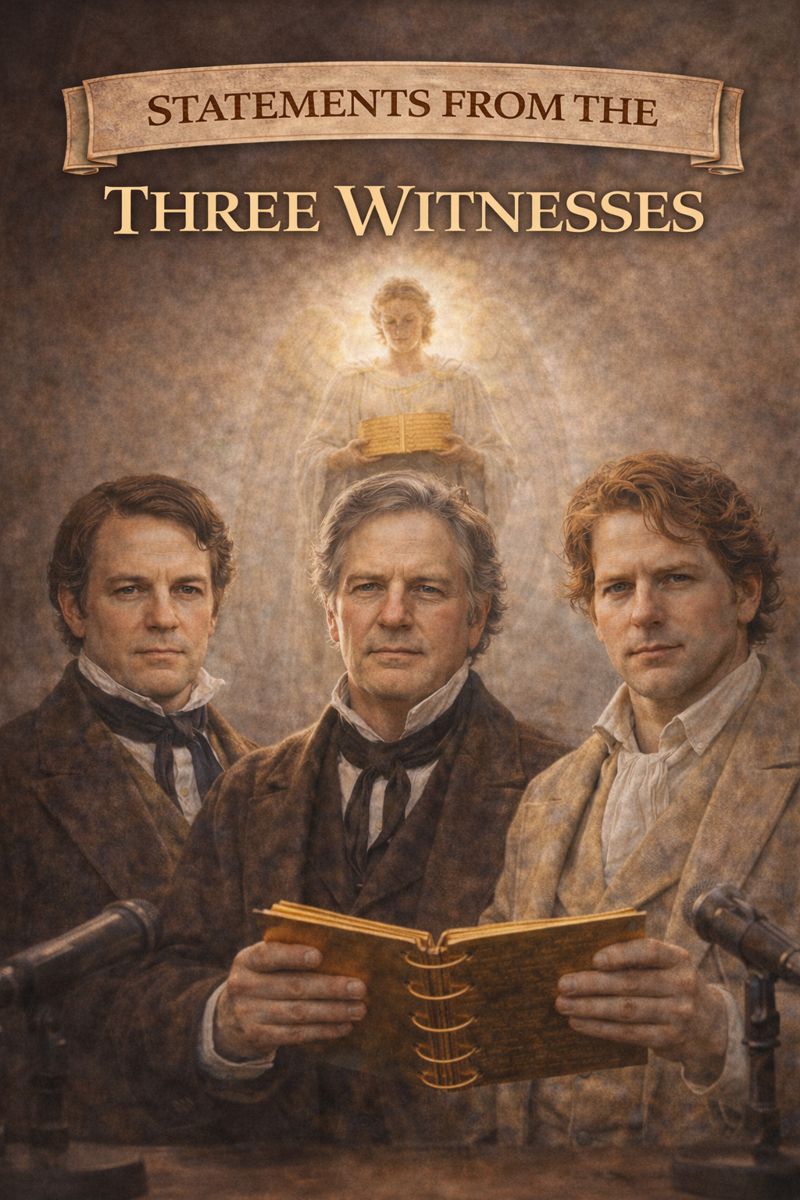
Statements from the Three Witnesses: (Primarily Martin Harris)
Introduction
In this episode, the discussion returns to the essential question of the Book of Mormon witnesses—what they said, when they said it, and how their testimonies developed across their lives. As always, the podcast approaches early Church history through original historical sources, highlighting the lived experience of those who were closest to Joseph Smith and the Restoration.
Before examining the witnesses themselves, the hosts reflect on a listener’s inquiry about which podcast episodes best help individuals wrestling with doubts. They explain that the answer varies depending on what the person is struggling with, but they also emphasize several foundational truths: doubts are normal, the Restoration teaches a consistent and deeply hopeful Plan of Salvation, spiritual testimony is more trustworthy than antagonistic sources, and unique Latter-day Saint doctrines—such as premortal existence, deification, eternal families, and universal salvation—provide answers that no other Christian tradition offers. Everything ultimately returns to the central question: Is Joseph Smith a prophet? And the keystone evidence is the Book of Mormon.
With this foundation laid, the episode turns back to the witnesses whose experiences affirm the reality of that book.
The Three Witnesses and Their Published Statement
The formal statement of the Three Witnesses—Oliver Cowdery, David Whitmer, and Martin Harris—appears at the front of the Book of Mormon. They declared that:
they saw the plates containing the records of the Nephites, Lamanites, and Jaredites,
an angel of God appeared before them,
the plates were shown to them by divine power,
the engravings were visible,
and the voice of God testified that the translation was true.
They stressed that they bore this testimony not by preference or personal devotion alone, but “by the commandment of God.”
This testimony has remained fundamentally unchanged across more than fifty surviving firsthand statements from the witnesses.
Early External Testimony About the Witnesses
Long before later interviews, outsiders documented what the witnesses were saying.
1829 Newspaper Account
A hostile Christian newspaper—intent on discrediting Joseph Smith—reported that Cowdery and Harris claimed:
they saw the plates “on a clear, open, beautiful day,”
they saw an angel “arrayed in glorious light” who placed the plates before them,
they saw and understood the engravings,
all of this was “by the power of God.”
Ironically, even an enemy source recorded their direct testimony of an angel and visible plates.
Hurlbut / Howe Anti-Mormon Report
When Doctor Philastus Hurlbut gathered affidavits for Eber Howe’s Mormonism Unvailed (1834), he recorded that Martin Harris publicly spoke about:
angels,
spirits,
and physically handling the plates “by the power of God.”
Once again, the most hostile sources inadvertently confirm Harris’s consistent claims.
Letter from Indian Agent Richard Cummins (1831)
In 1831, Oliver Cowdery and companions preached to Native Americans. Richard Cummins wrote to William Clark (of Lewis and Clark fame) to report that the missionaries:
claimed a new revelation,
testified that it had been shown miraculously,
and declared that an angel appeared to one man and two others.
This reveals that Oliver was repeating his witness experience from the earliest years of the Church.
Later Testimonies of the Witnesses
Martin Harris (1853 – Millennial Star Interview)
In 1853, in an interview published in The Millennial Star, Martin Harris reaffirmed his testimony:
“I know that the Book of Mormon is true.”
“I know that the plates have been translated by the gift and power of God.”
He also spoke in detail about physically handling the plates. He described:
holding the plates on his knee for “an hour and a half,”
lifting as many of the plates “as Joseph Smith translated,”
the plates’ size: about 8 inches long,
the thickness of the entire stack: about 4 inches,
each plate being “thicker than the thickest tin.”
He also recounted Joseph burying the plates in the woods to protect them.
This testimony is remarkable for the specificity Harris offers—especially considering that he had left the Church years earlier and had no institutional pressure to defend its claims.
Oliver Cowdery (1848 – Return to the Church)
When Oliver Cowdery rejoined the Church in 1848, his public testimony was sweeping and unequivocal.
He declared:
he wrote the Book of Mormon translation “as it fell from the lips of the Prophet Joseph Smith,”
Joseph translated through the “Urim and Thummim,”
he had seen and handled the gold plates and the holy interpreters,
the Book of Mormon fulfilled prophecy in Revelation 14,
the Spalding and Sidney Rigdon theories were false.
Cowdery had been estranged from Joseph Smith for nearly a decade, yet he returned with the same testimony he had always given.
Martin Harris (1859 – Tiffany’s Monthly Interview)
In 1859, Tiffany’s Monthly—a non-Latter-day Saint publication—recorded an extensive interview with Martin Harris. The interviewer had no reason to support the Church’s claims, yet he preserved Harris’s detailed descriptions.
Description of the Plates
Harris reported:
plates were approximately 7 x 8 inches,
each plate like “thick tin,”
the stack about 4 inches thick,
bound by three silver rings.
He also described the interpreters:
“two round stones” set in silver bows,
resembling polished marble.
Handling the Plates
Harris testified again that he had “hefted” the plates repeatedly and could hear the metal shift inside the box. He emphasized that the Smith family had neither the means nor the resources to fabricate metal of that quantity.
Joseph Smith’s Retrieval of the Plates
Harris recounted:
the plates resting beneath a flat stone supported by smaller stones,
the interpreters lying beneath the plates,
Joseph being physically attacked while carrying them home,
Joseph handing the plate box through a window to Lucy Mack Smith,
Harris hearing the metallic sound as they moved.
These details reveal that Harris was consistent over decades—and again, speaking to an interviewer with no ties to the Church.
Spiritual Confirmation
Harris described kneeling in prayer to know whether the Book of Mormon was true. He promised God that if he received an answer, he would support the work. The answer came as a “still small voice,” after which he felt bound by covenant to help publish the book.
He also explained why Joseph fled to Pennsylvania: hostility in New York was so severe that Joseph could not safely remain.
Additional Notes on the Physicality of the Plates
Throughout his life, Martin Harris emphasized that:
he physically lifted the plates,
they weighed 40–50 pounds,
he heard them move within the box,
he refused to see them until God granted the experience—matching the instructions in Doctrine and Covenants 5.
These details consistently undermine theories claiming the plates were imaginary, visionary only, or entirely spiritual.
Conclusion
Season 4, Episode 14 reinforces several key historical truths:
The Three Witnesses never denied their testimonies—not once.
Even estranged from Joseph Smith or the Church, they repeated the same claims.
Their testimonies combine spiritual and physical elements: angelic vision and physical handling.
Both friendly and hostile contemporary accounts preserve their statements.
Their witness stands at the center of examining Joseph Smith’s prophetic calling.
Further accounts—including additional statements from David Whitmer—are explored in the next episode.
Listen to the full podcast here:
https://www.youtube.com/@standardoftruthpodcastllc
Season 4, Episode 14 – Statements from the Three Witnesses (primarily Martin Harris)