
Introduction
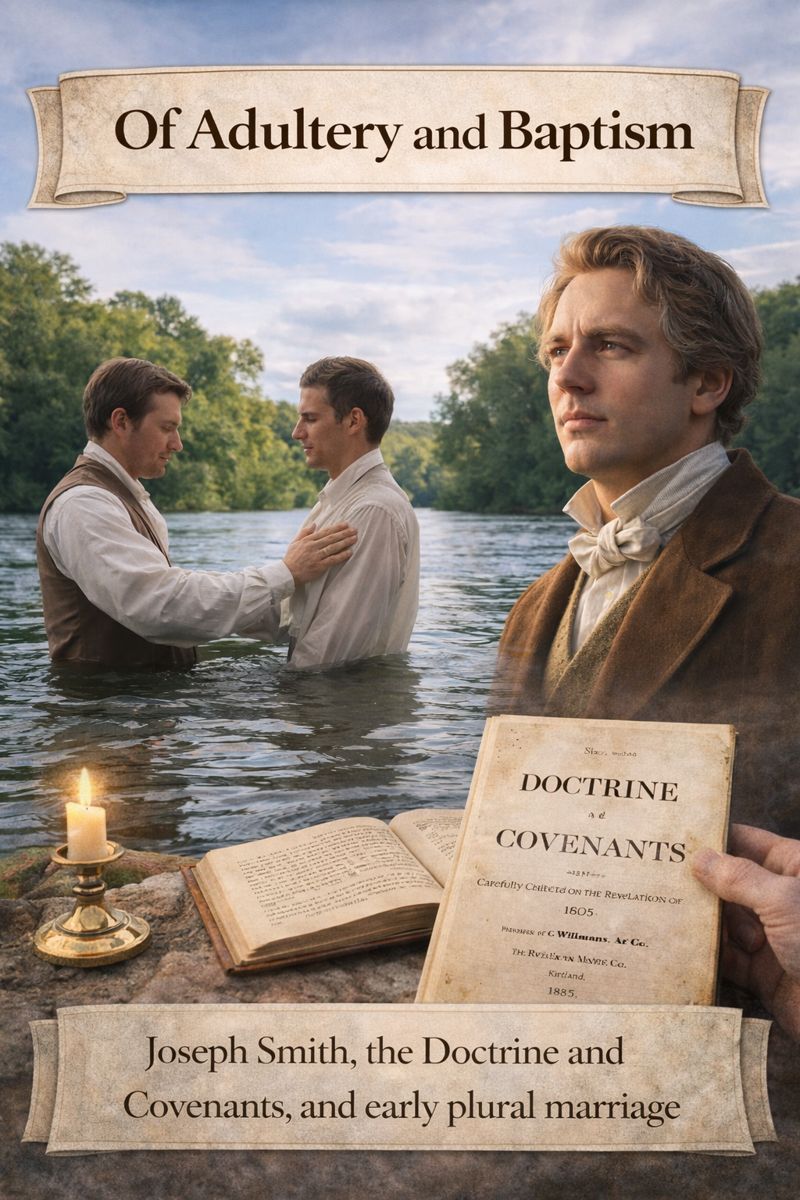
In the early years of the Restoration, doctrines and practices unfolded line upon line, including the wording used in sacred ordinances. This episode follows the historical journey of the baptismal prayer from the Book of Mormon text used in 1829 to the standardized wording adopted in the 1835 Doctrine and Covenants. Alongside this development stand some of the earliest controversies within the Church, moments when prophetic authority had to be clearly re-established and defended. Through these events we see how Joseph Smith taught the principle of continuing revelation, emphasizing that only the prophet could make authorized changes to Church practices and scripture.
The First Baptismal Wording in the Restoration
When Joseph Smith and Oliver Cowdery stood in the Susquehanna River in May 1829, they used the wording given by the risen Christ to the Nephites in 3 Nephi. The phrase was direct and simple—“Having authority given me of Jesus Christ.” Later that same year, Joseph instructed Oliver to prepare a summary document titled Articles of the Church of Christ, drawing heavily on Book of Mormon passages. That document preserved precisely the same wording, reflecting the Church’s reliance on freshly revealed scripture as its primary guide.
When Joseph dictated the revelation later known as Doctrine and Covenants 20—the Articles and Covenants of the Church—the earliest manuscripts and the 1833 Book of Commandments again carried the familiar phrase from the Book of Mormon. For the first several years, this was the official baptismal wording of the young Church.
The 1835 Revision and the Introduction of “Commissioned”
Between 1833 and 1835, Joseph Smith oversaw a careful editing and preparation of the revelations for publication in the new Doctrine and Covenants. During this process, the baptismal wording was altered to read, “Having been commissioned of Jesus Christ.” The change was intentional and made under Joseph’s supervision.
In nineteenth-century usage, “commissioned” conveyed the same sense of divine authorization as “having authority given.” Yet it reflected the Church’s growing administrative maturity after years of new quorums, organized priesthood offices, and expanding missionary work. From 1835 forward, this revised wording became the permanent baptismal prayer used in the Church.
Early Disputes and the Clarification of Prophetic Authority
Not all early Saints embraced changes so easily. In 1830, Oliver Cowdery raised strong objections to a phrase in D&C 20 that required candidates for baptism to manifest that they had received the Spirit of Christ. Believing the requirement added more than the Book of Mormon demanded, Oliver wrote to Joseph insisting the line be removed. Joseph firmly responded that no one could alter revelations except the one appointed to receive them. Through this experience, Joseph both preserved the integrity of the revelation and taught an essential principle—that even strong leaders could not impose their own doctrinal adjustments on the Church.
A year later, in 1831, Doctrine and Covenants 43 provided a decisive rule: only the prophet chosen and ordained according to God’s order could receive commandments and revelations for the Church. No one else’s teachings were to be accepted as binding doctrine. The revelation came at a time when charismatic teachings and competing claims were emerging, and it established a safeguard that would guide the Church in the decades ahead.
Continuing Revelation and the Development of Ordinances
These episodes reveal how the Lord guided the early Church step by step. Scripture itself anticipated this development: the Ninth Article of Faith affirms that God will yet reveal “many great and important things” pertaining to His kingdom. Under this principle, a living prophet may clarify or expand on earlier instructions as the Church grows, just as the shift from “having authority given me” to “having been commissioned” marked an organizational refinement rather than a doctrinal departure.
By the time the 1835 Doctrine and Covenants appeared, the new wording had been accepted as the official form. No subsequent prophet has altered it, and it continues unchanged in the Church today.
Conclusion
From 1829 to 1835, the baptismal prayer evolved under prophetic direction, mirroring the maturing structure of the restored Church. Early disputes, particularly Oliver Cowdery’s objections, prompted Joseph Smith to clarify the nature of revelation and establish firm boundaries around prophetic authority. These foundational moments helped shape the principle that governs Latter-day Saint administration to this day: ordinances and doctrine are guided by continuing revelation through the living prophet appointed by God.
Listen to the full podcast here:
https://www.youtube.com/@standardoftruthpodcastllc
(23) Season 4, Episode 27- Of Adultery and Baptism – YouTube