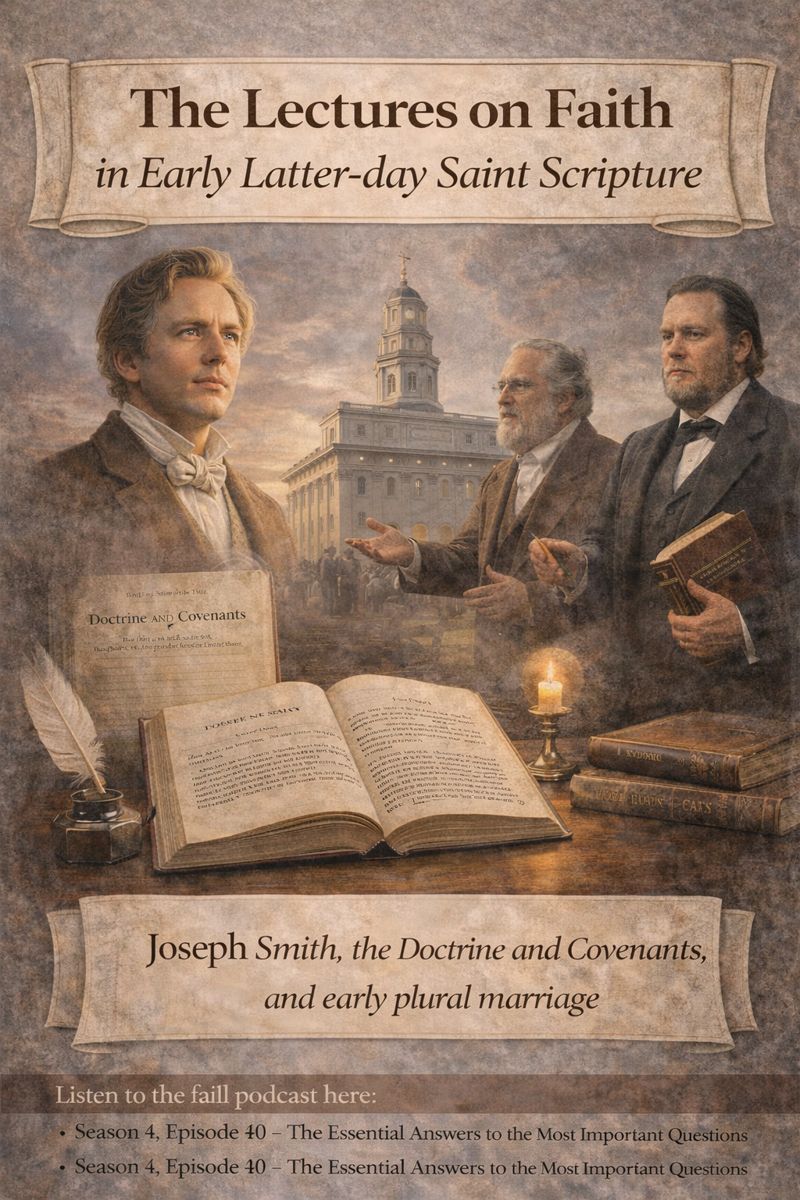
The Lectures on Faith in Early Latter-day Saint Scripture
When the Doctrine and Covenants first appeared in 1835, it contained two major parts: the “Doctrine,” which consisted of the Lectures on Faith, and the “Covenants,” a collection of revelations to Joseph Smith. The volume’s title page explained that its contents were “carefully selected from the revelations of God,” a phrase that signaled the editors’ awareness that not all previous revelations or teachings were being included, and that decisions were being made as part of the process of preparing a formal scriptural volume.
The authorship of the Lectures on Faith has been debated for generations. Joseph Smith, Oliver Cowdery, Sidney Rigdon, and Frederick G. Williams were named as compilers, and the preface uses the word “we,” indicating committee work. The lectures themselves had been delivered to a theological school in Kirtland, but the text does not identify who wrote each segment or who spoke the original material. Stylistic analysis points toward heavy editing before publication, and scholars have long differed on which figure—if any—should be considered the principal author. The Church’s position today is straightforward: the precise authorship of the Lectures on Faith is not definitively known.
Though deeply valued doctrinally, the Lectures did not remain part of the canon permanently. In 1921, a committee led by Elder James E. Talmage removed them from the Doctrine and Covenants. Their decision was rooted partly in the distinction between theological lessons and revelation. The lectures describe the Father as “a personage of spirit,” while later revelation—most notably Doctrine and Covenants 130:22 (1843)—teaches that the Father possesses “a body of flesh and bones.” To avoid doctrinal confusion, the lectures were relocated outside the scriptural canon. Even so, their influence endured. Teachings such as the oft-quoted declaration that a religion not requiring the sacrifice of all things cannot produce salvation continue to shape Latter-day Saint thought.
Charges That Joseph Smith Was “Removed” as Prophet
Among modern misunderstandings is a claim circulating online that Joseph Smith was killed because he failed to obey the command to practice plural marriage, and that he never actually practiced the principle at all. According to this argument, Brigham Young supposedly introduced plural marriage after the martyrdom and attributed it retroactively to Joseph. To assess such claims, historians rely not on speculation but on contemporary records, journals, official documents, and firsthand testimonies from the period.
Joseph Smith’s own history states that he received early knowledge of plural marriage in 1831—a point reflected in the heading to Doctrine and Covenants 132 and in statements by early leaders such as Orson Pratt. This understanding did not immediately lead to public practice, but it formed the basis of Joseph’s later actions.
The Relationship with Fanny Alger
A frequent point of debate concerns the early Kirtland-era relationship between Joseph Smith and Fanny Alger. Some online sources assert that Fanny’s name does not appear in any record until thirty years after Joseph’s death. This is incorrect. References to the relationship appear in sources from 1837—seven years after the events in question and long before Joseph’s death. While documentation is limited, the historical consensus among both Latter-day Saint and non-Latter-day Saint scholars is that Fanny Alger was Joseph Smith’s first plural wife.
Oliver Cowdery, during a period of estrangement from Joseph in 1838, wrote of a “scrape,” later overwritten as “affair,” though the original meaning of his comment remains uncertain. Oliver never claimed Emma told him anything about the matter, and no historical evidence supports that idea.
Plural Marriage Before and After the Kirtland Temple
The restoration of sealing authority in the Kirtland Temple in 1836 added complexity to later discussions. Not all marriages performed earlier could be retrospectively explained in terms familiar to later Latter-day Saints, since terminology for “marriage,” “sealing,” and “adoption” varied at the time. Crucially, plural marriages were performed among the Saints years before July 1843, when Doctrine and Covenants 132 was written by William Clayton at Joseph Smith’s dictation. Joseph stated that he had received the revelation earlier and recited it from memory.
Emma Smith’s opposition to plural marriage added emotional and spiritual strain to the process. Doctrine and Covenants 132 itself acknowledges her struggle and explains that Joseph was required to obey the command regardless of whether Emma accepted the principle. Nothing in the historical record supports the idea that Joseph’s prophetic calling depended on Emma’s acceptance.
Joseph Smith’s Public Denials and Their Legal Context
In 1844, under intense political and legal pressure, Joseph publicly stated that he could “only find one” wife. Historians understand this not as a denial of religious sealings but as a statement about civil marriage under Illinois law, which recognized only his union with Emma. Surviving journals—including those of William Clayton—along with the recorded testimonies of plural wives, demonstrate that Joseph believed he was obeying a divine command, even when the command could not be publicly explained.
Testimonies of the Plural Wives
Many women later affirmed their plural marriages to Joseph Smith. Eliza R. Snow, Lucy Walker, Melissa Lott, Zina Huntington, Emily and Eliza Partridge, and others described their experiences in affidavits, autobiographies, and legal testimony, especially during the Temple Lot Case in the 1890s. These accounts remain among the most important firsthand sources for understanding the practice. Modern DNA testing has eliminated some claims of biological descent, but such findings do not challenge the marriages themselves—only the assumption that a child must have resulted.
Brigham Young and the Continuation of Plural Marriage
Plural marriage was not Brigham Young’s invention; it was an established though limited practice under Joseph Smith. After the martyrdom, Brigham Young declared that it was a test of fellowship to believe that Joseph died a prophet in good standing. No contemporary leader expressed the idea that Joseph had been “removed” for disobedience. Instead, the Saints regarded his death as martyrdom and his life as faithful to the revelations he received.
Conclusion
The historical record shows clearly that the Lectures on Faith were a collaborative theological curriculum rather than revealed scripture, later removed from the canon to maintain doctrinal clarity. Likewise, the documentary record demonstrates that Joseph Smith taught and practiced plural marriage before his death, that multiple witnesses confirmed these practices, and that Brigham Young simply continued what Joseph had begun. Claims that Joseph was removed as prophet or that he failed to obey the Lord’s command find no support in contemporary evidence. Instead, Joseph Smith’s prophetic standing was repeatedly affirmed by those who lived closest to him and preserved in the documents of his time.
Listen to the full podcast here:
https://www.youtube.com/@standardoftruthpodcastllc
Season 4, Episode 30 – Lectures on Faith and Joseph Smith Removed as Prophet – Part 1
Season 4, Episode 31 – S4E31 Joseph Smith Removed as Prophet – Part 2