
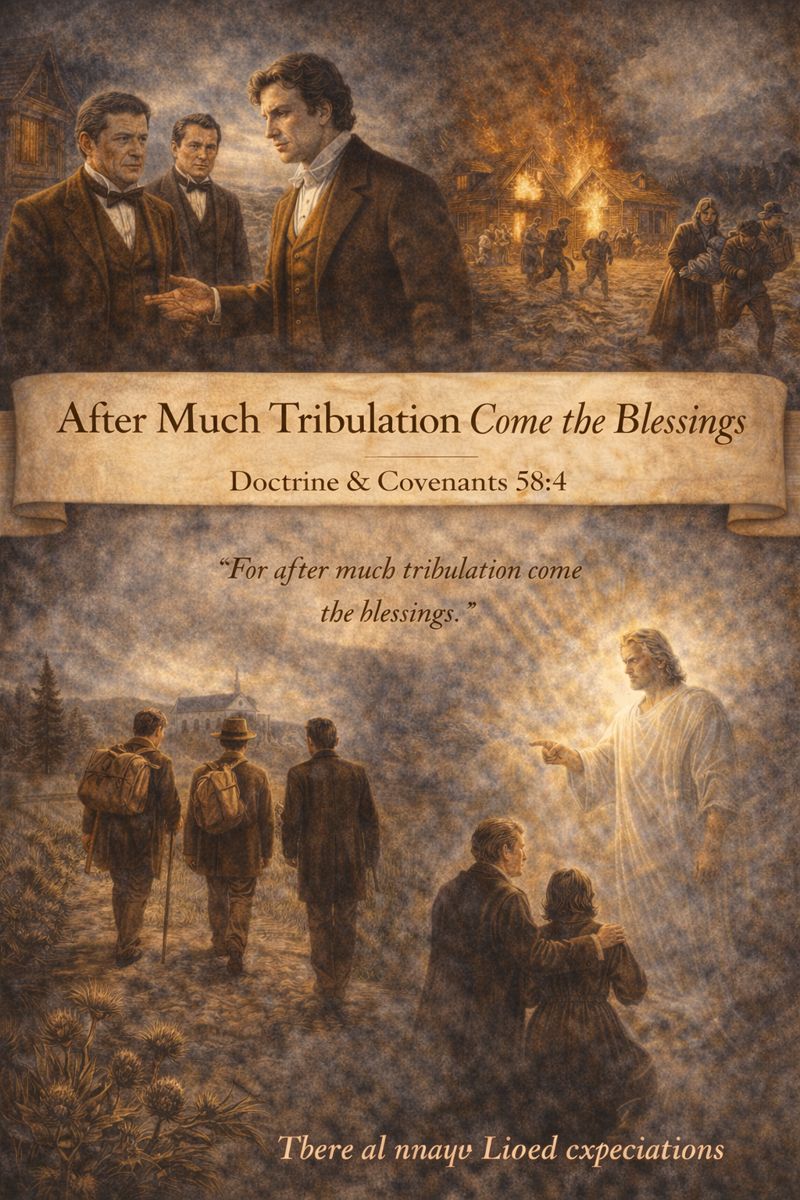
This article explores Doctrine and Covenants 58, revealed to Joseph Smith in August 1831 shortly after arriving in Independence, Missouri—the newly designated center place of Zion (D&C 57). Many elders expected Zion to be a thriving holy city, but instead found a small frontier settlement. Their disappointment created the need for this revelation, in which the Lord clarified expectations, corrected attitudes, and taught eternal principles about tribulation, agency, sacrifice, and Zion’s future.
The Purpose of Tribulation
Doctrine & Covenants 58:4 declares:
“For after much tribulation come the blessings; wherefore the day cometh that ye shall be crowned with much glory; the hour is not yet, but is nigh at hand.”
In this revelation, the Lord teaches that:
- Tribulation comes before blessings, not after.
- Mortality is not designed to provide immediate rewards for righteousness.
- Christianity teaches that ultimate glory is reserved for the next life.
- All injustice, loss, and suffering will be made right through the Resurrection.
- Faith requires focusing on eternal outcomes, not temporary setbacks.
The elders’ disappointment in Missouri was meant to refine their faith and correct expectations about the timing of God’s promises.
Zion Will Require Sacrifice
The Lord explains that the elders were sent to Missouri to:
- Show obedience
- Bear testimony
- Prepare the land
- Lay the foundation for the New Jerusalem
Although Missouri appeared unimpressive, God promised that the region would one day host the New Jerusalem, a gathering place for all nations before the great supper of the Lamb.
The Saints needed to understand that Zion would not be handed to them in a finished form—it would require sacrifice, labor, unity, and spiritual preparation.
Chastisement and Instruction for Leaders
The revelation contains specific corrections for two prominent leaders in Missouri.
Edward Partridge (Bishop)
- Had disputed Joseph Smith’s decisions about which lands to purchase
- Was rebuked for unbelief, blindness of heart, and failure to recognize his calling
- Was instructed to repent and faithfully act as a judge in Israel
W. W. Phelps
- Was corrected for pride and lack of meekness
- Was instructed to humble himself and fulfill his role properly
These corrections show that Zion’s establishment required humility and unity among its leaders.
“It Is Not Meet That I Should Command in All Things”
Verses 26–28 contain one of the most quoted passages in modern church discourse. The Lord explains:
- He will not give detailed instructions for every action
- Those who must be compelled are “slothful and not wise”
- Men and women are agents unto themselves
- They should be anxiously engaged in good causes
- Righteous initiatives undertaken voluntarily bring eternal reward
The Saints were expected to act with spiritual maturity, initiative, and personal responsibility rather than waiting for constant direction.
Mission Assignments and Preaching
Not all elders were meant to remain in Zion immediately. The Lord instructed some to:
- Return to their homes
- Preach the gospel along the way
- Strengthen the Church in various regions
The revelation made clear that the work of salvation must expand to all nations and that Zion would grow gradually.
Later Fulfillment: The Suffering in Missouri
Two years after this revelation, mob violence erupted in Jackson County. Many Saints were:
- Driven from their homes
- Beaten or attacked
- Forced to flee in winter
- Killed or left destitute
During this crisis, Joseph Smith wrote to Edward Partridge, quoting the revelation:
“After much tribulation cometh the blessing.”
In his letter, Joseph:
- Reaffirmed that Zion would eventually be redeemed
- Acknowledged that he did not know the timing or duration of Zion’s suffering
- Explained that the Lord instructed him: “Be still and know that I am God”
- Promised that all who suffer for Christ’s sake will reign with Him
- Declared that those who lose their lives for the gospel will receive them again
The tribulations in Missouri fulfilled the prophecy and reinforced its central doctrine: Zion requires sacrifice and patience.
Doctrinal Theme: Mortality as Preparation for Eternal Joy
Doctrine & Covenants 58 teaches that:
- Mortality includes unavoidable suffering, injustice, grief, and death
- These experiences refine the Saints and prepare them for celestial glory
- Through the Atonement of Jesus Christ, every wrong will eventually be made right
- Every earthly loss will be restored in a higher and eternal form
- Zion can only be established by a people who have been spiritually refined
The revelation encourages long-term, eternal perspective rather than immediate gratification.