
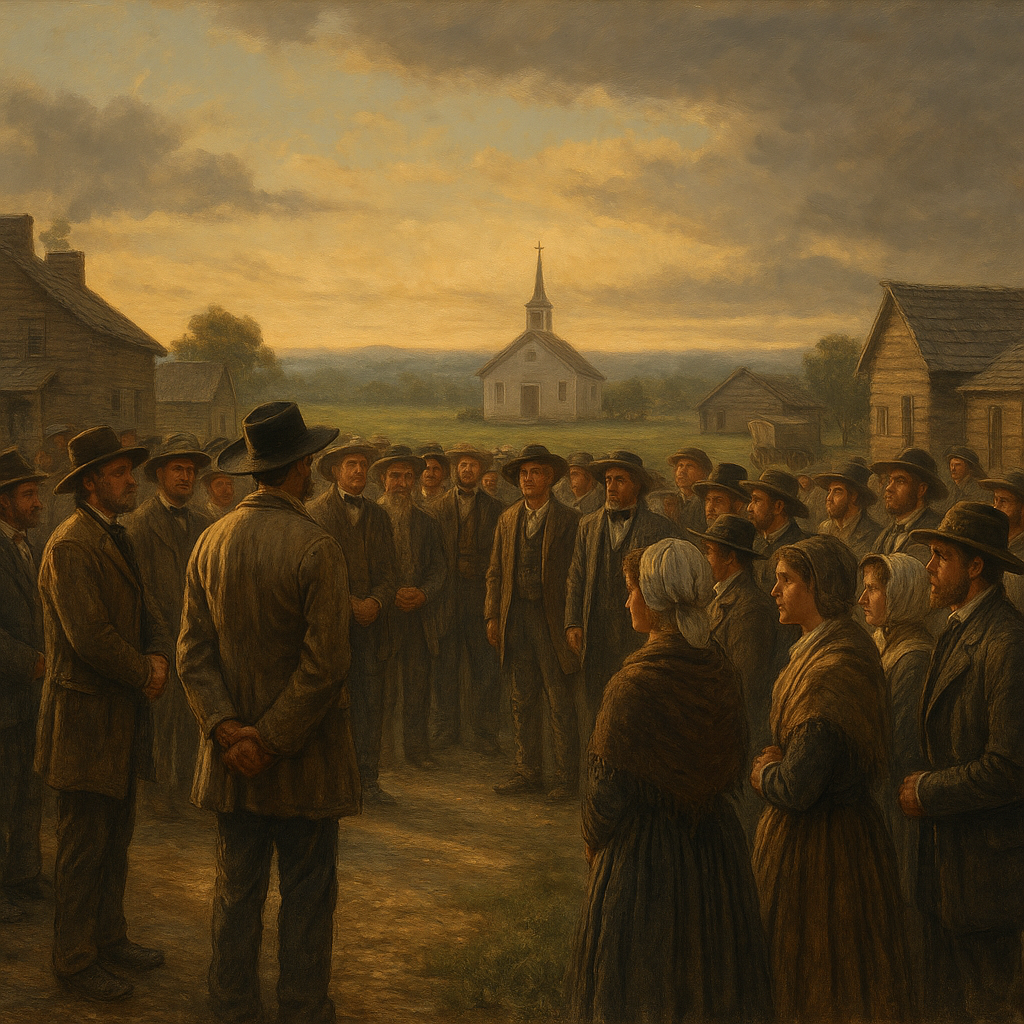
Scriptural Foundations for Zion
The idea of Zion emerged from biblical sources but took on a distinct meaning among early Latter-day Saints, who believed in a literal New Jerusalem to be built in preparation for the Second Coming of Jesus Christ. Passages in the Book of Mormon—including prophecies in Ether and 3 Nephi 21—described a future holy city on the American continent, built by a remnant of Israel assisted by believing Gentiles. From the earliest days of the Restoration, building Zion was viewed as a prophetic mandate central to gathering Israel.
Uncertainty About Zion’s Location
Following the organization of the Church, members sought to know where Zion would be established. Doctrine and Covenants 28 clarified that the location had not yet been revealed and rejected false revelations such as those claimed by Hiram Page. Later, Doctrine and Covenants 48 reaffirmed that the place of Zion was still unknown and would be revealed after Church members gathered in Ohio.
The Mission to Identify Zion
In October 1830, Oliver Cowdery, Parley P. Pratt, Peter Whitmer Jr., and Ziba Peterson entered a covenant to preach to Native Americans and to “rear up a pillar as a witness where the temple of God shall be built in the glorious New Jerusalem.” Their journey took them west to the border of Missouri, but legal restrictions prevented them from preaching in Indian Territory without a federal permit. This mission demonstrated that long before Zion’s location was revealed, early Saints were actively seeking it.
Revelations Describing Zion’s Society
Revelations in the early 1830s described Zion as a land of promise and inheritance, a community of economic equality with no rich or poor, patterned after the Zion of Enoch. It would be governed by the Lord, free from earthly kings, and serve as a refuge of holiness for the Saints. These teachings attracted converts hoping for a united, righteous society.
The Revelation of Zion’s Center: Missouri (1831)
In June 1831, elders were called by revelation to travel to Missouri. In July 1831, Doctrine and Covenants 57 identified Independence, Missouri, as “the center place” of Zion. The revelation specified:
- Independence was the land of promise for the gathering of the Saints.
- The temple lot lay west of the courthouse.
- Saints were to purchase land in the region.
At the time, Jackson County was the western edge of the United States, bordering Indian Territory.
Initial Reactions to Jackson County
Many Saints expected a prepared or even miraculously refined location for Zion. Instead, they found a rough frontier settlement with gambling halls, saloons, and minimal development. This mismatch between expectation and reality caused disappointment and contributed to early apostasy.
Ezra Booth: A Case of Disillusionment
Ezra Booth, a former Methodist minister educated in Greek, converted because of the promises associated with Zion. After the difficult journey to Missouri and encountering harsh frontier conditions, he became disillusioned. His later apostasy had significant impact because he wrote nine letters condemning Mormonism, which were widely circulated and reprinted in Mormonism Unvailed (1834).
Booth claimed he had been deceived by emotional influence and that Zion did not match expectations. He misrepresented the Three Witnesses’ experience and later moved between religious movements before abandoning organized religion.
Edward Partridge’s Struggles and Faithfulness
Edward Partridge, the Church’s first Bishop and a respected Ohio businessman, also wrestled with the revelation. He had left his sick family to travel to Missouri amid ridicule from neighbors who believed he had been deceived. Although he struggled with the frontier revelation, he remained faithful and later endured severe persecution, including mob violence and physical abuse in Missouri.
Migration and Administrative Challenges (1831–1833)
Between 1831 and 1833, hundreds of Saints migrated to Jackson County. Growing numbers led to tension both with Missourian settlers and between Missouri Saints and Church leaders in Ohio. Communication delays of two to four months caused misunderstandings and administrative concerns.
A March 1832 conference in Ohio reviewed Missouri administrative decisions and corrected procedural errors, including the improper use of a moderator instead of Bishop Partridge to preside over a conference.
Tension Between Leaders
Phelps and Joseph Smith
William W. Phelps, assigned to run Church printing in Missouri, expressed frustration in a letter to Joseph Smith. Joseph replied in July 1832, addressing several issues:
- He excused the cold tone of Phelps’s previous letter.
- He warned against alarming outsiders by making reckless claims about Indians rising up.
- He instructed Phelps not to alter wording when typesetting revelations.
- He explained why original copies of revelations could not be immediately sent to Missouri.
- He emphasized unity, caution, and sensitivity to local tensions.
This correspondence reveals Joseph’s awareness of growing internal strain and external threats.
The Evening and Morning Star Newspaper
Phelps established The Evening and the Morning Star, the Church’s first official periodical. It published revelations, doctrine, and instructions. The name referenced Revelation 22:16, where Christ identifies Himself as the “bright and morning star.” The publication attracted attention from both supporters and critics, contributing to rising tension with Missourians.
Cultural and Social Conflict with Missourians
As more Saints arrived, cultural differences grew. Many Missourians were descendants of southern migrants, whereas most Saints came from New England or the northern United States. Differences in religion, politics, social customs, and economic behavior heightened suspicion.
The Saints’ belief in building Zion and their communal ideals deepened local anxiety. Missourians increasingly feared that Latter-day Saints intended to dominate the region politically and socially.
Rising Tensions Leading Toward Conflict
By 1833, hostility had escalated. Saints were viewed as outsiders who threatened established settlements. Their rapid immigration, religious unity, and beliefs regarding Zion appeared to challenge political and cultural authority in Jackson County. These tensions soon erupted into mob violence, destruction of property, and the forced expulsion of the Saints from their designated Zion.
Zion’s Central Role in Early Church History
The revelation that Independence, Missouri, was Zion shaped missionary work, migration patterns, settlement choices, and theological expectations. It also contributed to some of the most intense conflicts in early Church history. The determination of early Saints to build a literal Zion—despite poverty, persecution, and opposition—defined much of their experience in Missouri and played a key role in shaping the future of the Restoration.
Listen to the Full Podcast
https://www.youtube.com/@standardoftruthpodcastllc