
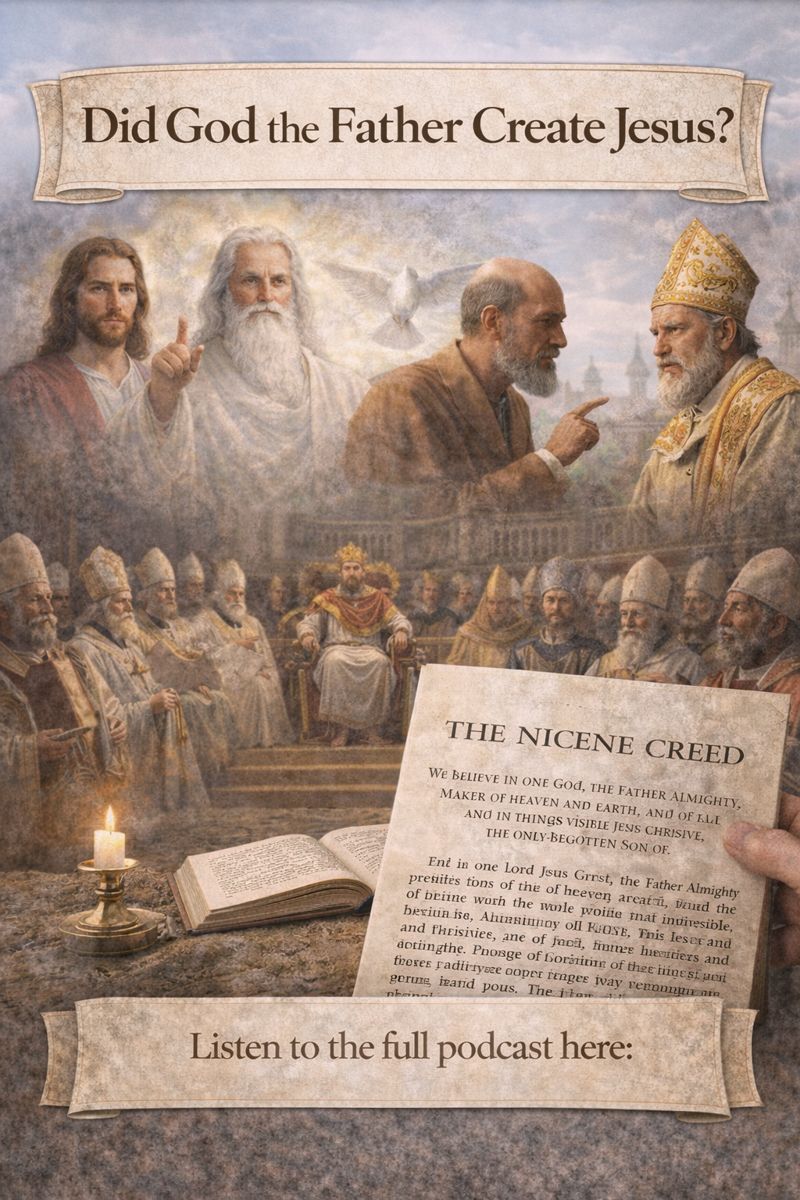
Did God the Father Create Jesus?
Introduction
This episode explores one of the most consequential theological debates in Christian history: the Arian Controversy. Long before Joseph Smith prayed in the woods of upstate New York, Christians had wrestled for centuries over the identity of Jesus Christ and His relationship to God the Father. The dispute between Arius and Athanasius in the early fourth century shaped the doctrinal landscape that later confronted the young boy-prophet during the Restoration. To understand why the First Vision contradicted traditional Christianity so sharply, one must first understand the theological world produced by Nicaea.
Competing Early Christian Views of Jesus
In the first two centuries after the New Testament, Christians lacked an official, unified doctrinal tradition. Communities scattered throughout the Roman world argued passionately about Christ’s nature, the afterlife, salvation, and scripture. Groups such as the Ebionites, Docetists, and several varieties of Gnostics offered conflicting portrayals of Jesus. Some saw Him primarily as a human prophet; others denied He had a physical body; still others believed He came to impart hidden, esoteric knowledge rather than to atone for sin.
Egypt, and especially the intellectual hub of Alexandria, became an incubator for many of these ideas. Philosophers and Christian theologians debated endlessly about whether Jesus was divine, how He related to the Father, and how salvation operated. By the early 300s, Alexandria was a cauldron of competing theological schools, and it was in this setting that a presbyter named Arius entered Christian history.
Arius and the Rise of Arianism
Arius taught that God the Father alone was truly eternal and uncreated, and that Jesus Christ, though exalted above all creation, was nevertheless a created being. According to Arius, there had been a time when the Son did not exist, even if that time lay beyond all human comprehension. The Son, he argued, was “begotten,” meaning He was brought into existence by the Father and thus subordinate to Him forever.
Arius’s ideas spread rapidly. His theology appealed both to Christians influenced by Greek philosophical hierarchies and to pagans transitioning into Christianity, for whom the idea of divine beings of various ranks seemed natural. His teaching also used scriptural language that appeared, on the surface, to support his claims—especially the New Testament descriptions of Christ as “begotten.”
Athanasius and the Defense of Co-Eternal Divinity
In opposition to Arius stood a young Alexandrian theologian named Athanasius. Athanasius insisted that the Son had no beginning, that He was eternally begotten, and that His divine nature was the same as the Father’s. If Christ were a created being, Athanasius argued, He could not fully reveal the Father, nor could He truly save humanity. For Athanasius, the unity of God required the full and eternal divinity of both Father and Son.
The central idea of Athanasius’s theology was that the Father and the Son are of the same substance—homoousios in Greek. To deny this equality was, in his view, to compromise the very heart of Christianity.
Constantine and the Council of Nicaea
The escalating dispute threatened Christian unity at a politically sensitive moment. Emperor Constantine, newly sympathetic to the Christian faith, feared that division within the Church could destabilize his empire. In 325 AD, he summoned bishops from across the Christian world to the city of Nicaea.
At the Council of Nicaea, the bishops debated fiercely but ultimately rejected Arianism. The resulting Nicene Creed proclaimed that Jesus Christ is “begotten, not made,” and is “of one substance with the Father.” The creed condemned Arian statements such as “there was a time when he was not” and “the Son is of a different substance.”
This marked the beginning of what would become orthodox Trinitarian Christianity: one God in three co-eternal persons—Father, Son, and Holy Spirit.
Later Developments in Trinitarian Theology
Although Nicaea established the foundation of the Trinity, the doctrine required later refinement. Additional councils at Constantinople, Ephesus, and Chalcedon clarified the nature of Christ’s humanity and divinity, the personhood of the Holy Spirit, and the unity of the divine essence. Meanwhile, other theological options—such as Modalism, which portrayed God as a single being appearing in different modes, and Patripassianism, which claimed the Father suffered on the cross—were rejected because they erased the distinctions among the three divine persons.
By the time of the Middle Ages, Trinitarian orthodoxy had become universal across Catholicism and, later, Protestantism. The theology of Nicaea shaped all subsequent Christian liturgy, creeds, and scriptural interpretation.
The Restoration and the Nicene Legacy
When Joseph Smith entered the Sacred Grove in the spring of 1820, this Trinitarian tradition had been dominant for nearly seventeen centuries. Every major Christian denomination—whether Catholic, Anglican, Lutheran, or Methodist—affirmed the creeds of Nicaea and Athanasius. According to these creeds, God was immaterial, incorporeal, and of a single essence shared equally by Father, Son, and Spirit.
The First Vision directly contradicted this theological inheritance. Joseph Smith saw two distinct personages, each with a body, each fully divine, and each separate in identity and being. For Christians grounded in Nicene doctrine, such a claim was necessarily heretical. For the Restoration, however, it represented the return of ancient truth: God the Father and His Son Jesus Christ are separate, glorified beings united not in substance but in purpose, love, and divine authority.
Thus, the Arian controversy and the Nicene settlement explain why Latter-day Saint teachings sound so foreign—and so radical—within traditional Christianity. They are not minor theological disagreements but a fundamental redefinition of the nature of God.
Listen to the full podcast here:
https://www.youtube.com/@standardoftruthpodcastllc
Season 4, Episode 21 – The Arian Controversy: Did God the Father Create Jesus? (former JSR content)