
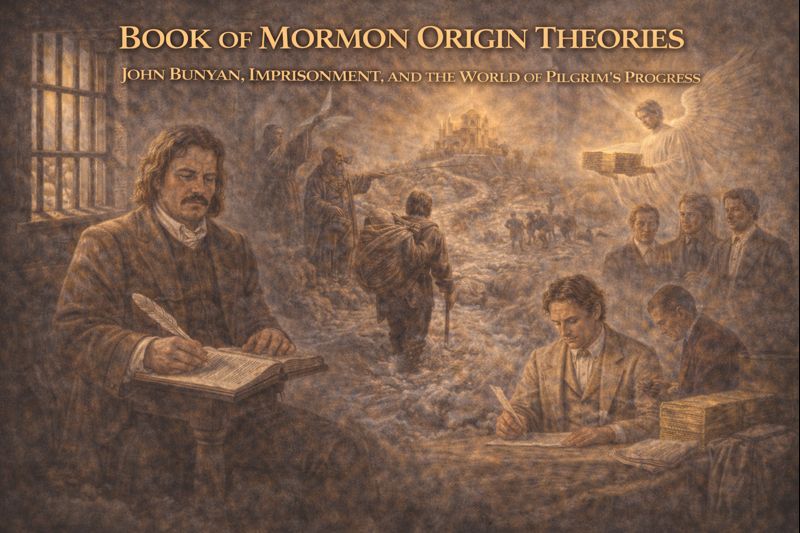
John Bunyan, Imprisonment, and the World of Pilgrim’s Progress
John Bunyan lived during the upheaval of the English Civil War and the restored monarchy that followed. A Puritan soldier and later a non-conformist preacher, Bunyan refused to accept the Church of England as the state religion. For this he spent twelve years in prison under the reign of Charles II. During this confinement he began writing The Pilgrim’s Progress, which would become one of the most influential works of English Christian literature.
Bunyan’s allegory unfolds as a dream, guiding the character Christian from the “City of Destruction” toward the “Celestial City.” The narrative uses symbolic names—Evangelist, Obstinate, Pliable, Worldly Wiseman—to illustrate temptations, virtues, and the Christian journey. Because The Pilgrim’s Progress is so prominent in Protestant culture, some modern critics have suggested it influenced the Book of Mormon.
The proposed parallels are limited largely to general Christian motifs:
the phrase “I dreamed a dream,”
the idea of a journey toward a divine destination,
and the presence of spiritual trials.
Yet these are neither unique nor original to Bunyan. The phrase itself appears extensively in the Bible—Joseph’s dreams in Genesis, Daniel’s visions, and prophetic writings throughout the Old Testament. No meaningful correspondences exist in narrative structure, names, geography, chronology, or doctrinal content. For this reason historians find no evidence that The Pilgrim’s Progress shaped the Book of Mormon in any identifiable way.
Oral Composition Theories and Their Historical Problems
A modern theory argues that Joseph Smith created the Book of Mormon by orally re-working themes from earlier English literature. But this requires assuming that he memorized hundreds of pages from multiple works, dictated day after day without a manuscript, and maintained perfect internal consistency—all while leaving no evidence that he rehearsed or read from notes.
Such a proposal conflicts with every contemporary account from scribes and observers. They consistently reported that Joseph dictated with his face in a hat containing the seer stone, consulting no manuscript or notes. When dictation paused—sometimes for meals or overnight—he resumed immediately without reviewing prior material. Draft pages bear no evidence of copied text.
If Joseph had composed a 500-plus-page narrative from memory, one would expect:
evidence of planning,
written outlines,
hidden manuscripts,
or witnesses describing lengthy recitation.
Instead, the surviving record uniformly portrays spontaneous dictation in the presence of others, with scribes often struggling to keep pace.
The Persistent Physicality of the Plates
The theory of literary influence does not address the foundational historical claim of the Restoration—the existence of the plates. More than a dozen men testified that the plates were real.
The Eight Witnesses described lifting them, turning their leaves, feeling the weight of the metal, and assessing their texture with their hands. The Three Witnesses testified that an angel presented the plates and that the voice of God declared the translation correct. Even after separating from the Church—some in deep conflict with its leaders—none retracted their testimony of what they saw.
Any theory that the Book of Mormon arose solely from Joseph Smith’s imagination must also account for the independent testimonies of these witnesses, whose statements were consistent, public, and lifelong.
A Pioneer Rescue and Brigham Young’s Sacrifice
The discussion turns from book-origin theories to a moment later in Latter-day Saint history, during the westward migration. After leading the first company into the Salt Lake Valley, Brigham Young and several men returned eastward to assist later groups still on the trail. They expected to encounter all companies traveling from Winter Quarters, but one—Jedediah M. Grant’s company—was missing.
Grant’s group had suffered a disastrous stampede that scattered their oxen. Weeks were spent searching, and without enough draft animals their progress nearly stopped. When Brigham Young’s returning party finally found them, winter storms had already begun in the Wyoming mountains. On the very day they arrived, an Indigenous raid drove off the last of Grant’s remaining animals.
Realizing the urgency, Brigham Young ordered his own men to surrender their horses so that Grant’s company could continue west. The rescuers then made the long return to Winter Quarters on foot, enduring early snows, but saving the stranded company from likely catastrophe.
This episode illustrates the deep mutual sacrifice that marked the early Latter-day Saint migration and offers a contrasting example of historical reality beside conjectural theories about the Book of Mormon’s origins.
Listen to the full podcast here:
https://www.youtube.com/@standardoftruthpodcastllc
Season 4, Episode 33 – Theory for the Origin of the Book of Mormon