
Introduction
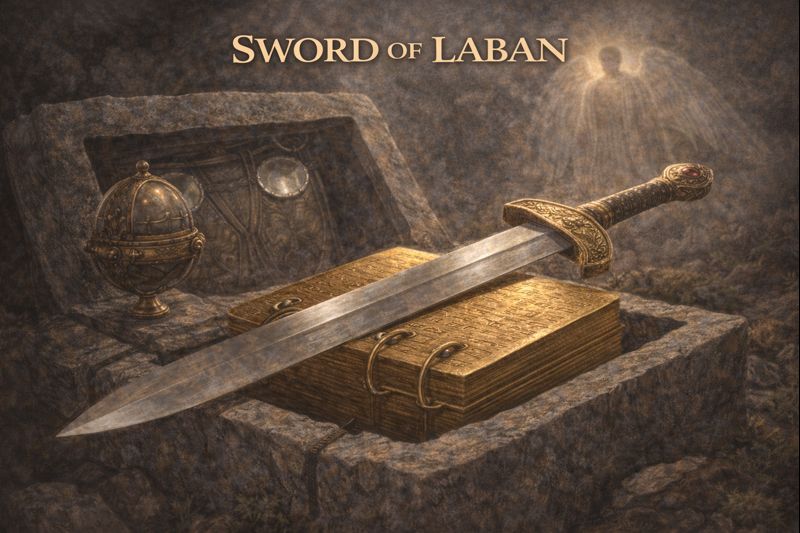
The sword of Laban is one of the most iconic artifacts mentioned in the Book of Mormon. While modern Latter-day Saints often associate it with visionary experiences reported by early Church leaders, its historical role begins in Nephi’s narrative and extends through centuries of Nephite history. This episode explores what can be known from scripture, early sources, the Three Witnesses’ vision, and later Latter-day Saint tradition.
The Sword of Laban in the Book of Mormon Record
The earliest references to the sword appear in 1 Nephi, where Nephi describes retrieving it after the slaying of Laban in Jerusalem. Nephi later forged other swords “after the manner of the sword of Laban” to defend his people. The weapon thus represents both the divine deliverance of Nephi’s family and the military defense of the Nephite nation.
As with the Liahona, breastplate, and interpreters, the sword of Laban was preserved as a sacred relic by Nephite record-keepers. It appears repeatedly in the Book of Mormon as a symbol of divine intervention and national identity.
The Hill Cumorah Box: What Joseph Smith Reported Recovering
When Joseph Smith described obtaining the plates in 1827, he consistently listed three items inside the stone box:
The gold plates
The breastplate
The interpreters (Urim and Thummim)
Notably absent from Joseph’s firsthand accounts are the sword of Laban or the Liahona. Joseph’s official history (now in the Pearl of Great Price) and the 1842 Wentworth Letter both reiterate that only these three objects were physically retrieved.
Doctrine and Covenants 17 and the Witnesses
The revelation to the Three Witnesses (D&C 17) expands the list of sacred objects they were promised to see by divine means:
The plates
The breastplate
The interpreters
The sword of Laban
The Liahona (“the miraculous directors”)
The canonical testimony of the Three Witnesses in the published Book of Mormon mentions seeing the angel, the plates, and the engravings, but does not list the other items. This brevity reflects the formal wording prepared for publication, not the full extent of their visionary experience.
David Whitmer’s Expanded Accounts
Throughout his later life, David Whitmer gave several interviews describing the vision. In these accounts the angel displayed multiple Nephite artifacts arranged on a table:
The plates
The interpreters
The Liahona
The sword of Laban
Whitmer also said that after the angel removed the artifacts, the witnesses were shown—again by divine power—a representation of a chamber where the plates had been kept.
Although these details appear in interviews decades after the event, they are consistent across Whitmer’s numerous retellings.
The Cumorah Cave Tradition
A second stream of Latter-day Saint tradition comes from later recollections of early Church leaders. In a well-known sermon, Brigham Young reported that Oliver Cowdery had described a visionary experience in which he and Joseph Smith were shown a large repository of Nephite records inside a cave in the Hill Cumorah. Young stated that in this vision:
The sword of Laban hung on the wall
Later, the sword lay across the plates
An inscription declared the sword “will never be sheathed again until the kingdoms of this world become the kingdom of our God”
Other early leaders, including Heber C. Kimball, gave similar secondhand affirmations of this account. These recollections place the sword not in Joseph’s physical possession but in a heavenly or visionary context associated with angelic guardianship.
Did Joseph Smith Ever Possess the Sword?
There is no historical evidence that Joseph Smith ever physically handled the sword of Laban. Every reliable source places the sword:
In visionary scenes
In angelic custody
As part of the sacred artifacts shown to witnesses by divine means
A late reminiscence by Katherine Smith Salisbury (1886) states that Joseph told the family he had seen the sword, the brass plates, and other objects at the hill. Her account is decades after the fact and describes Joseph seeing, not retrieving, the artifacts.
Symbolism and Theological Meaning
Latter-day Saint tradition frequently interprets the sword as symbolic:
A tangible token of Book of Mormon historicity
A reminder of Nephite covenant identity
A sign of divine justice and protection
An emblem of the Lord’s involvement in preserving sacred records
For the Three Witnesses, and for many believers today, the sword functions as a material link to an ancient people whose record was brought forth for the last days.
Current Status of the Artifact
No known physical location—within Church possession or elsewhere—holds the sword of Laban. Latter-day Saint tradition maintains that such relics remain under angelic care and will be revealed again only in a future divine context.
Conclusion
The sword of Laban occupies a unique place in Restoration memory: a Nephite artifact not physically recovered by Joseph Smith, yet deeply embedded in the visionary experiences of early witnesses. Through scripture, eyewitness accounts, and later tradition, the sword stands as a symbol of the reality of the Book of Mormon, the preservation of sacred history, and God’s hand in the Restoration.