
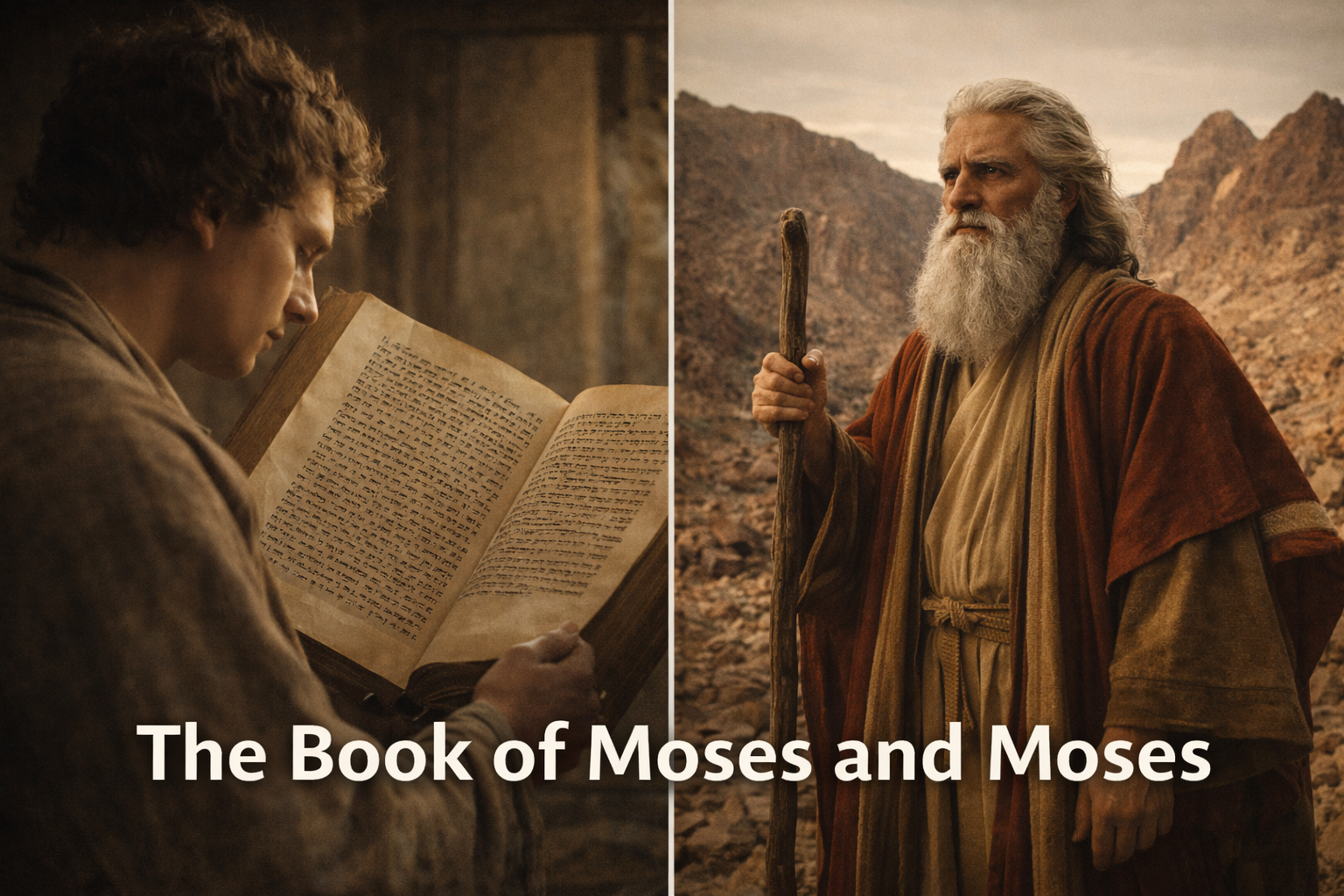
This episode focuses on the Book of Moses, especially Moses 1, as a key early revelation in the history of The Church of Jesus Christ of Latter-day Saints and in Joseph Smith’s doctrinal development.
Historical Context and Dating of Moses 1
The Book of Moses comes from Joseph Smith’s early work revising/“translating” the Bible (later called the Joseph Smith Translation).
Moses 1 (sometimes called “The Visions of Moses”) was originally a stand-alone revelation, not just an edited Bible passage.
The earliest manuscript heading for Moses 1 reads:
“A Revelation given to Joseph the Revelator June 1830.”
So the text is dated June 1830.
Timeline Around the Revelation
- March 1830 – Book of Mormon is published.
- 6 April 1830 – The Church of Christ (later Church of Jesus Christ of Latter-day Saints) is organized.
- June 1830 – Joseph receives the Moses 1 revelation.
Church Organization at the Time
At this point in church organization:
- No bishop yet (first bishop called February 1831).
- No quorum of the Twelve Apostles (organized 1835).
- No developed doctrine yet on Zion’s location, degrees of glory (D&C 76, 1832), or eternal intelligences (D&C 93, 1833).
In other words, Moses 1 is one of the very earliest and most theologically expansive revelations of the Restoration.
Nature of the Text
Moses 1 is presented as a visionary experience of the prophet Moses, given after the narrative of the burning bush but before the biblical Exodus story.
In the early manuscripts it is explicitly labeled a revelation to Joseph Smith, not merely an editorial gloss on the King James Bible.
Doctrinal Textual Connections
It introduces themes and vocabulary that will later reappear in:
- Doctrine and Covenants 76 (vision of the degrees of glory)
- Doctrine and Covenants 93 (man as the same “species” of being as God, premortal existence)
Main Doctrinal / Conceptual Content (Descriptive)
From a historical-doctrine perspective, Moses 1 contains several distinctive ideas.
Moses’ Vision of God and Humanity
Moses is “caught up into an exceedingly high mountain” and sees God face to face.
God calls Moses “my son” and tells him he is in the “similitude” of the Only Begotten.
Moses sees the earth and “the ends thereof” and all the children of men which are and which were created on this earth.
Encounter with Satan
After God’s presence withdraws, Satan appears and commands Moses to worship him.
Moses distinguishes between God and Satan by glory: he has experienced divine glory and notes Satan has none.
Satan rages and “rants upon the earth” until Moses, invoking “the name of the Only Begotten,” finally commands him to depart.
The narrative presents Satan as a real, personal being with influence, not just a metaphor for evil.
Multiple Worlds and “Worlds Without Number”
God shows Moses not only this earth but “many lands,” each called “earth,” with inhabitants on them.
God states:
- There are “many worlds that have passed away” and “many that now stand.”
- They are “innumerable unto man,” but “all things are numbered” to God, “for they are mine and I know them.”
This introduces a cosmology of multiple inhabited worlds, far beyond typical early-19th-century American Protestant teaching.
Scope of the Revelation Limited to This Earth
God tells Moses that only an account of this earth and its inhabitants will be given to him, even though many other worlds exist.
The narrative thereby explains why scripture deals primarily with this planet’s history, despite acknowledging a much larger creation.
Statement of Divine Purpose: Moses 1:39
After describing God’s creations and the multiplicity of worlds, God declares:
“For behold, this is my work and my glory—to bring to pass the immortality and eternal life of man.”
Historically, this becomes a foundational Latter-day Saint statement about the purpose of God and creation.
Historical–Theological Significance
Radicality for 1830
In 1830 American Protestantism, the dominant view was:
- Creation ex nihilo (God created all things out of nothing).
- A single created world, with other worlds or species only rarely and speculatively discussed.
- Humanity as creatures of God, but not usually framed as being in the same “similitude” or order of being as the Only Begotten in the sense later LDS theology would develop.
Moses 1 diverges from that by:
- Positing multiple inhabited worlds.
- Emphasizing humans as children of God in a strong sense.
- Presenting God’s primary “work and glory” as exalting humanity, not simply displaying divine power.
Place in the Development of Latter-day Saint Doctrine
Moses 1 anticipates later teachings in:
- D&C 76 (1832) – vision of degrees of glory and expanded post-mortal cosmology.
- D&C 93 (1833) – humans and Christ as eternal intelligences, same “type” of being as God.
- Later discourses such as the King Follett Sermon (1844) on the nature of God and humans.
Historically, Moses 1 shows that expansive LDS cosmology and anthropology began emerging very early—within months of the Church’s organization and well before more formal doctrinal expositions.
Distinct View of Satan in Latter-day Saint Thought
While some modern Christian groups have increasingly interpreted Satan symbolically, Moses 1 (and Joseph Smith’s own earlier First Vision accounts) present Satan as a literal personal adversary.
This becomes characteristic of Latter-day Saint teaching about a premortal rebellion and a personal devil.