
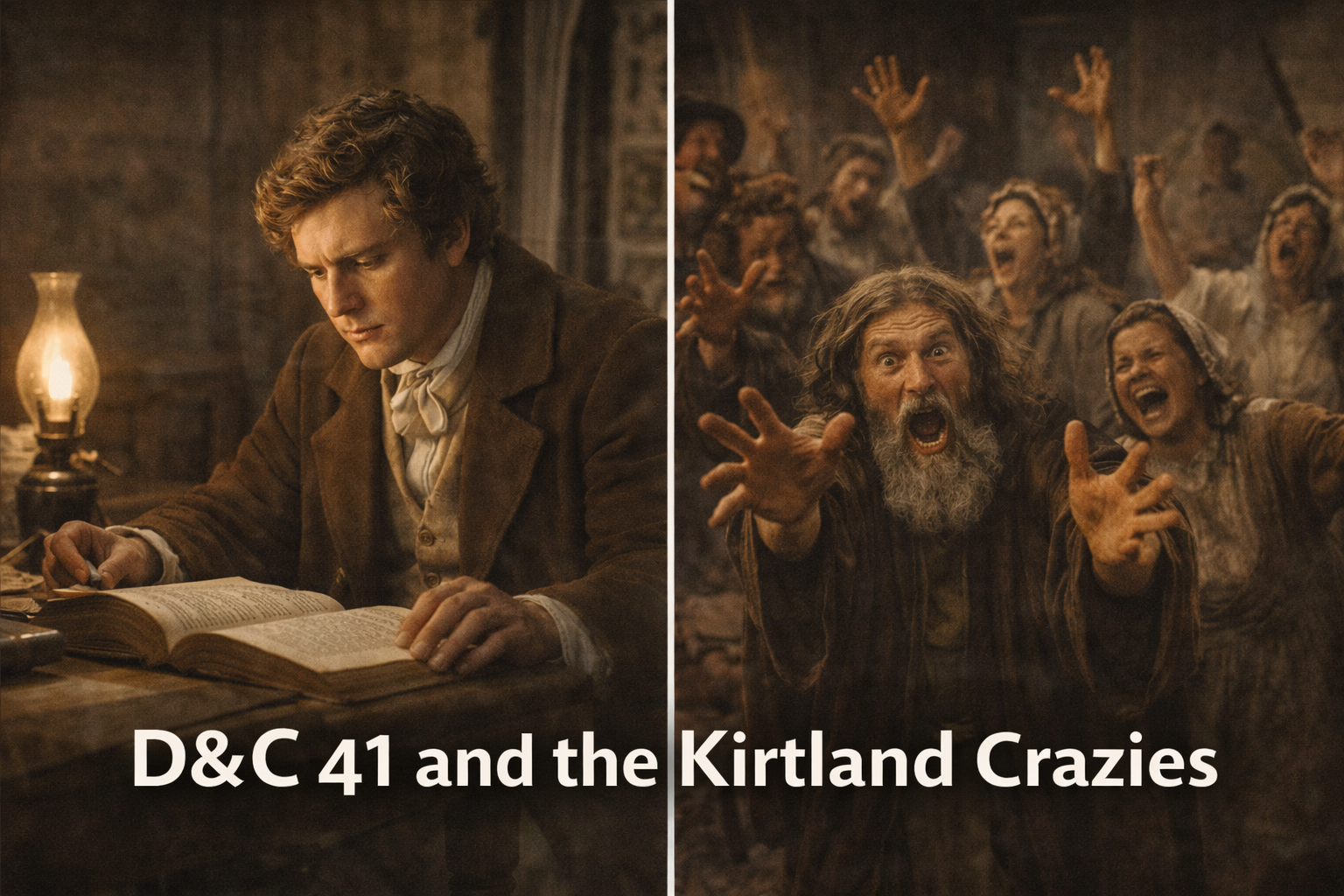
This historical extract discusses early developments in the Church of Jesus Christ of Latter-day Saints in early 1831, focusing on the context and content of Doctrine and Covenants 41, the first revelation Joseph Smith received after relocating to Kirtland, Ohio.
Missionaries Arrive in Kirtland and Convert Sidney Rigdon (Late 1830)
Missionaries preaching to Native Americans passed through Kirtland, Ohio, where they taught Sidney Rigdon, a prominent Campbellite minister.
Rigdon and 100–200 members of his congregation were baptized within weeks.
At this time, Church membership in New York totaled only about 150, so the Kirtland group instantly doubled the size of the Church.
Command to Migrate from New York to Ohio (D&C 37–38)
Joseph Smith received revelations commanding the New York Saints to move to Ohio.
This required major sacrifice:
- Saints abandoned homes, farms, and property.
- Many properties could not be sold quickly or at full price.
- Property ownership in early 19th-century America was central to social and economic identity.
The migration was a profound upheaval for the Saints.
Edward Partridge’s Conversion and Role
Edward Partridge, a respected hat-maker and businessman in Ohio, was initially skeptical.
He traveled to New York to meet Joseph Smith.
After speaking with Joseph, Partridge was baptized and returned to Ohio, quickly becoming a key leader among the new converts.
Joseph Smith Relocates to Ohio (Early 1831)
Doctrine and Covenants 41
Joseph arrived in Kirtland in early 1831.
On February 4, 1831, he received Doctrine and Covenants 41, which:
- Called Edward Partridge to be the first bishop of the Church.
- Commanded him to “leave his merchandise” and devote himself fully to Church service.
This calling came before any detailed instructions about the office existed.
Five days later, Doctrine and Covenants 42 (“the Law”) defined:
- consecration
- stewardship
- Partridge’s responsibilities in receiving and distributing property
Disorder Among the Ohio Converts (“Kirtland Crazies”)
When Joseph arrived, the Ohio branches were experiencing problems due to:
- rapid influx of converts
- the absence of organized leadership
- missionaries leaving quickly to continue their preaching
Historical accounts from John Whitmer, Levi Hancock, and Parley P. Pratt describe:
- visionary claims
- ecstatic behavior
- claims of angelic manifestations
- visions of crowns and parchment inscriptions
They also report dramatic physical acts:
- sliding on floors
- contorting bodies
- hanging or swinging from rafters
- shouting and shaking
Church leaders identified these as false spiritual manifestations that required correction.
The Original Context of Doctrine and Covenants 41
Modern headings connect D&C 41 with the issue of “false spirits.”
However, the earliest manuscript heading (Book of Commandments and Revelations, 1831) shows the actual context:
- Leman Copley, a recent Shaker convert, offered Joseph Smith and Sidney Rigdon housing on his large farm in Thompson, Ohio.
- Joseph inquired of the Lord about whether to move Church operations there.
- D&C 41 instructed Joseph not to relocate to Thompson but to remain in Kirtland.
Why This Mattered
A few months later:
- Leman Copley left the Church.
- He expelled Saints settling on his land under consecration.
If Church headquarters had moved to Thompson, the consequences would have been severe.
Remaining in Kirtland was crucial.
Edward Partridge Sent to Missouri (Mid-1831)
Doctrine and Covenants 52 called Edward Partridge to travel to Missouri to help identify the future gathering place.
Despite hardships, he obeyed:
- His household contracted measles after taking in new converts.
- His wife, Lydia Partridge, recorded how difficult it was for him to leave while their children were ill.
Joseph Smith’s Efforts to Correct Doctrinal Errors (1831)
Throughout 1831, Joseph Smith worked to:
- correct false teachings
- regulate spiritual practices
- establish order in the Ohio branches
Joseph wrote to Hyrum Smith that:
“The devil had made many attempts to overthrow” the new branches,
and correcting the disorder had been
“a serious job.”