
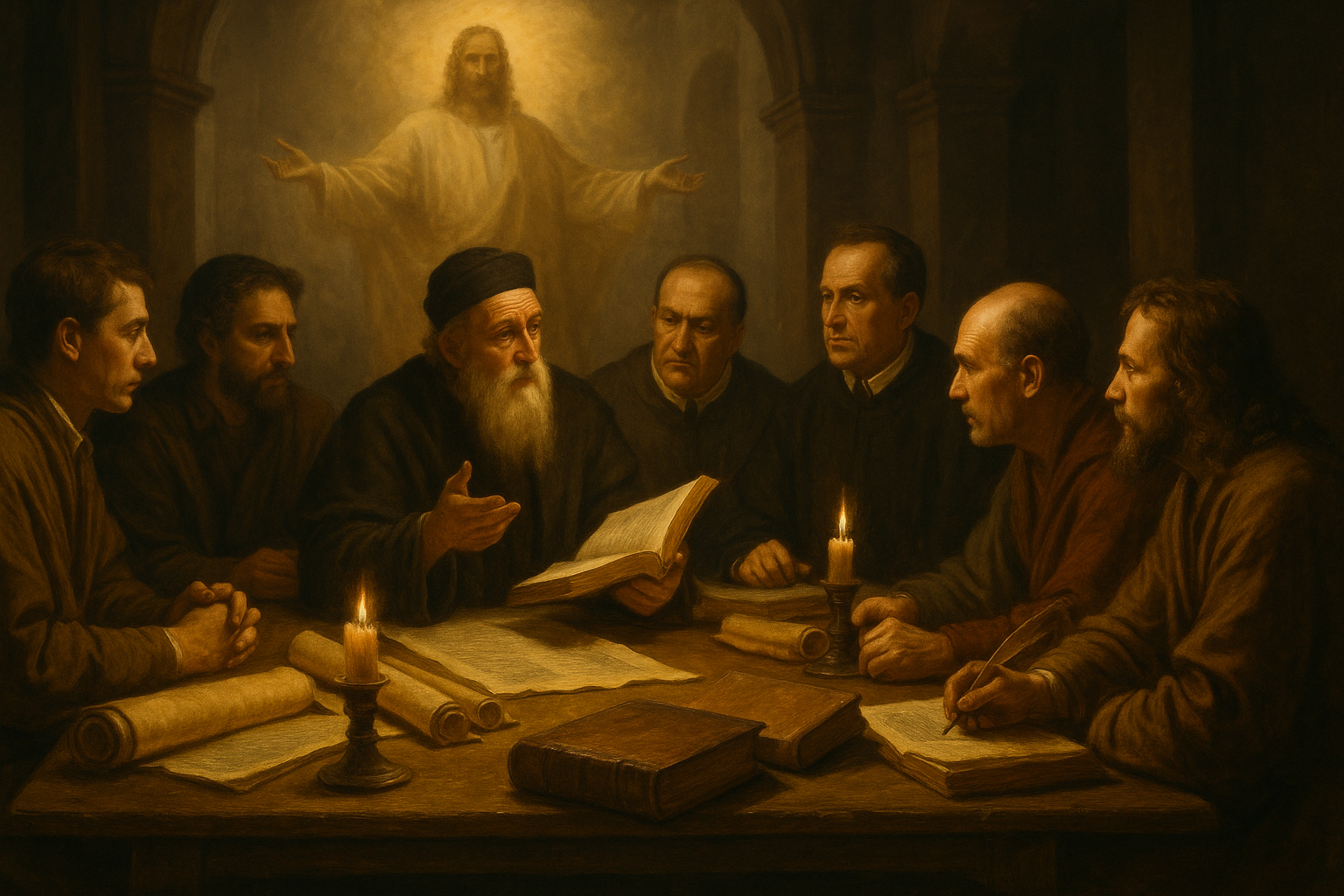
D&C 93 and the Nature of God – Part 1
Early Christian Context: Monotheism and the Nature of Christ
Judaism in the time of Jesus was distinguished from surrounding pagan religions primarily by monotheism. Pagan religions accepted many gods; Judaism rejected the existence of other gods entirely. This strict monotheism created a theological problem for early Christians once they claimed that Jesus was divine.
If God the Father is God, and Jesus is also declared to be God, this raises the question:
How can Christianity remain monotheistic?
Early Christians struggled to reconcile:
- Jesus’ divinity
- Jesus’ mortality
- The unity of God
These debates shaped the earliest centuries of Christian theology.
Early Christian Diversity
Early Christianity was not uniform. Beliefs spread largely by word of mouth long before the New Testament was compiled, resulting in different interpretations about Jesus’ nature.
Ebionites (Early Adoptionists)
This Jewish-Christian group believed:
- Jesus was the Messiah, but not divine.
- God “adopted” Jesus as His son because of Jesus’ righteousness.
- Maintaining strict monotheism was more important than affirming Christ’s divinity.
Docetism
At the opposite extreme, Docetists taught:
- Jesus was fully divine and not truly mortal.
- He only appeared to have a physical body.
- His suffering and death were illusory, because a divine being could not truly die.
These views eliminated the paradox of a divine being suffering or dying, but contradicted accounts of Jesus’ physical life.
Marcionism
Marcion (2nd century) taught that:
- Jesus and the God of the Old Testament were two different gods.
- The Old Testament deity was a lesser, jealous creator god.
- Jesus represented a higher, benevolent God.
- The Old Testament was rejected; only parts of the New Testament were accepted.
Marcion’s ideas created theological and social consequences, including fostering early Christian anti-Judaism because the Old Testament God was viewed negatively.
Arianism
Arius (early 4th century, Alexandria) proposed a solution to the divine-human paradox by teaching:
- Jesus was divine but created by the Father.
- Because He was created, He was not co-eternal with God.
- The Father and the Son were not equal in nature.
Arianism spread widely in parts of the Roman Empire, remaining influential for centuries.
Athanasius and Trinitarian Theology
Athanasius, also of Alexandria, opposed Arianism. His arguments became foundational for mainstream Christian doctrine:
- The Father, Son, and Holy Spirit are co-eternal, uncreated, and of the same substance (homoousios).
- Jesus is fully God in the same way as the Father.
- There was never a time when Christ did not exist.
Athanasius’ theology became central at the Council of Nicea (325 A.D.), where the Nicene Creed was formed, affirming:
- One God in three persons
- The Son is uncreated and co-eternal with the Father
Although Arianism continued for decades after, the Nicene position eventually became dominant.
Council of Chalcedon (451 A.D.)
Further debate arose regarding how Jesus could be both divine and mortal. At Chalcedon, the Church rejected both extremes:
- Rejected the adoptionist view that Jesus was only human
- Rejected the docetic/monophysite view that Jesus was only divine
The council declared that Christ is:
- Fully God
- Fully human
- Two natures “without confusion, without change, without division, without separation”
This Chalcedonian Definition became the standard Christological position for most of Christianity.
Influence on Later Christianity
These doctrinal formulations from Nicea (325) and Chalcedon (451):
- Continued to define mainstream Christian theology
- Were accepted by Catholics, Orthodox Christians, and nearly all Protestant Reformers
- Were still the dominant understanding in America during Joseph Smith’s lifetime
Relevance for Doctrine and Covenants 93
By the early 19th century, nearly all Christian denominations upheld:
- Trinitarian theology
- The co-eternality of the Son
- The changeless, immutable nature of God
- God’s absolute omnipotence and omnibenevolence
- Christ’s full divinity from birth
These long-standing doctrines formed the theological environment in which Joseph Smith lived and taught.
Doctrine and Covenants 93 (1833) would later challenge or redefine several of these traditional Christian assumptions, contributing to the distinctiveness of Latter-day Saint theology.
D&C 93 and the Nature of God – Part 2
Scope of the Historical Content
Below is ONLY the historical content, fully cleaned and extracted from the transcript you provided.
All banter, humor, jokes, opinions, personal commentary, preaching, application, metaphors, emotional discussion, modern stories, and non-historical digressions have been removed.
What remains is strict historical content concerning:
- Traditional Christian theology
- Calvinism and Jonathan Edwards
- The problem of evil
- Early 19th-century Protestant beliefs
- Early Joseph Smith revelations
- Book of Moses (1830)
- Doctrine and Covenants 93 (1833)
- Early Christian councils and Christology
- Relevant passages from the New Testament
D&C 93 and the Nature of God – Part 3
Continuation of Historical Context
Doctrine and Covenants 93 builds on the themes of John 1, early Christian debates, and previous revelations given to Joseph Smith. The previous portions of the revelation emphasized that Christ did not receive a fulness at first but progressed “grace for grace,” receiving a fulness of the Father only after His baptism.
This doctrine contradicted traditional Christian positions established at ancient councils such as the Council of Chalcedon (451 A.D.), which declared that Jesus Christ possessed full divinity and full humanity from birth and throughout mortality.
Pre-existence in Early Christian and Latter-day Saint Thought
Traditional Christianity, especially after the solidification of creatio ex nihilo (“creation out of nothing”), taught that:
- God alone existed in the beginning.
- Human spirits did not pre-exist.
- All creation was made from nothing.
- God possessed absolute aseity (self-existence) and omnipotence, with no external limitations.
By contrast, Doctrine and Covenants 93 introduces a concept radically different from the dominant Christian theology of Joseph Smith’s time.
Historical Content Directly from Section 93
Christ in the Beginning
Doctrine and Covenants 93 declares:
- Christ was “in the beginning with the Father” and is the “Firstborn.”
- All who are “begotten through Christ” become partakers of His glory.
This mirrors and expands upon the Johannine prologue (“In the beginning was the Word…”), reinforcing Christ’s premortal existence.
Human Premortal Existence
A major doctrinal distinction appears in verse 23:
“Ye were also in the beginning with the Father, that which is spirit.”
This teaching affirms that human spirits—not just Christ—existed with God in the beginning.
Doctrine and Covenants 93:29 further develops the doctrine:
“Man was also in the beginning with God.”
“Intelligence, or the light of truth, was not created or made, neither indeed can be.”
This rejects creatio ex nihilo, asserting instead that:
- Intelligence is eternal.
- Some aspects of human identity were uncreated and co-eternal with God.
This doctrine diverged sharply from the classical Christian view that God created every soul from nothing.
Intelligence, Agency, and Eternal Elements
D&C 93 further teaches:
- “Truth is knowledge of things as they are, were, and are to come.”
- “He that keeps God’s commandments receives truth and light until he knows all things.”
- “The elements are eternal.”
- “Spirit and element inseparably connected receive a fulness of joy.”
These assertions outline:
- Eternal matter (elements)
- Eternal intelligence
- The possibility of progressing in knowledge toward divine fulness
These ideas form key components of early Latter-day Saint cosmology.
Early Latter-day Saint Rejection of Original Sin
The revelation rejects inherited sinfulness:
- “Every spirit of man was innocent in the beginning.”
- “Men became again, in their infant state, innocent before God.”
This differs from traditional Western Christianity, especially as influenced by Augustine and Calvin, which taught inherited fallen nature.
Causes of Human Sinfulness
D&C 93 attributes human sinfulness not to inherited fallen nature but to:
- Disobedience
- Traditions of earthly fathers
- The influence of “the wicked one”
This teaching distinguishes the Latter-day Saint understanding from both Catholic and Protestant interpretations of the Fall.
Historical Links to Joseph Smith’s Broader Revelations
Doctrine and Covenants 93 introduced foundational doctrines later expanded by Joseph Smith:
- The eternal nature of human spirits
- The eternal nature of matter
- The progression of beings toward divine fulness
- A rejection of creation from nothing
- The idea that God Himself progressed to godhood (clarified in later sermons)
These ideas ultimately aligned with Joseph Smith’s later teachings, including the King Follett discourse.
Purpose of the Revelation
Although the revelation introduces profound cosmological doctrines, its immediate purpose was corrective:
- God chastened Church leaders to properly teach and raise their children.
- The revelation used a discussion of divine and human nature to emphasize their responsibility toward their families.
Referenced Sources
- https://www.churchofjesuschrist.org/study/scriptures/dc-testament/dc/93
- https://www.britannica.com/topic/Arianism
- https://www.britannica.com/topic/Council-of-Nicaea
- https://www.josephsmithpapers.org
- https://www.fairlatterdaysaints.org