
D&C 49 and the Shaker Mission
The Rise of the Shakers and Their Unusual Theology
The movement known as the Shakers—formally The United Society of Believers in Christ’s Second Appearing—emerged in late-18th-century England under the leadership of Mother Ann Lee. Their beliefs set them apart from every other Christian body of their time. Celibacy was considered essential to salvation, and every sexual act, even within marriage, was treated as inherently sinful because it perpetuated mortal fallenness. Married couples who joined the Shakers were required to live in absolute abstinence thereafter.
The Shakers organized themselves into communal societies where men and women lived separately and property was held in common. Central to their doctrine was an unconventional Christology: they distinguished between Jesus, the mortal man, and the “Christ-spirit,” a divine essence that could descend on chosen individuals. Jesus received this spirit, but they believed Ann Lee received its fullness—making her, in their theology, the Second Appearing of Christ.
Some Shaker groups also rejected the killing of animals for food and avoided meat. Their communities grew not through natural family life but through adult converts, women seeking refuge, and the practice of raising abandoned children. Before the first U.S. adoption laws were created in 1851, it was common for outsiders to leave unwanted children at Shaker settlements, where they would be raised communally. As time passed, conversion rates fell, adoption laws changed, and the celibate lifestyle lost appeal—leading to the movement’s near disappearance by the early twenty-first century, with only two remaining members in Sabbathday Lake, Maine.
Kirtland in 1831 and the Conditions Leading to Doctrine & Covenants 49
In early 1831 the Latter-day Saints arrived in Ohio and encountered a significant Shaker presence near Kirtland. Among the newest converts was Leman Copley, a former Shaker who held onto elements of Shaker doctrine even after joining the Church. Hoping his former community might accept the Restoration, he encouraged Joseph Smith to send a delegation to preach to the Shakers at North Union.
On May 7, 1831, the revelation now known as Doctrine & Covenants 49 was received. Addressed to Sidney Rigdon, Parley P. Pratt, and Leman Copley, it corrected core Shaker doctrines and clarified fundamental teachings of the restored gospel.
Marriage, Celibacy, and the Divine Order of Creation
For the Shakers, celibacy was the purest expression of Christian life. Marriage was not merely discouraged; it was forbidden. In contrast, the revelation declared that marriage was ordained of God and served the divine purpose of allowing the earth to fulfill the reason for which it was created. In a period where the Saints themselves were still learning the structure of gospel ordinances, this clarification established a key doctrinal foundation that would later expand into the Church’s teachings on eternal marriage.
The Question of Meat and the Stewardship of Creation
Although some Shaker communities abstained from meat as part of a broader ideal of nonviolence, D&C 49 affirmed that animals were created for humanity’s benefit. The Lord warned only against wastefulness or killing without need. This balanced view reinforced stewardship rather than asceticism.
The Second Coming and the Rejection of Ann Lee’s Messianic Role
Shaker belief that Ann Lee represented the Second Appearing of Christ prompted one of the most direct doctrinal statements in the revelation. Jesus Christ Himself declared that His return would be literal, personal, and future—not symbolic, and certainly not fulfilled in the person of Ann Lee. This struck at the core of Shaker theology and established clear boundaries between the Restoration and the Shaker movement.
Baptism and the Necessity of Ordinances
Shakers denied the need for outward ordinances, especially baptism. The revelation reaffirmed what Joseph Smith had learned through translating the Book of Mormon: baptism by immersion and the laying on of hands for the gift of the Holy Ghost were essential and required proper authority. These doctrines were already beginning to distinguish the Latter-day Saints sharply from surrounding Christian groups.
The Mission to North Union and Its Immediate Failure
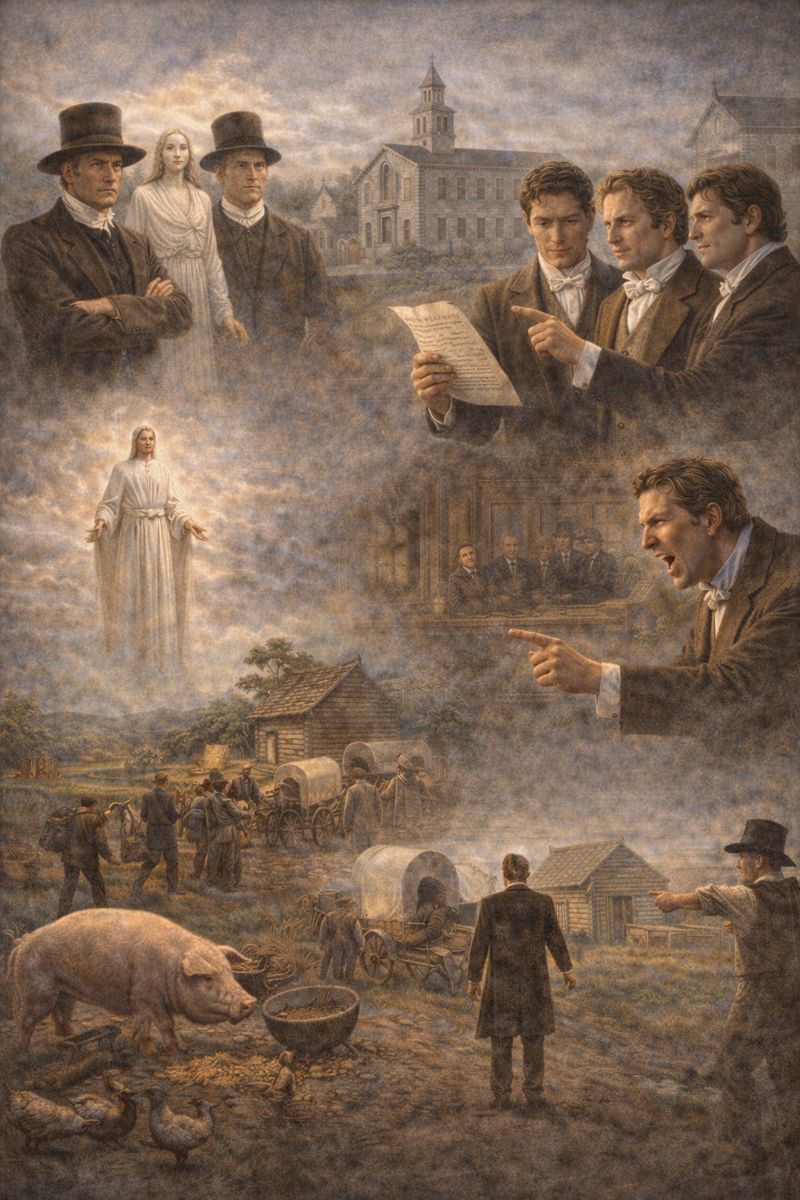
With the revelation in hand, Rigdon, Pratt, and Copley went to the Shaker settlement the same day. They read the entire revelation aloud to the Shaker leaders, who rejected it completely. Many Shakers objected that the missionaries were married men, and they refused every doctrine presented to them. The mission produced no converts.
Copley’s Betrayal and the Displacement of the Colesville Saints
After the failed mission, Leman Copley returned to the Shakers and subsequently renounced the Church. He then expelled the newly arrived Colesville Saints from his property in Thompson, Ohio, where they had only recently begun building homes. Copley even demanded payment for supposed damage to the land. Having already left New York under persecution, the displaced Saints were forced to seek new direction from the Prophet.
Doctrine & Covenants 54 and the Command to Move West
Joseph Smith sought the Lord’s will, and the revelation now known as D&C 54 instructed the Colesville Saints to leave Thompson and travel to Missouri. This required undertaking yet another long migration—nearly a thousand miles from Ohio to the “borders of the Lamanites.” Their obedience under repeated hardship became a foundational story of early Latter-day Saint perseverance.
Newspaper Bias, Anti-Mormon Rhetoric, and the Myth of a Heber C. Kimball Quote
The mid-nineteenth century saw an explosion of anti-Mormon publications, including an 1860 New York Times article quoting Heber C. Kimball. The article’s anonymous authorship, hyper-partisan political background, and lack of corroboration render the quote historically unreliable. Many such “letters from Utah” were written by pseudonymous correspondents hostile to the Church, reflecting national debates over polygamy, federal authority, and territorial control.
The Republican Party platforms of 1856 and 1860 explicitly targeted Mormonism, pairing polygamy with slavery as the “twin relics of barbarism.” These sentiments shaped journalism of the era, often producing sensational or fabricated material. No verified Church source, sermon, or journal aligns with the alleged Kimball quotation.
Anti-Mormon Politics and the Drive to End Plural Marriage
The national campaign against Mormon polygamy intensified through the mid-nineteenth century. Congressional speeches, including those of Representative Steven C. Foster, framed Mormonism as a threat to American morals and political stability. Legislation followed: the Morrill Anti-Bigamy Act (1862), the Edmunds Act (1882), and the Edmunds–Tucker Act (1887). These laws dismantled Church institutions, seized assets, barred Latter-day Saint women from voting, and criminalized cohabitation.
Ironically, while Utah Territory granted women the vote in 1870—ahead of most of the United States—the federal government revoked that right in its effort to weaken perceived Mormon political unity.
Legal Realities in the Face of Hostility
Accusations that “Mormon courts protected Mormon criminals” fit the rhetoric of anti-Mormon newspapers but not the documented legal history. No one was ever convicted for the massacre at Haun’s Mill in Missouri or for the murders of Joseph and Hyrum Smith. In both instances, courts excluded Latter-day Saints from juries and denied them legal protection. The broader American legal landscape repeatedly failed the Saints, even as anti-Mormon writers alleged the opposite.
Listen to the full podcast here: