
Introduction
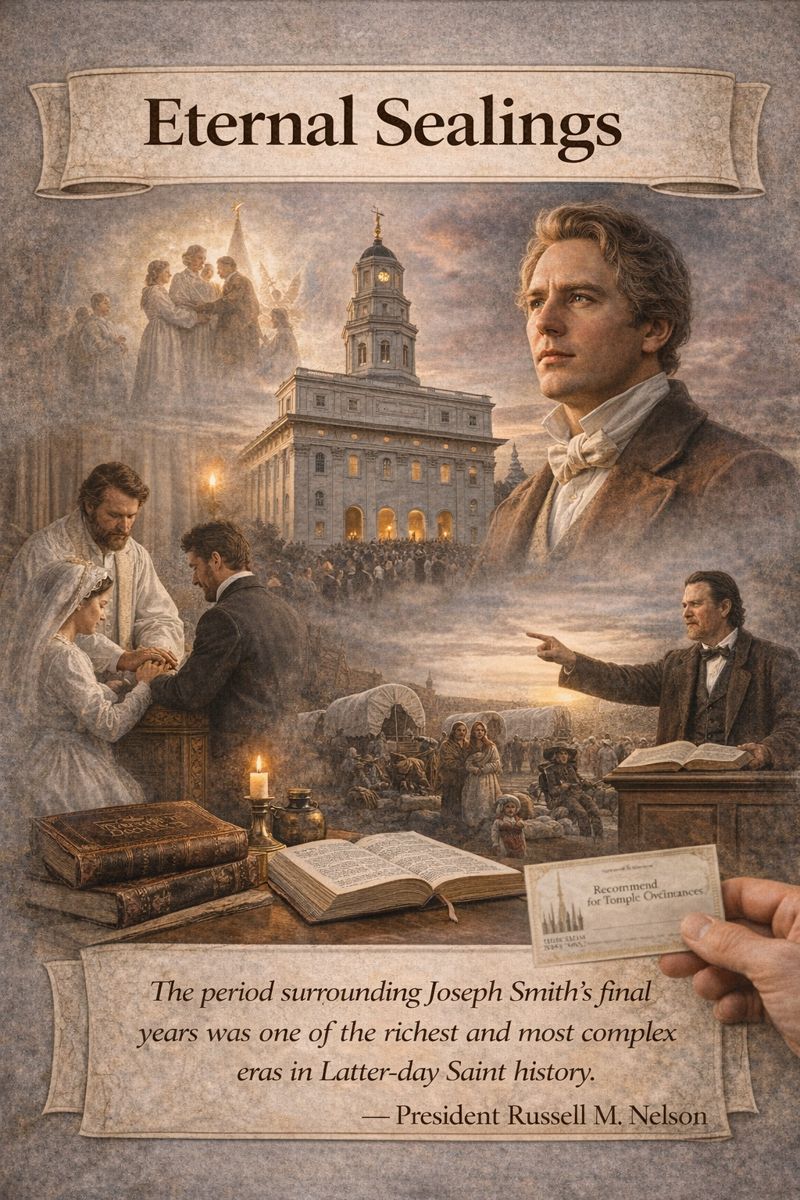
The period surrounding Joseph Smith’s final years in Nauvoo remains one of the richest and most complex eras in early Latter-day Saint history, shaping doctrines, ordinances, and leadership structures that continue to define the Church today. This episode explores that historical context, the succession crisis that followed Joseph Smith’s death, the rise and fall of Sidney Rigdon’s competing movement, and the hardships the Latter-day Saints endured as they completed the Nauvoo Temple and crossed Iowa under brutal conditions.
Joseph Smith, Early Leadership, and the Rise of Temple Doctrine
When Joseph Smith organized the Church of Jesus Christ of Latter-day Saints in 1830, he set in motion a rapidly expanding religious community that faced severe persecution wherever it settled. The First Presidency, composed of the Prophet and his counselors—including Sidney Rigdon—functioned as the highest governing quorum, while the Quorum of the Twelve Apostles and other priesthood quorums carried out missionary work and administrative responsibilities.
Throughout the 1830s and early 1840s, the Saints were driven repeatedly from their homes: first from Ohio, then from Missouri following the 1838 Mormon War, the massacre at Haun’s Mill, and Governor Boggs’s Extermination Order. They rebuilt in Illinois, establishing the city of Nauvoo. There, the construction of the Nauvoo Temple became central to Joseph Smith’s final ministry. In Nauvoo he taught the Saints the endowment, eternal marriage, and sealing ordinances—doctrines that transformed the trajectory of the Restoration.
The Martyrdom and the Succession Crisis of 1844
The murders of Joseph and Hyrum Smith in Carthage Jail on June 27, 1844, threw the Church into deep mourning and uncertainty. The Saints now faced the question of who held authority to lead and continue the Restoration.
Sidney Rigdon, Joseph’s longtime counselor, returned to Nauvoo and announced that he should serve as the “Guardian of the Church.” Rigdon privately told leaders that the Church had not been led by the Spirit for some time, suggesting that Joseph had introduced incorrect doctrines in his later years. These private comments, paired with his refusal to submit to apostolic leadership, created immediate conflict.
The Quorum of the Twelve Apostles, led by Brigham Young, countered that Joseph Smith had conferred all priesthood keys upon them before his death. Acting under this authority, the Twelve moved forward to direct the Church, continue temple construction, and prepare for an eventual westward relocation.
Rigdon refused to defer to the Apostles. After contentious meetings with the Twelve, he was excommunicated in September 1844 and left Nauvoo.
Rigdon’s Rival Church and His Attacks Against Nauvoo
After departing Nauvoo, Sidney Rigdon founded a separate church in Pittsburgh, Pennsylvania. Through his newspaper, the Messenger and Advocate, he attempted to win supporters by criticizing the Twelve, condemning Nauvoo temple practices, and claiming that Joseph Smith had introduced “corrupt” doctrines.
Rigdon asserted that Joseph had departed from godliness, that the Twelve were perpetuating false teachings, and that the harsh conditions endured by the Saints after Joseph’s death were proof of divine displeasure. As the exodus from Nauvoo began in early 1846, Rigdon interpreted the Saints’ suffering as evidence that God was punishing them. His rhetoric, however, failed to gain traction, and his movement quickly diminished.
A remnant of Rigdon’s followers eventually reorganized under William Bickerton, becoming what is now The Church of Jesus Christ (Bickertonite). This group accepts the Bible and Book of Mormon but rejects Nauvoo-era revelations, including sealings, endowments, and modern prophets—precisely because Rigdon had taught that Joseph had erred in his final years.
The Exodus from Nauvoo and Hardships Across Iowa
The Saints hoped to remain in Nauvoo long enough to organize their migration and complete necessary temple ordinances. External pressures, however—attacks, mob threats, and political hostility—forced them to leave in February 1846, far earlier than planned.
The journey across Iowa was grueling. Rainstorms turned the prairies into deep mud; freezing temperatures battered the Saints, many of whom had inadequate shelter or food. Illness spread rapidly. Wagons broke down, oxen weakened, and progress slowed to a crawl. The objective was to reach the Missouri River, regroup in Council Bluffs and Winter Quarters, and then continue to the Rocky Mountains, where the Saints hoped to rebuild beyond the reach of U.S. persecution.
Rigdon seized upon these reports as proof that the Apostles were misguided, but Church leaders and the Saints themselves understood the hardships differently—as the price of faithfulness, endurance, and their determination to preserve temple teachings.
Completion of the Nauvoo Temple
In defiance of every pressure placed against them, the Saints completed the Nauvoo Temple in 1846. Thousands received ordinances before departing the city. The completion of the temple emphatically contradicted Rigdon’s prophecies that it would never be finished. For the Saints, the temple represented both a spiritual triumph and the preservation of the most sacred teachings Joseph Smith restored.
Medical Practices in the Nauvoo Era
The episode briefly references the medical world of the 19th century. Two major traditions influenced early Mormon health care:
Thomsonian medicine, advocated by Samuel Thomson, relied heavily on botanical remedies and rejected bleeding and purging.
Heroic medicine, influenced by Benjamin Rush, embraced aggressive treatments—bloodletting, purgatives, and mercury-based medicines like calomel.
Early Latter-day Saints encountered both systems. These medical debates framed the world in which Nauvoo families sought healing amid the physical demands of temple work and the exodus.
Listen to the full podcast here:
https://www.youtube.com/@standardoftruthpodcastllc
Season 4, Episode 46 – Questions About Eternal Sealings
https://app20602.cloudwayssites.com/sidney-rigdon-apostasy-succession-crisis-1844-history/