
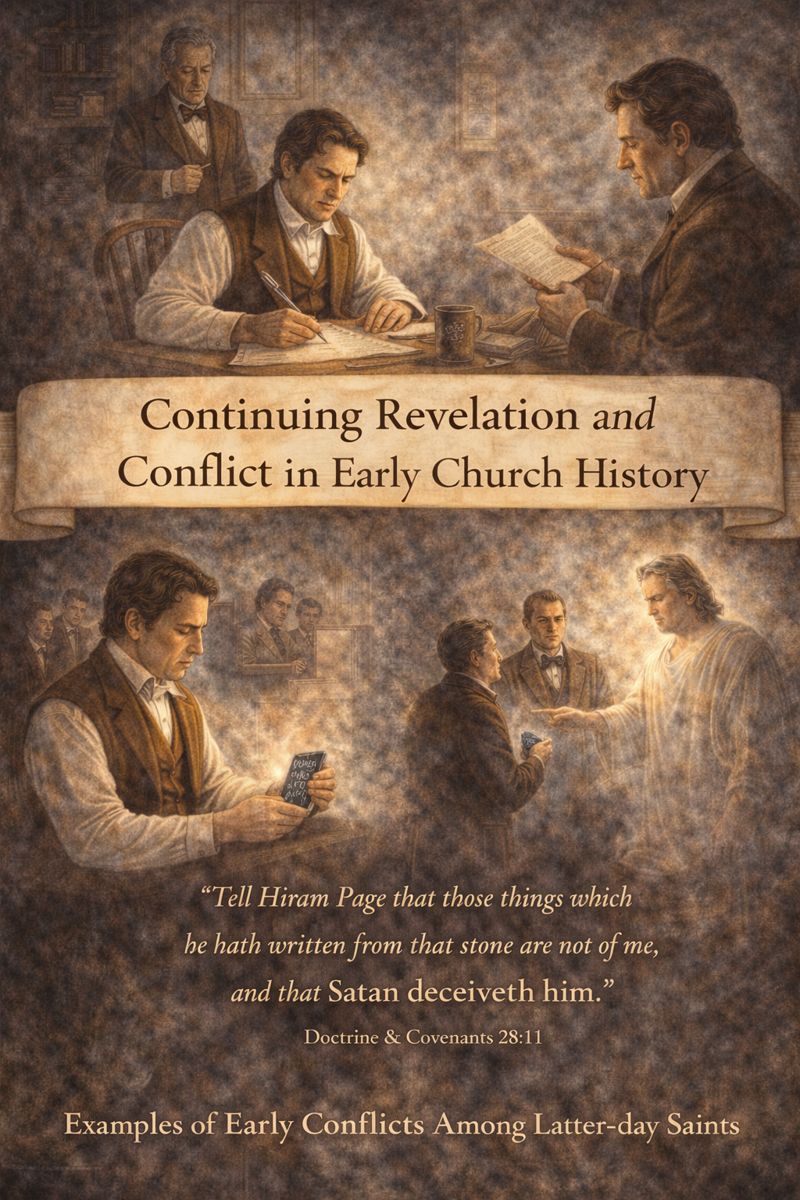
This article examines continuing revelation in early church history through real conflicts among early Saints.
Follow the Prophet part 1
Modern Disagreement vs. Early Church Disagreement
Brady asked how the disagreement seen after modern General Conferences compares to disagreement in the early church. Members today often interpret prophetic teachings through the lens of political belief. In the early church, however, disagreement centered on continuing revelation, and the experience was far sharper than most imagine.
Joseph Smith Receives the Command to Give Heed
At the organization of the Church of Christ on April 6, 1830, Joseph received a revelation now found in Doctrine and Covenants 21, declaring that he would be “a seer, a translator, a prophet, an apostle of Jesus Christ, an elder of the church,” and that the Church must “give heed unto all his words and commandments… for his word ye shall receive, as if from mine own mouth, in all patience and faith.”
The phrase “in all patience and faith” is crucial. Continuing revelation means prophets will reveal truths that members do not already believe. Members instinctively test new revelation by asking whether it matches what they already think. When it does, they accept it. When it contradicts prior belief or desire, they struggle.
Continuing Revelation in Early Church History
Brigham Young and the Vision of the Degrees of Glory
A historical parallel is Brigham Young’s response to the 1832 revelation now known as Doctrine and Covenants 76, the “Vision” of the degrees of glory. Brigham Young wrote of his first reaction:
He could not understand it. He did not reject it, but he could not understand it.
The difficulty was not the existence of multiple degrees of glory. The struggle was the elimination of eternal hell, which contradicted everything Christians had ever been taught. Brigham spent years praying for understanding until God revealed its truth to him. This is the “patience and faith” required when revelation contradicts what one has always believed.
This example demonstrates continuing revelation in early church history.
The Articles and Covenants Dispute (D&C 20)
In the earliest years of the church, the challenges were even more extreme. Soon after the founding conference, the Articles and Covenants (Doctrine and Covenants 20) were presented and unanimously accepted. Joseph returned home, but soon received a letter from Oliver Cowdery, the second elder of the church, who wrote that he had “discovered an error” in Doctrine and Covenants 20 regarding who may be baptized, specifically objecting to the phrase:
“and truly manifest by their works that they have received of the Spirit of Christ unto the remission of their sins.”
Oliver Cowdery wrote:
“I command you in the name of God to erase those words, that no priestcraft be among us.”
Joseph replied immediately, asking:
“By what authority he took upon him to command me to alter or erase, or to add or diminish to or from a revelation or commandment from Almighty God.”
This example demonstrates continuing revelation in early church history.
Conflict in the Fayette Branch
Joseph felt uneasy and traveled to Fayette. There he found not only Oliver Cowdery but every member of the church in Fayette rejecting what Joseph had received. Joseph recorded:
“It was not without both labor and perseverance that I could prevail with any of them to reason calmly on the subject.”
The entire Whitmer family, along with Oliver, insisted Joseph had introduced false doctrine. Only after Joseph convinced Christian Whitmer, who then helped persuade the others, did the group recognize their error.
Joseph reflected:
“This error, having its rise in presumption and rash judgment, was calculated to teach each and all of us the necessity of humility and meekness before the Lord.”
He identified the cause as presumption (“I already know what God wants”) and rash judgment (instant anger when revelation contradicts prior belief).
Continuing Revelation in Early Church History
Hiram Page and the Stone Revelations
Shortly afterward, another crisis arose. At the September 1830 conference in Fayette, Hiram Page, one of the Eight Witnesses, claimed to receive revelations through a stone. These revelations contradicted Joseph’s, yet almost the entire Fayette branch accepted Hiram Page’s revelations as authentic because:
-
They were produced through what appeared to be a miraculous method—writing appearing on a stone.
-
They used revelatory language.
-
They told members exactly what they wanted to hear, particularly revealing the location of Zion.
Early Saints deeply longed to know where the New Jerusalem would be. Page’s revelations reportedly placed Zion in New York, meaning members would not have to uproot their lives. This made the false revelations powerfully appealing.
This example demonstrates continuing revelation in early church history.
Doctrine and Covenants 28 and Prophetic Order
Doctrine and Covenants 28 was revealed in direct response. The Lord instructed Oliver:
“Thou shalt not command him who is at thy head and at the head of the church.”
“I have given unto him the keys of the mysteries.”
“It is not revealed, and no man knoweth where the city of Zion shall be built.”
“Tell Hiram Page that those things which he hath written from that stone are not of me, and that Satan deceiveth him.”
God explained that Page’s revelations contradicted previous covenants, and therefore could not be from Him. This established a pattern: personal revelation is real and essential, but no one receives revelation for the church except the prophet.
Types of False Revelation
This early conflict illustrates two forms of false revelation:
-
Fraudulent revelation, where a person deliberately uses the language of revelation to influence others.
-
Demonic deception, where actual supernatural phenomena are present but originate from Satan, who “transformeth himself nigh unto an angel of light.”
Members must evaluate revelations by whether they contradict the established order of revelation through the prophet.
Boundaries of True Revelation
The Lord set clear boundaries:
-
Individuals may receive revelation for themselves and their families.
-
Only the prophet receives revelation for the entire church.
Listen to the full podcast here:
https://www.churchofjesuschrist.org/study/scriptures/dc-testament/dc/20
https://www.josephsmithpapers.org