
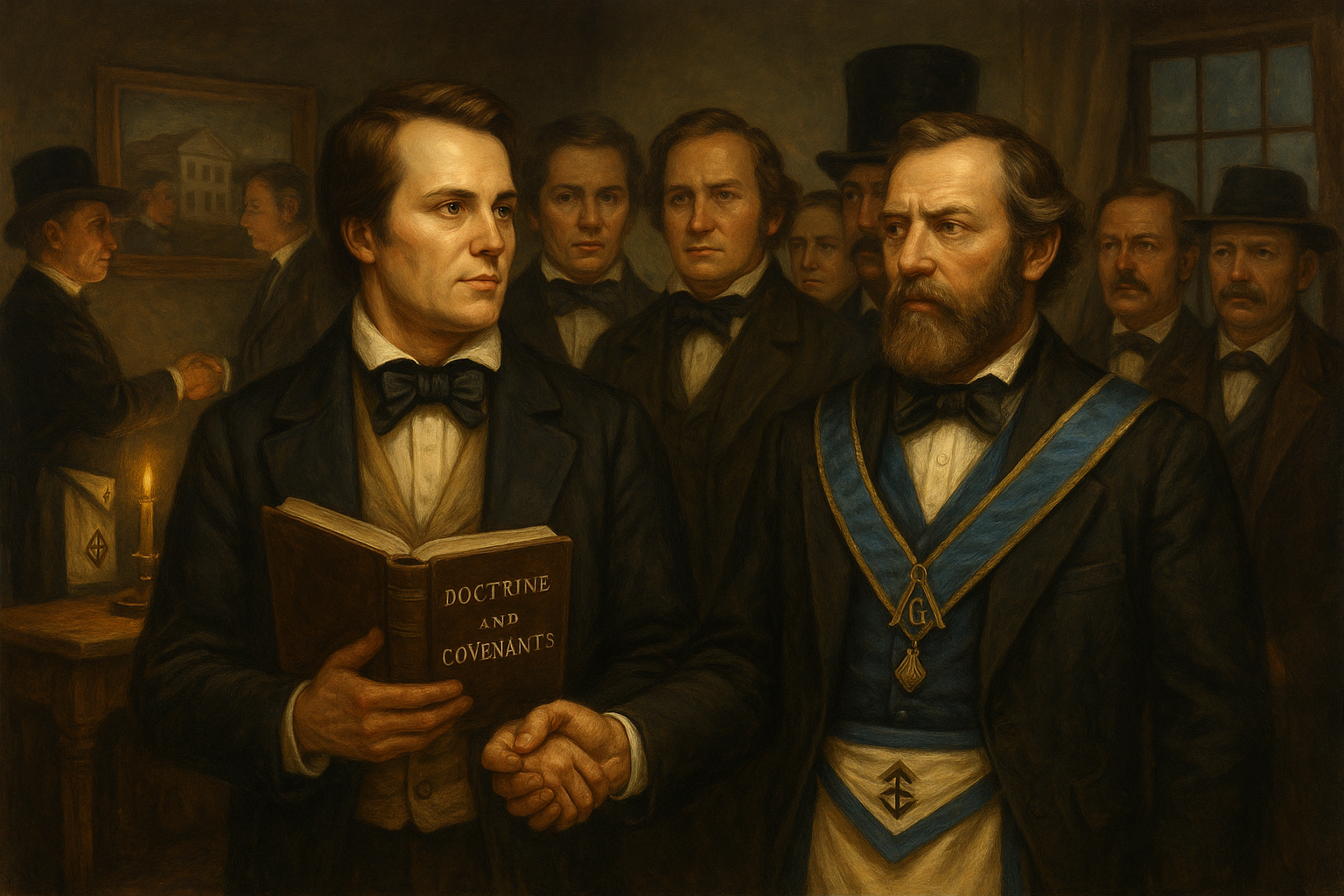
In the 19th century, fraternal organizations such as the Freemasons, Odd Fellows, Elks, and other civic groups played a central social role in American life. These groups offered networking, charity, and community-building in an era before modern clubs and institutions existed. Contrary to modern conspiratorial ideas, these organizations were considered mainstream, respectable, and socially important.
This cultural environment shaped how Americans—including early Latter-day Saints—interacted with Freemasonry.
Origins and Early Growth of Freemasonry
Modern Freemasonry emerged around 1717 in England and Scotland. Historians emphasize that Freemasonry descends from medieval stonemason guilds, which used handshakes, passwords, and symbols to verify professional skill.
Masons preserve a traditional narrative connecting their rituals to the Temple of Solomon. While meaningful symbolically, this has no documentary historical support.
During the colonial and early U.S. periods, many leaders—including George Washington and John Hancock—were Masons. However, the claim that “all Founders were Masons” is incorrect. About one-third had some Masonic affiliation.
The Anti-Masonic Reaction (1826–1832)
Anti-Masonry became a powerful movement in upstate New York—the same region where the Smith family lived.
Reasons Included
- Perceptions that Masons behaved as an elite class
- Religious concerns about secrecy and oaths
- The disappearance of William Morgan, who threatened to publish Masonic rituals
The Anti-Masonic Party emerged as the first third party in U.S. history, dominating regions of western New York. Many early Saints, including W. W. Phelps, had connections to this movement.
Joseph Smith himself expressed caution in the early 1830s, warning Hyrum:
“Be careful of the Masons.”
Kirtland and Missouri: Limited Interaction
During the early Church periods in Kirtland (1831–1838) and Missouri (1831–1839), there was no significant institutional involvement with Masonry. A few members had Masonic backgrounds, but the Church had no organizational connection.
Nauvoo: Strategic Alignment (1841–1844)
The relationship changed in Nauvoo, where Church leaders sought to integrate the Saints into Illinois society after repeated expulsions from other states.
Community-Building Efforts Included
- Founding the University of Nauvoo
- Establishing theater and cultural societies
- Organizing bands and public institutions
- Active political participation
- Founding a Masonic Lodge in 1842
Joseph Smith, Hyrum Smith, and many Church leaders became Masons. Joseph advanced through Masonic degrees unusually fast, raising concerns among other Illinois lodges.
Conflict With Illinois Masonry
Complaints Emerged
- Nauvoo advanced candidates too quickly
- Members used Masonic signs outside proper contexts
- The Nauvoo Lodge grew rapidly and independently
By 1844, Masonic authorities revoked Nauvoo’s charter, ending the relationship even before the martyrdom of Joseph and Hyrum.
Utah: Freemasonry as an Anti-Mormon Force
After the Saints migrated West, a new Masonic lodge formed at Camp Floyd with federal soldiers.
Later, Utah Masonry:
- Forbade Mormons from membership
- Became a center of the Liberal Party, which opposed the Church
- Was dominated by critics and apostates
- Supported anti-polygamy and anti-Church legislation
- Worked to block Latter-day Saints from voting, serving on juries, or holding office
This antagonism endured for decades. Utah Masons formally banned Latter-day Saints until 1986, and informally much longer. This long conflict explains why Utah remains the U.S. state with the lowest percentage of Masons.
Historical Phases of LDS–Masonic Relations
- Initial Hostility (1820s–1830s): Local Masons and Anti-Masons both participated in persecutions against early Latter-day Saints.
- Neutrality (Kirtland & Missouri): No institutional connection.
- Strategic Cooperation (Nauvoo): Leaders became Masons to build political alliances; relationship ended abruptly.
- Institutional Conflict (Utah): Masonic lodges opposed the Church and became political enemies.
- Cultural Distance (20th Century): Most Saints avoided Masonry due to its anti-LDS legacy.
Doctrine and Covenants 87: Prophecy of War (1832)
On December 25, 1832, Joseph Smith received the revelation now known as Doctrine and Covenants 87, predicting future wars beginning in South Carolina.
Modern readers often assume the Civil War was expected. Historically, this is incorrect.
Context in 1832
At the time:
- Americans did not expect a civil war
- Slavery appeared “settled” under the Missouri Compromise of 1820
- Fewer than 1% of Northerners were abolitionists
- National debates focused on tariffs, banking, and expansion—not slavery
Even by 1860, most Americans expected only minor conflict.
Key Elements of the Revelation
D&C 87 prophesied:
- War beginning with rebellion in South Carolina
- Widespread death and misery
- Division between North and South
- Foreign involvement, including Britain
- Enslaved people rising up
- Global war and divine judgments
- Catastrophic natural disasters
- A cessation of the Saints’ cries for justice
Notably, this prophecy came before:
- The Missouri persecutions
- The 1838 Extermination Order
- Haun’s Mill
- The murders of Joseph and Hyrum Smith
Later events shaped how Latter-day Saints interpreted the prophecy.
Fulfillment and Historical Interpretation
Civil War Expectations
Even after secession:
- Many believed the war would be brief
- Families picnicked at the First Battle of Bull Run
- Lincoln’s call for 75,000 volunteers seemed excessive compared to an army of 16,000
The war ultimately caused over 620,000 deaths.
Enslaved People “Rising Up”
Historical reality:
- Tens of thousands fled plantations
- Over 100,000 served in the Union Army
- Many aided Union troops before official enlistment policies
This matches the broad description in D&C 87.
Divine Judgment in Latter-day Saint Thought
The Saints interpreted the Civil War as judgment for:
- Missouri persecutions
- The extermination order
- The murders of Joseph and Hyrum
- Federal refusal to punish anti-Mormon violence
- The Utah War (1857)
- Failure to protect Latter-day Saints
Northern abolitionists also preached that the war was divine judgment for slavery.
Lincoln’s Second Inaugural (1865)
Lincoln echoed similar themes:
- Slavery caused the war
- Both sides misjudged God’s purposes
- Bloodshed might match blood drawn by the lash
- God’s judgments were “true and righteous altogether”
His worldview mirrored themes found in D&C 87.
Conclusion
Freemasonry and Latter-day Saint history share a complex relationship defined by:
- Early tensions
- Strategic cooperation in Nauvoo
- Bitter conflict in Utah
- A legacy of cultural distance
Meanwhile, Doctrine and Covenants 87, received in 1832, stands as one of Joseph Smith’s most detailed prophecies. Its descriptions of war, division, slavery, and divine judgment align strikingly with the events and interpretation of the American Civil War.