
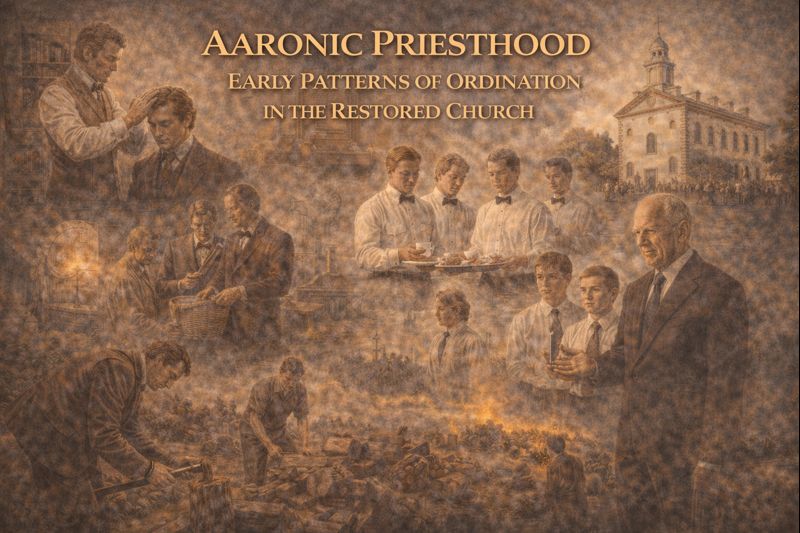
Early Patterns of Ordination in the Restored Church
In the opening years of the Restoration, the landscape of priesthood offices looked very different from the age-structured system familiar today. During the 1830s, the Articles and Covenants—now Doctrine and Covenants 20—provided broad definitions for deacons, teachers, and priests, yet offered little detail about how these offices functioned in daily practice. In those early decades, the men called to the Aaronic Priesthood were not young boys but adults, often seasoned members of their communities. Offices were not assumed to be sequential; a convert might be ordained a teacher or a priest without ever serving as a deacon.
Priesthood ordination itself was selective. Early Saints did not expect that every male convert would automatically become an elder. But as missionary work expanded and branches multiplied across the frontier, elders were increasingly needed to confirm members and organize congregations. This growing demand gradually broadened priesthood ordination among adult men.
Significantly, the earliest Plat of Zion (1833) designated specific houses of worship for deacons and teachers, suggesting that these offices were taken seriously—expected to have educational, communal, and disciplinary responsibilities that extended far beyond later youth-oriented interpretations.
The Temple Endowment and the Expansion of Priesthood Ordination
A major shift occurred in the early 1840s as temple worship was introduced. Because endowment and sealing ordinances required men to hold the Melchizedek Priesthood, priesthood ordination quickly became more widespread among Latter-day Saint men. The change in temple practice prompted an evolution in Aaronic Priesthood use: as adults increasingly held the Melchizedek Priesthood, the Aaronic Priesthood became positioned for younger members, eventually forming the age-based structure known today.
Acting Quorums and Adult Aaronic Priesthood Service
Through much of the nineteenth century, the majority of deacons, teachers, and priests were adult men acting in those callings because youth ordination was still rare. These “acting” Aaronic Priesthood holders filled practical needs within the ward. Their duties often involved manual labor, community service, and maintaining the meetinghouse. Many men resisted assignments as acting deacons or teachers, viewing them as lower offices when compared with the Melchizedek Priesthood they already held. Nevertheless, the work they performed was essential to daily worship and community life.
Standardizing the Aaronic Priesthood for Youth
By the turn of the twentieth century, Church leaders formally aligned priesthood ordination with specific ages, establishing a clear developmental progression for boys and young men.
Ages of Ordination (Standardized in the 20th Century)
Deacons: Set at age 12 in 1908—unchanged since.
Teachers:
Age 15 in the early 1900s
Lowered to 14 in 1954
Priests:
Age 18 in 1908
Lowered to 17 in 1925
Lowered to 16 in 1954
Elders:
Age 21 in 1908
Gradually lowered to 18 by 1970
This period also saw priesthood quorums become formalized training environments focused on preparation for missionary service, marriage, temple worship, and adult priesthood responsibilities.
The 1916 Duties of Deacons and Teachers
In 1916, priesthood responsibilities were formally published, providing a clearer picture of how Aaronic Priesthood offices functioned at the time.
Deacons were expected to:
Collect fast offerings, pass the sacrament, carry messages for the bishop, assist the poor—especially by supplying fuel for winter—distribute notices, pump bellows for early pipe organs, care for church property and cemeteries, maintain meetinghouse grounds, usher at services, help in Primary and Boy Scouts, and attend the doors during worship.
Teachers were to:
Assist in home teaching (then called ward teaching), help with the sacrament, support Boy Scout activities, lead meetings on occasion, speak or sing in services, collect funds, clean or renovate meetinghouses, serve as clerks, sing in choirs, and notify quorum members of upcoming meetings.
These detailed responsibilities reflect the communal and hands-on nature of early twentieth-century priesthood life.
Sacrament Administration Across the Decades
Contrary to modern assumptions, deacons and teachers were not always the ones passing the sacrament in earlier periods. Adult men often performed that duty, and standards of dress varied widely. In some areas during the early 1900s, young men wore white shirts and black bow ties; in others, coats were discouraged. The Improvement Era of 1931 offered formal recommendations to encourage reverence and uniformity.
President Heber J. Grant clarified in 1928 that in mission districts where priesthood holders were scarce, non-priesthood members could assist in distributing the sacrament after it had been blessed, reflecting the practical realities of a growing international church.
Cultural Development and Modern Expectations
Over time, the Aaronic Priesthood became a central institution for mentoring youth, shaping character, and preparing young men for lifelong discipleship. Duties shifted from manual labor to spiritual preparation, reverence, and service. The transformation reflects a broader evolution within the Church as it expanded beyond frontier settlement and established itself as a global faith.