
Table of Contents
ToggleHistory of the Word of Wisdom: How Latter-day Saint Health Standards Developed
The “Word of Wisdom,” now canonized as Doctrine and Covenants 89, is one of the most recognizable features of Latter-day Saint religious life. Today it functions as a clear standard: members seeking full participation in the Church, including temple worship, abstain from alcohol, tobacco, coffee, and tea.
Historically, however, the Word of Wisdom developed gradually. It began as a revealed “principle with a promise,” explicitly “not by commandment or constraint,” and over roughly a century became a binding commandment and a temple recommend requirement.
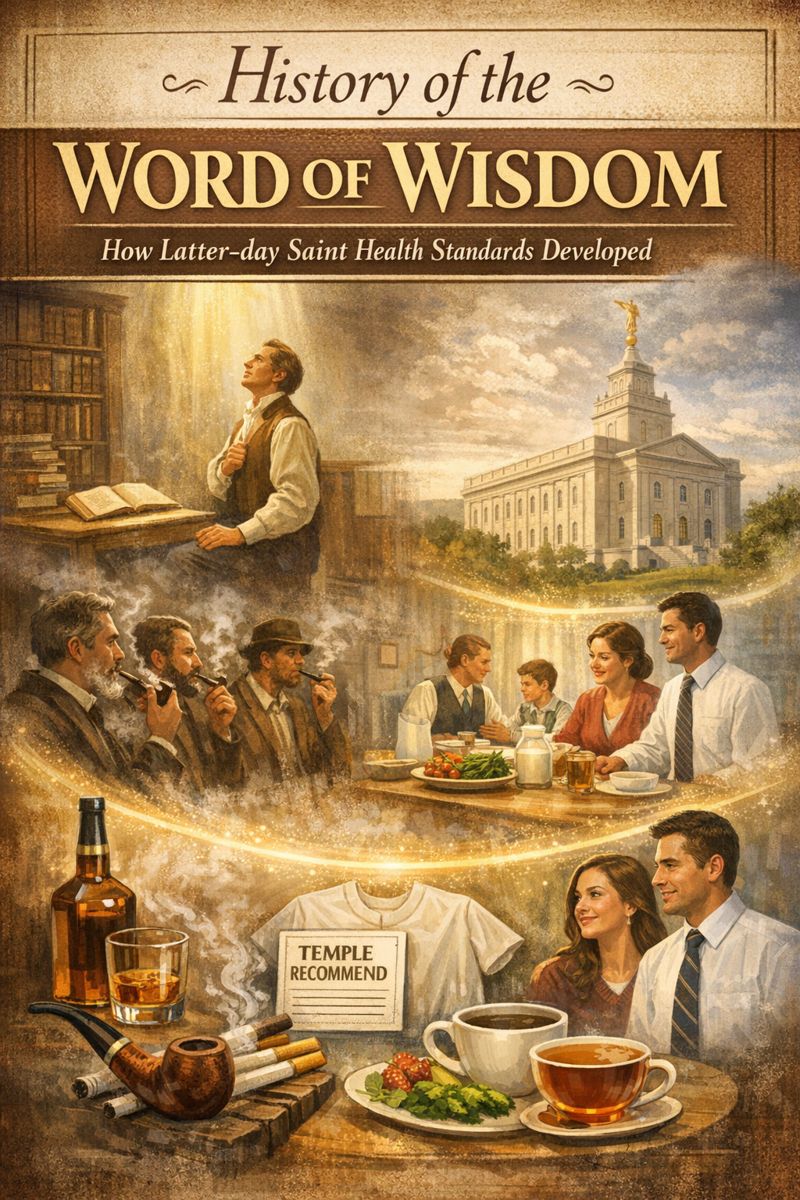
This article traces that development: the 1833 origins in Kirtland, the nineteenth-century temperance context, how early Saints—including Joseph Smith—actually lived it, the Brigham Young era, and the twentieth-century shift to strict observance.
Origins of the Word of Wisdom in Kirtland (1833)
The School of the Prophets and the Kirtland Setting
In late 1832, Joseph Smith received a revelation instructing him to organize the “school of the prophets.” The purpose was both spiritual and practical: elders of the Church would meet to study “the great things of the Kingdom” and also languages, governments, geography, and other subjects that would help them preach the gospel more effectively.
These meetings took place in a small upstairs room of Newel K. Whitney’s store in Kirtland, Ohio. That cramped space became the immediate setting for the Word of Wisdom.
Brigham Young later described what he had been told about those meetings:
“When the elders came they used their freedom they got up in their little small room over Joseph Smith’s kitchen the house he lived in and Kirtland belonged to Bishop Whitney it was the room the prophet received revelations in and instructed his brethren when they came into the room after breakfast the first thing was for each and every man to light a pipe and to begin talking about the great things of the kingdom and to Puff away and how is this and how is this and spittle here and spittle there and by the time they were ready to hearken to Joseph to hear his counsel … by the time he came to instruct them here was tobacco spit all over the floor and as soon as a pipe goes out of a mouth in goes a block of tobacco… This set Joseph to thinking and Emma complained of cleaning the room and could not make the floor look decent one complaint after another the girls complain of scrubbing the floor and the prophet…”
According to this account, the smoke was so dense that “you could hardly see across the room.” Emma Smith and others complained about the filthy floors, and Joseph himself helped clean up the tobacco spit. That oppressive environment “set Joseph to thinking” and led him to “inquire of the Lord with regard to the use of tobacco … and saw unto the Lord to know with regard to the conduct of the elders with this particular practice.”
The immediate problem, then, was practical and specific: excessive smoking and chewing in a small, sacred meeting room. The revelation that came in February 1833, however, addressed much more than that one issue.
The Word of Wisdom and Nineteenth-Century Temperance
The Word of Wisdom did not appear in a cultural vacuum. It came during the Second Great Awakening, a period of intense religious revival and moral reform in the United States. One prominent reform was the temperance movement.
At that time:
-
“Temperance” generally meant moderation in alcohol use, especially avoiding drunkenness—not total abstinence.
-
Some reformers argued for complete abstinence (“teetotaling”), but they were a minority.
-
A few voices criticized tobacco.
-
An even smaller number questioned the use of coffee and tea; many temperance advocates actually promoted them as safer alternatives to alcoholic drinks.
Thus, while Joseph Smith lived in a world where people were beginning to criticize drunkenness and, occasionally, tobacco, there was no widespread movement combining these positions into a single, strict health code that:
-
Forbade all alcohol,
-
Forbade all tobacco, and
-
Forbade coffee and tea.
In that respect, the Word of Wisdom, even in its early form, was unique. It echoed some contemporary concerns (especially about alcohol), but it went well beyond any existing temperance platform by tying these practices together in one revelation.
“Not by Commandment or Constraint”: The Original Revelation
Doctrine and Covenants 89 opens with an important framing statement:
“A word of wisdom for the benefit of the Council of high priest assembled in Kirtland at and the church and also the Saints in Zion to be sent greeting not by commandment or constraint but by Revelation and the word of wisdom showing forth the order and will of God in the temporal salvation of All Saints in the last days given for a principle with a promise adapted to the capacity of the weak and the weakest of All Saints who are or can be called Saints.”
Several key points emerge:
-
Audience: Initially, the revelation is addressed to the council of high priests in Kirtland and “also the Saints in Zion.”
-
Form: It is “not by commandment or constraint but by Revelation,” given as a principle with a promise.
-
Timing: It is explicitly tied to “the temporal salvation of All Saints in the last days” and to “the evils and designs that which do and will exist in the hearts of conspiring men in the last days.”
In early Latter-day Saint usage, commandment and revelation were often synonymous. The first printed collection of Joseph’s revelations was titled The Book of Commandments, and Saints routinely referred to new revelations as “commandments” and acted on them quickly.
Against that background, the phrase “not by commandment or constraint” is striking. It signaled that this revelation, while divine, was not being imposed immediately as a binding law. It was wise counsel, adapted to the weak, given in view of specific dangers of the last days.
What the Original Word of Wisdom Said
The revelation itself addresses several categories: alcohol, tobacco, “hot drinks,” and diet more broadly.
Wine and “Strong Drink”
Verses 5–7 deal with alcohol:
“And inasmuch as any man drink with wine or strong drink among you behold that is not good neither meat in the side of your father only in assembling yourselves together to offer up your sacraments before him.
And behold this should be wine yea pure wine of the grape of the vine of your own make.
Again strong drinks are not for the belly but for the washing your bodies.”
From this, early Saints would have understood that:
-
Wine was allowed in connection with the sacrament—“only in assembling yourselves together to offer up your sacraments before him”—and ideally should be “pure wine of the grape of the vine of your own make.”
-
“Strong drinks” (distilled spirits such as whiskey) were “not for the belly” but only for external use (“for the washing your bodies”).
Even though an earlier revelation (Doctrine and Covenants 27) stated that “it mattereth not what you eat or what you shall drink” for the sacrament, historical evidence indicates that in Joseph Smith’s lifetime Saints continued using wine for sacramental services whenever possible. When wine was unavailable, they sometimes pressed berries or grapes and used the fresh juice. Regular use of water in place of wine for the sacrament came later, around the turn of the twentieth century.
The original Word of Wisdom, then, called for limiting alcohol, especially outside sacred ordinances, rather than banning it outright.
Tobacco
Verse 8 addresses tobacco:
“And again tobacco is not for the body neither for the belly and is not good for man but as an herb for bruises and all sick cattle abuse with judgment and skill.”
In the 1830s, tobacco was ubiquitous. Men commonly smoked pipes or cigars and chewed tobacco; some women used it as well. While isolated voices raised health concerns, tobacco was not generally seen as medically dangerous. Some purported “doctors” even argued that smoking helped “clean” the lungs.
Against that backdrop, the revelation’s direct statement—“tobacco is not for the body neither for the belly and is not good for man”—stands out. Latter-day Saints have often pointed to this as an instance of prophetic insight long preceding modern medical consensus.
Initially, the most immediate application seems to have been narrow: no smoking or chewing in the School of the Prophets. Some accounts describe men throwing their pipes into the fire in response to the revelation, at least in that setting. Yet several of those same men continued to use tobacco later in life, reflecting the gradual, advisory nature of early implementation.
“Hot Drinks”: Coffee and Tea
Verse 9 is brief but consequential:
“And again hot drinks are not for the body or the belly.”
Nineteenth-century Americans mainly drank coffee and tea as hot beverages. Hyrum Smith and other early leaders explicitly interpreted “hot drinks” as meaning coffee and tea, and this understanding became standard in the Church.
Because the text does not name coffee or tea directly, some later readers have speculated about temperature or other beverages. But historically, Church leaders treated “hot drinks” as referring specifically to coffee and tea, not to any warmed liquid.
Unlike tobacco, for which modern science offers overwhelming evidence of harm, the health literature on moderate coffee and tea consumption is mixed and often neutral or positive. That difference is one reason why attempting to justify every aspect of the Word of Wisdom solely on scientific grounds can be difficult.
Herbs, Fruits, and Meat “Sparingly”
Verses 10–12 broaden the discussion to diet:
“And again verily I say unto you all wholesome herbs God is ordained for the Constitution nature and use of man… every herb in the season thereof and every fruit in the season thereof all to be used with prudence and Thanksgiving.
Yea flesh also of beasts and the fowls of the air I the Lord of ordained for the use of man with Thanksgiving nevertheless they are to be used sparingly.”
The revelation teaches that:
-
Wholesome herbs and fruits are ordained for human use, in their season, “with prudence and Thanksgiving.”
-
Meat is also ordained “for the use of man,” but “they are to be used sparingly.”
Unlike the later, clearly defined prohibitions on alcohol, tobacco, coffee, and tea, the phrase “used sparingly” has never been codified with the same precision. Some early leaders, such as Hyrum Smith, encouraged very limited meat consumption. In actual practice, nineteenth-century Saints ate meat when they could obtain it; there is little evidence of systematic efforts to avoid it entirely.
In modern times, even when general conference talks discuss the Word of Wisdom, meat is usually mentioned only when reading the text itself. Authoritative interpretations have not tried to define “sparingly” in quantitative terms.
How Early Latter-day Saints Lived the Word of Wisdom (1830s–1840s)
Early Church Discipline and Drunkenness
In the 1830s and 1840s, Church disciplinary procedures were much less differentiated than they are today. There were no formal categories like “probation” or “disfellowshipment.” Members were essentially either “within the bonds of fellowship” or “cut off.”
Because of that, excommunication could come quickly for various offenses—and re-admission could also happen relatively quickly once repentance was evident.
Within that framework:
-
Habitual drunkenness was treated seriously.
-
Members could be cut off from the Church for repeated, public drunkenness, even though moderate drinking was still common.
-
Simply smoking a pipe or drinking tea or coffee was not, in itself, a typical basis for disciplinary action.
Joseph Smith himself summarized his position late in his life by saying “there is no excuse for a man to drink and get drunk in this church.” Drinking in “small quantities” might be tolerated; drunkenness was the clear line.
Local Variation and Hyrum Smith’s Zeal
Application of the Word of Wisdom varied locally. Some leaders and congregations pushed toward stricter observance and “teetotaling”; others maintained a more moderate understanding focused on avoiding excess.
Brigham Young later remarked that Hyrum Smith was especially intense about the Word of Wisdom. Hyrum is described as someone who could preach on it for hours, and a sermon of his printed in Times and Seasons treats it as a serious, binding standard.
Despite such strong voices, however, the Word of Wisdom in Joseph Smith’s day was not yet a universal marker of Latter-day Saint identity in the way it is today. Many faithful members—including leaders—still drank coffee and tea, used tobacco, and drank alcohol in moderation.
Did Joseph Smith Drink Alcohol, Tea, or Coffee?
Modern members sometimes assume that Joseph Smith personally lived the current, strict interpretation of the Word of Wisdom and that he never drank alcohol, coffee, or tea. That assumption often draws on Lucy Mack Smith’s account of his childhood leg surgery:
“Then Dr Stone said will you drink some Brandy no said the child not one drop then the doctor said will you take some wine you must take something you can never endure the severe operation which you have which you must be subjected no answer the boy I will not touch one particle liquor neither will I be tied down but I will tell you what I will do I’ll have my father some of the bed close beside me and then I’ll bear whatever is necessary.”
This story shows remarkable courage and resolve in a young boy, but it does not represent a fully formed nineteenth-century Word of Wisdom standard. Joseph’s surviving journals and contemporary accounts show that as an adult:
-
He sometimes drank tea. One cold day in 1843, his journal notes that he “had tea with his breakfast,” and when asked about it, he remarked that “if it had been a little stronger he would have liked it better,” prompting a joking reply that the tea was already so strong “that I should think it would have answered for both drink and for food.”
-
He sometimes drank beer. On June 1, 1844, his journal records that he “drank a glass of beer at moshers,” a tavern in Nauvoo.
-
He participated in using wine for social refreshment as well as for the sacrament.
John Taylor’s famous account of the martyrdom at Carthage Jail describes the men sharing wine on the day Joseph and Hyrum were killed:
“Sometime after dinner we sent for some wine…”
Writing about ten years later, Taylor was clearly aware that some readers were uncomfortable with that detail. He notes that:
“It has been reported by some that this was taken as a Sacrament… It was no such thing… Our Spirits were generally dull and heavy and it was sent to revive us we all drank of the wine and gave some of it to one or two of the prison guards…”
By 1854, as the Word of Wisdom was being preached more strictly, some Saints apparently wanted to reinterpret that episode as a sacramental use of wine to avoid the implication that Joseph drank recreationally. Taylor, who was present, explicitly rejected that reinterpretation.
These sources do not indicate hypocrisy on Joseph Smith’s part. They illustrate how he and his contemporaries understood the revelation in their own time:
-
As “neither by commandment nor by constraint,”
-
As urging moderation and avoidance of drunkenness,
-
As discouraging tobacco and “hot drinks,” especially in sacred settings,
-
But not yet as total abstinence from all alcohol, coffee, and tea in every circumstance.
Brigham Young and the Word of Wisdom in Utah Territory
Continued Focus on Drunkenness
After the Saints migrated to Utah, Brigham Young repeatedly addressed the Word of Wisdom. His sermons show a consistent emphasis on drunkenness as the critical line, alongside calls to move toward broader observance.
In an 1859 sermon, he warned:
“My counsel of the Elders of Israel is to let cursed whiskey and Brandy alone… Those that are in the habit of drinking liquor cease to drink liquor.”
He then urged members to change the underlying pattern: if they worked so hard that they felt they “have to get half drunk to keep your spirits up,” they should instead “take a little meal bread and butter and go to bed and rest and not work too hard.”
In the same discourse he instructed local leaders:
“I have further request a little further I’ve requested the high priest the 70s the elders the High Council and the Bishops to deal with men that will make a practice of getting drunk and if they don’t stop it cut them off from the church…”
The focus remained on habitual drunkenness, not mere consumption.
Clarifying “Hot Drinks” as Coffee and Tea
By the 1860s, some Saints were already trying to narrow the meaning of “hot drinks” or to argue that the revelation did not explicitly name coffee and tea. Brigham Young responded directly.
In an 1867 sermon in Tooele he said:
“Some of the sisters and some of the Brethren will say Tien coffee is not mentioned in the word of wisdom but hot drinks is… as if this doesn’t refer directly perfectly absolutely definitely and truly to that which we drank hot what does it allude to what did we drink hot tea and coffee when we made milk porridge it was our food we didn’t wash it down red hot the way we drank down tea it alludes to tea and coffee whatever we drank… I said to the Latter-Day Saints at the annual conference of six April that the spirit Whispers to me for this Spirit of this people to observe the word of wisdom to let the tea and the coffee and the tobacco alone whether they smoke or take snuff or chew let it alone those are in the habit of drinking liquor cease to drink liquor.”
Here Brigham explicitly identified “hot drinks” with tea and coffee and called on Saints to give them up along with tobacco and liquor.
Moving Toward a “Test of Fellowship”
Two years later, in 1869 in Nephi, he pushed further:
“President young said I require all under 100 years of age to stop using tobacco and drinking whiskey… if they do not stop we will soon make it a test of Fellowship in the church you should keep the word of wisdom…”
At this moment, the Word of Wisdom was not yet a formal test of fellowship. Brigham’s language (“we will soon make it”) shows that he understood the Church was moving in that direction. He linked keeping the Word of Wisdom to readiness for Zion and the Millennium:
“Babylon is going to fall and the Millennium all will be filled with the knowledge of God and then all people will keep the word of wisdom and they will take Delight in it…”
By the end of Brigham Young’s presidency, then, the Word of Wisdom had become:
-
A strongly preached expectation, especially for leaders;
-
A disciplinary matter in cases of ongoing drunkenness;
-
Increasingly seen as a marker of spiritual preparation for Zion;
-
But not yet a universally enforced, all-or-nothing standard for every member.
When Did the Word of Wisdom Become a Commandment?
Late Nineteenth and Early Twentieth Century Developments
In the decades after Brigham Young, Church leaders continued to encourage stricter observance. By the turn of the twentieth century, pressure increased to require Word of Wisdom conformity for leadership positions.
Joseph F. Smith, for example, spoke clearly about the importance of keeping the Word of Wisdom but also showed pastoral concern. He did not want “to keep an old woman out of the temple who’s been drinking tea for 50 years of her life” if that was her only obstacle.
Gradually, however, expectations tightened:
-
Leaders were increasingly expected not to use alcohol, tobacco, coffee, or tea.
-
Observance of the Word of Wisdom became part of the informal evaluation of members’ spiritual readiness and worthiness.
Formal Temple Recommend Requirement
A key turning point came under President Heber J. Grant in the era of national Prohibition in the United States. By 1921, full compliance with the Word of Wisdom was being treated as a requirement for receiving a temple recommend.
This development was formally reflected in the 1933 Church Handbook of Instructions, which stated:
“Members Desiring Temple recommends should observe the law of tithing the applicant should also observe all other principles of the Gospel… should keep the word of wisdom should not use profanity… and should sustain without reservation the general and local authorities of the church.”
By that point, the Word of Wisdom had completed its long progression:
-
From “not by commandment or constraint” (1833),
-
Through decades of counseling, preaching, and incremental tightening,
-
To a binding standard for temple worship and a defining feature of Latter-day Saint identity (by the early twentieth century).
Today, for Latter-day Saints, abstinence from alcohol, tobacco, coffee, and tea is woven into baptismal preparation, temple recommend interviews, and global church culture.
Modern Interpretation of the Word of Wisdom (Coffee, Tea, Vaping, etc.)
The Word of Wisdom as a Living, Interpreted Revelation
Doctrine and Covenants 89 does not mention many modern substances or practices—e-cigarettes, vaping, flavored energy drinks, or iced coffee, to name a few. Its language is nineteenth-century and relatively general.
Latter-day Saints understand the Word of Wisdom as a living revelation, interpreted and applied by modern prophets and apostles. Thus, current Church policy on specific substances comes not from parsing every word of the 1833 text, but from continuing prophetic guidance.
2019 Clarifications: Vaping, Green Tea, Coffee-Based Drinks
In August 2019, the Church provided a contemporary clarification on the Word of Wisdom. It described the revelation as:
“a law of Health for the physical and spiritual benefit of God’s children… Over time Church waiters have provided additional instruction on those things that are encouraged or forbidden by the word of wisdom and have taught that substances that are destructive habit-forming or addictive should be avoided.”
Recent publications for youth and adults have stated that the following are prohibited under the Word of Wisdom:
-
Vaping or e-cigarettes
-
Green tea
-
Coffee-based products (including popular coffee drinks, even if chilled or flavored)
They have also cautioned that:
-
Marijuana and opioids should be used only “for medicinal purposes as prescribed by a competent physician.”
These statements show how the Church applies the principles of Doctrine and Covenants 89 to modern substances and practices. The argument is not that “vaping” appears in the 1833 text, but that it clearly falls under the pattern of addictive, habit-forming, and harmful substances the revelation was designed to guard against.
Spiritual Promises of the Word of Wisdom: Health, Wisdom, and Covenant Identity
“A Principle with a Promise”
The Word of Wisdom describes itself as “a principle with a promise,” and its closing verses (Doctrine and Covenants 89:18–21) enumerate those promised blessings:
“And All Saints remember to keep and do these sayings walking in obedience to the Commandments shall receive a health in their navel and Marrow to their bones
and shall find wisdom and great Treasures of knowledge even hidden treasures
and shall run and not be weary and shall walk and not faint
and I the Lord give unto them a promise that the destroying Angel shall pass by them as the children of Israel and not slay them amen.”
Latter-day Saints often point to the obvious temporal benefits:
-
Lower risk of alcohol-related accidents and abuse.
-
Avoidance of tobacco’s well-documented health harms.
-
Freedom from certain addictive patterns.
Modern experience and studies give support to these aspects of the promise.
At the same time, Church leaders have emphasized that the blessings of the Word of Wisdom are not purely physical and not always immediately measurable in health metrics. One apostle, reflecting on his military experience in Germany, recalled feeling troubled when he was “overtaken and passed by people who were definitely not following the word of wisdom,” and wondering whether the promise to “run and not be weary” was really fulfilled. He later concluded:
“God’s promises are not always fulfilled this quickly as or in the way that we might hope… looking back I know for sure that the promises of the Lord if perhaps not always Swift are always certain.”
The revelation itself highlights “wisdom and great Treasures of knowledge, even hidden treasures” and protection akin to the Passover, where the “destroying Angel” passed by homes marked with the lamb’s blood. That imagery has led many Latter-day Saints to see the Word of Wisdom as:
-
A covenant marker, distinguishing a people willing to obey modern prophetic counsel;
-
A means of spiritual protection, not merely physical;
-
A doorway to greater spiritual sensitivity and revelation (“hidden treasures of knowledge”).
Covenant Identity and Non-Members
One important implication of this history is that the Word of Wisdom is a covenant standard, not a universal moral yardstick for all of humanity.
Only Latter-day Saints have covenanted to obey the Word of Wisdom as currently interpreted. It would be as odd for a Latter-day Saint to condemn a non-member for drinking coffee as it would be for an observant Jew to condemn a Christian for eating bacon. As the article’s sources point out, a Jewish grandmother might simply say, “God told me not to eat cheeseburgers,” without implying that everyone else is sinful for doing so.
Similarly, for Latter-day Saints, the primary reason to obey the Word of Wisdom is not that every forbidden item has the worst possible health profile, but that God, through his prophets, has asked them to refrain.
Conclusion: The Word of Wisdom in Historical Perspective
From a smoky upstairs room in Newel K. Whitney’s store to a global Church health code, the Word of Wisdom has undergone a remarkable historical development:
-
1833: Revealed in Kirtland in response to practical concerns about tobacco in the School of the Prophets, set within a broader temperance culture, explicitly “not by commandment or constraint” but “a principle with a promise.”
-
1830s–1840s: Understood as wise counsel emphasizing moderation. Saints continued to use wine (including for the sacrament), some tobacco, and coffee and tea; drunkenness was treated as a serious sin.
-
Brigham Young era: Strengthened preaching against drunkenness, tobacco, coffee, and tea; local discipline for habitual drunkenness; clearer identification of “hot drinks” as coffee and tea; early language about making the Word of Wisdom a “test of fellowship.”
-
Late nineteenth–early twentieth century: Gradual tightening of expectations, especially for leaders; movement toward requiring Word of Wisdom adherence for temple attendance.
-
By 1920s–1930s: Under President Heber J. Grant, observance of the Word of Wisdom became a formal temple recommend requirement, and the 1933 Handbook codified it as part of worthiness standards.
-
Today: Modern prophets and apostles continue to interpret and apply the revelation to new substances and practices (vaping, coffee-based drinks, medicinal marijuana and opioids), reinforcing its status as a living law of health with both temporal and spiritual purposes.
Seen in context, the Word of Wisdom is neither a static nineteenth-century pamphlet nor a collection of arbitrary health taboos. It is a continuing revelation that has shaped— and been shaped by—Latter-day Saint history, identity, and covenant life.
For modern readers searching “history of the Word of Wisdom,” “did Joseph Smith drink alcohol,” or “when did the Word of Wisdom become a commandment,” the historical record shows a clear trajectory: from advisory counsel in 1833 to binding covenant standard today, always framed as a principle given “in consequence of the evils and designs” of the last days and accompanied by promises of health, wisdom, hidden knowledge, and spiritual protection for those who choose to obey.