
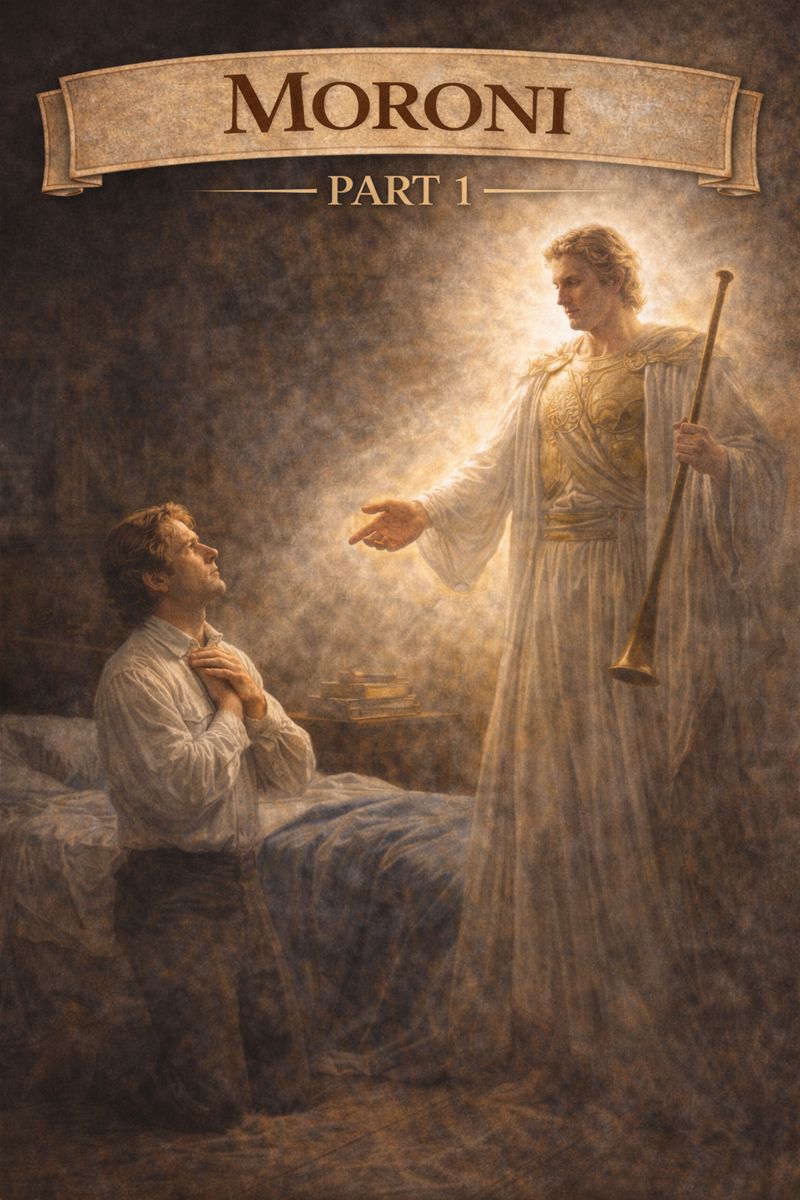
Moroni Part 1
In order to understand the earliest visits of the angel Moroni to Joseph Smith, it is essential to place those events within the real conditions of Joseph’s youth. The world in which he lived was shaped by poverty, economic instability, and constant physical labor. These pressures influenced his spiritual development and played an important role in the divine preparation necessary for the Restoration.
Joseph Smith’s childhood and adolescence unfolded against a backdrop of repeated family relocations and continual economic insecurity. From 1805 onward, the Smiths moved throughout New England in search of better prospects, but opportunity consistently slipped from their reach. Episodes of illness, including the severe leg infection of Joseph’s early years, strained the family emotionally and financially. Their move from Vermont to New Hampshire, back to Vermont, and finally to Palmyra, New York in 1816–17 was not motivated by ambition but by survival. Each relocation represented another attempt to place the family on stable economic ground.
When the Smiths arrived in western New York, the nation was experiencing a short-lived agricultural boom brought on by conditions in Europe. The devastation of European farmlands during the Napoleonic Wars created an unusual demand for American wheat, and prices rose rapidly. Wheat that sold for more than two dollars a bushel gave many farm families, including the Smiths, the hope that they could establish themselves through agriculture. Lucy Mack Smith remembered this optimism clearly, explaining that the family became convinced that wheat could be produced in abundance and sold at high prices.
Yet this hope quickly dissolved. Beginning in 1819, the United States entered its first major financial depression. Wheat prices collapsed to less than a third of their earlier value, and land prices followed. The Smiths, having purchased land, tools, and seed at the height of the market, now faced debts that could no longer be repaid through agricultural labor. Their position was not unique—families across the region were ruined—but the financial strain placed the Smiths in a precarious situation that shaped much of Joseph’s early life.
On top of financial hardship, the family bore the weight of social pressure. Early nineteenth-century American culture, strongly influenced by Calvinist thought, often interpreted prosperity as a sign of divine approval and failure as evidence of weakness or sin. Though the Smiths’ difficulties were the result of national economic forces, neighbors frequently viewed them with suspicion or condescension. Poverty in such an environment was not only a temporal struggle but a social wound.
These factors formed the everyday setting in which Joseph came of age. Clearing forested land became essential to the family’s survival, requiring backbreaking labor from every able body. Joseph’s own account of the First Vision includes the detail that he went to pray in the woods where he had left his axe—a reminder that he was engaged in the constant toil of bringing new land under cultivation. Spiritual searching occurred literally in the moments he could steal away from physical labor.
The death of Alvin Smith in 1823 intensified the family’s hardship. Alvin had been not only beloved but also the strongest and most productive worker in the household. His sudden passing removed both emotional stability and the primary economic engine of the family. When Moroni appeared to Joseph for the first time later that same year, it was within a household grieving deeply and struggling for survival.
Against this background, the significance of Moroni’s repeated visits becomes clearer. Joseph was young, inexperienced, and shaped by poverty. He possessed spiritual desire but had not yet acquired spiritual maturity. The Lord therefore prepared him gradually through Moroni’s ministering. The angel did far more than reveal the existence of the gold plates. He taught Joseph about the work that lay ahead, warned him against improper motives, instructed him in doctrine, and corrected him when necessary. Each visit functioned as part of a long educational process.
Joseph’s circumstances—financial pressure, physical exertion, family loss, and social marginalization—became part of this divine preparation. These experiences cultivated humility and dependence on God, qualities essential for prophetic responsibility. Moroni’s appearances were not isolated miracles; they were steps in a carefully designed training process in which Joseph was shaped into the instrument God required.
Understanding Moroni’s early visits within this historical reality gives clarity to Joseph Smith’s spiritual formation. It reveals how deeply the Restoration was rooted in the concrete world of early nineteenth-century America. The boy who prayed in the woods was also a laborer struggling to save his family, and the young man who listened to an angel was one who had been refined by hardship. Moroni’s visits, occurring in this context, prepared Joseph for the responsibilities that would culminate in the eventual receiving of the plates and the unfolding of the Restoration.
Moroni Part 2
In the years following the First Vision, Joseph Smith entered a period of uncertainty, spiritual struggle, and deep introspection. Although he had been commanded by the Lord not to join any of the existing churches, he found himself isolated and often rejected by the very religious community that might have been expected to support a sincere seeker of truth. His youth and lack of social standing, coupled with the continuing poverty of his family, left him particularly vulnerable to the ordinary weaknesses of adolescence. Joseph later wrote that during this time he mingled with various kinds of company, made foolish mistakes, and displayed the imperfections of youth. Yet he emphasized that he did not engage in serious wrongdoing. Rather, what distressed him most was an increasing sense of distance from the spiritual purity he had felt during the First Vision, and a growing burden of guilt that led him again to seek reconciliation with God.
By the autumn of 1823, when Joseph was seventeen years old, this inner conflict reached a point of urgency. On the night of September 21, overwhelmed by a desire for forgiveness and divine approval, he knelt beside his bed and prayed with earnest intensity. He asked for mercy, acknowledged his shortcomings, and pleaded for direction. This moment closely mirrored the spiritual hunger that had driven him into the woods three years earlier. Once again, Joseph sought peace with God; once again, the heavens responded.
As Joseph prayed, the room grew bright until a pillar of light appeared beside his bed, within which stood an angelic messenger. The fear that initially seized Joseph quickly departed, and the angel spoke his name. He identified himself as Moroni and delivered the message Joseph most needed to hear: the Lord had forgiven him of his sins. Only after Joseph was spiritually reconciled did Moroni proceed with the larger divine purpose for which he had been sent. This ordering is significant. Before the angel would entrust Joseph with knowledge of ancient records or prophetic missions, Joseph first had to be spiritually prepared. Forgiveness preceded calling.
Moroni then revealed that a sacred record, written on gold plates, was deposited in a nearby hill. This record contained the history of ancient peoples on the American continent and preserved the fulness of the everlasting gospel as taught by Jesus Christ. Joseph had been chosen to translate it. God had prepared instruments—the Urim and Thummim—specifically for this purpose, and Joseph would receive them in accordance with divine timing. Moroni further explained that the work was foreordained and that Joseph’s name would eventually be known for good and evil among all nations. This prophecy would prove to be one of the most literal statements in early church history, as Joseph’s reputation has indeed become a point of praise for believers and controversy for critics across the world.
Alongside this remarkable declaration, Moroni delivered sober warnings. The plates were sacred and could not be used for material gain. Joseph would face intense temptation, especially concerning the value of the gold from which the plates were made. The adversary would seek to cloud his motives and stir in him desires that were incompatible with divine trust. Moroni insisted that Joseph must overcome such influences and maintain complete purity of purpose. He also told Joseph to inform his father of the vision, assuring him that his father would believe his words.
Moroni then described in detail the location of the plates. They rested in a stone box buried in a hill approximately three miles from Joseph’s home. The box was covered by a large flat stone and rested upon four small stones or pillars of cement. Later accounts from family members, as well as Joseph’s own repeated descriptions, confirm the consistency of this physical portrayal.
After delivering these instructions, Moroni departed. Yet this did not end the night’s events. As Joseph attempted to rest, the angel returned and repeated the entire message, adding further detail and emphasis. When Moroni departed a second time, he returned once again, reiterating both the promise of the record and the dangers of temptation. The triple repetition underscores the extraordinary importance of the message and suggests that Joseph’s understanding needed to be precise. Moroni acted as a divine instructor whose responsibility was to ensure that the young prophet comprehended both the magnitude of the work and the seriousness of the commandments associated with it.
During these visits, Moroni quoted and interpreted several passages of scripture. These included the closing chapters of Malachi, modified in ways that clarified prophetic meaning; Isaiah 11, which speaks of the latter-day gathering of Israel; Acts 3, which foretells the restitution of all things; and Joel 2, which prophesies the outpouring of the Spirit in the last days. These scriptures formed the earliest doctrinal lessons of the Restoration. They provided Joseph with a prophetic framework for understanding the mission before him, revealing that the unfolding events in his life were part of a much larger divine narrative that stretched from ancient prophecy to the latter days.
The following morning, Joseph reported the vision to his father, who confirmed that the experience was from God. Joseph then visited the hill and located the stone box exactly as Moroni had described. Yet when he attempted to retrieve the plates, he was told that he was not yet ready. Over the next four years, Joseph returned annually to the hill, meeting Moroni each time and receiving further instruction. These visits served as a period of discipline and refinement, in which Joseph’s motives, humility, and spiritual maturity were tested and strengthened. Only after this lengthy preparation did he finally receive the plates in 1827, beginning the work of translation that would culminate in the publication of the Book of Mormon.
From this narrative several doctrinal themes emerge clearly. The first is that reconciliation precedes commission. Before Joseph could be entrusted with the record, he needed forgiveness and spiritual clarity. Second, the purity of motive is central to divine work; sacred objects require sacred intention. Third, revelation often unfolds gradually and repetitively. God instructs line upon line, ensuring comprehension through repetition. Fourth, scripture itself forms the foundation of Restoration theology. Moroni began Joseph’s education not with abstract instruction but with the words of ancient prophets. And finally, God prepares His servants through trials. Joseph’s poverty, his social marginalization, and his inward struggles were not obstacles to the divine plan but instruments shaping his humility and reliance on God.
In these early visits from Moroni, the Restoration begins not with outward miracles but with inward transformation. The young man praying for forgiveness became the young prophet called to open a new dispensation. Moroni’s repeated ministering laid the foundation upon which every later event—the priesthood, the translation, the organization of the church—would rest.
Moroni parte 3
The visits of the angel Moroni to Joseph Smith beginning in 1823 mark the formal commencement of the Restoration of the gospel in this dispensation. These events were not limited to informing Joseph of the existence of an ancient record but provided a detailed doctrinal framework rooted in biblical prophecy. Moroni’s teachings situated Joseph’s future mission within the prophetic expectations of the last days, the return of priesthood authority, and the preparatory work preceding the Second Coming of Jesus Christ.
Joseph Smith in 1823: Historical Background
In September 1823, Joseph Smith was a 17-year-old farm laborer living with his family in conditions of deep poverty in the Palmyra–Manchester region of New York. Since early childhood he had worked intensively to help support his family, whose repeated financial setbacks shaped a life of constant struggle.
Three years earlier, Joseph had already reported seeing God the Father and Jesus Christ in what is now known as the First Vision (1820). Yet this experience did not remove the temporal burdens he faced. By 1823 he was still a young, relatively uneducated farmhand, deeply aware of his family’s material hardship. It is against this historical backdrop of spiritual searching and economic distress that the angel Moroni appeared.
The First Visit of Moroni and Introduction to the Plates
On the night of September 21, 1823, Joseph had prayed for forgiveness of sins and to know his standing before God. As he lay awake, a brilliant light filled the room and an angelic messenger appeared, identifying himself as Moroni.
Moroni declared that God had a work for Joseph to accomplish, and that his name would eventually be known for good and ill among all nations. He then revealed the existence of an ancient record written upon gold plates, containing an account of former inhabitants of the American continent and the fulness of the gospel of Jesus Christ.
Accompanying the plates, Moroni said, were sacred instruments called the Urim and Thummim, prepared to assist in translating the record. From the outset it was clear that this was not simply a discovery of ancient artifacts but a divine commission linked to the unfolding of God’s purposes in the last days.
Scriptures Quoted by Moroni and Their Doctrinal Interpretation
After explaining the existence of the plates, Moroni proceeded to quote numerous biblical passages. These citations were not given as mere recitations but as prophecies interpreted in light of Joseph’s future mission.
Malachi 3 and 4: The Temple, Priesthood, and Sealing Power
Moroni first quoted portions of Malachi 3, which discusses the Lord coming suddenly to His temple and purifying the “sons of Levi.” Although Joseph does not record every verse cited, the emphasis corresponds to themes of covenant purification and priesthood restoration.
Moroni then quoted Malachi 4, but with significant variations from the King James text. Instead of simply stating that the coming day would “burn as an oven,” Moroni emphasized that agents would come who would burn the wicked as stubble. More strikingly, instead of the biblical phrase “I will send you Elijah the prophet,” Moroni declared:
“I will reveal unto you the priesthood by the hand of Elijah the Prophet before the coming of the great and dreadful day of the Lord.”
This addition clarified that Elijah’s future appearance would involve restoring priesthood keys—particularly sealing authority. This prophecy was fulfilled in 1836 when Elijah appeared to Joseph Smith and Oliver Cowdery in the Kirtland Temple.
Moroni further explained that God would “plant in the hearts of the children the promises made to the fathers,” thus connecting the Restoration with Abrahamic covenant blessings. Without this sealing power, Moroni said, the whole earth would be utterly wasted at the Lord’s coming, indicating that the very purpose of the earth’s creation is tied to the exaltation of God’s children through eternal covenants.
Isaiah 11: Messianic and Latter-day Fulfillment
Moroni then cited Isaiah 11, the prophecy of a “rod” from the stem of Jesse upon whom the Spirit of the Lord would rest. Traditionally applied to Christ, this chapter also carries latter-day implications associated with the gathering of Israel. Moroni stated that this prophecy was about to be fulfilled, linking the Restoration to the long-awaited renewal of covenant promises.
Acts 3:22–23: Christ as the Prophet and Future Judgment
Quoting Acts 3, Moroni explained that the “prophet like unto Moses” was Christ, but that the time when those who rejected His voice would be “cut off from among the people” had not yet arrived. This judgment, however, would soon come. Moroni thus situated Joseph’s mission within the eschatological framework of the New Testament.
Joel 2: Spiritual Gifts and Signs of the Last Days
Finally, Moroni quoted Joel 2:28–32, describing the outpouring of the Spirit, visions, dreams, and wonders in heaven and earth preceding the great day of the Lord. Moroni taught that these prophecies were not yet fulfilled but soon would be, and he declared that the fulness of the Gentiles was near. This further emphasized that Joseph’s calling belonged to the prophetic unfolding of the last days.
Repeated Visits During the Night
Moroni’s visit did not occur only once. After ascending through what Joseph described as a conduit of light, Moroni returned and repeated the same message word for word. A third visit followed in which he again repeated all the prior instructions and added warnings of coming judgments by sword, fire, and pestilence.
The repetition underscored the seriousness of Joseph’s commission and ensured he would not forget what he had been taught. At some point during these visits, Moroni also opened to Joseph’s mind a vivid panoramic vision showing the exact location of the plates on the nearby hill.
A Fourth Visit and the Warning Against Seeking Wealth
The next morning, exhausted from lack of sleep, Joseph tried to work with his father but collapsed. Moroni appeared yet again—his fourth visit within roughly twelve hours—repeating the message and adding a new warning.
He cautioned Joseph that Satan would tempt him because of his family’s poverty, urging him to seek the plates for financial gain. Moroni strictly forbade this and insisted that Joseph could obtain the plates only if his sole motive was to glorify God and build His kingdom.
This warning reveals that Joseph’s economic desperation was not incidental but a genuine point of vulnerability.
Joseph’s Ascent to the Hill and the Struggle of Intent
After receiving his father’s encouragement, Joseph went to the hill shown in his vision. Accounts preserved by Oliver Cowdery describe that as Joseph walked, competing influences worked upon his mind—one reminding him of the sacred purpose of the plates, the other enticing him with the prospect of wealth.
When Joseph uncovered the stone box and saw the plates, the sight of the gold intensified the temptation. For a moment his thoughts focused not on the divine commission but on the possibility of relieving his family’s poverty. This lapse in intent prevented him from receiving the record at that time.
A Doctrinal Parallel: Laman and Lemuel’s Weakness After Seeing an Angel
Joseph’s momentary failure, even after multiple angelic visits, parallels the account of Laman and Lemuel in the Book of Mormon. After seeing an angel who instructed them to return to Jerusalem, they immediately doubted and feared upon the angel’s departure.
The pattern illustrates a doctrinal principle: spiritual manifestations do not remove human weakness. Revelation does not erase agency or eliminate the struggle between heavenly influence and mortal inclination.
Doctrinal Significance of Moroni’s Visits
Historically, Moroni’s visits announce the beginning of the Restoration. Doctrinally, they emphasize several central themes:
The Restoration involves the return of priesthood authority, including sealing keys associated with Elijah.
The purpose of the Restoration is exaltation, not merely salvation from hell; the earth fulfills its purpose only through eternal family covenants.
The events are situated within the last days, fulfilling prophecies of Malachi, Isaiah, Joel, and the New Testament.
God works through imperfect humans, who learn and grow through correction, repentance, and continuing revelation.
Thus, Moroni’s visits in 1823 form a foundational moment in Latter-day Saint history, grounding Joseph Smith’s mission in ancient prophecy and inaugurating the work that would lead to the coming forth of the Book of Mormon and the restoration of priesthood keys and covenants in preparation for the return of Jesus Christ.
Moroni parte 4
Joseph Smith, Moroni, and the Struggle to Obtain the Plates:
The early years of Joseph Smith’s interaction with the angel Moroni reveal not only the introduction of the gold plates and the coming forth of the Book of Mormon, but also a prolonged period of spiritual education, chastening, and preparation. These experiences show Joseph learning, often painfully, about temptation, repentance, priesthood, and the reality of the adversary.
This text focuses only on the historical and doctrinal aspects of those events, without the conversational elements of the podcast.
Joseph’s First Attempt to Take the Plates (1823)
After the initial visits of Moroni during the night of 21–22 September 1823, Joseph Smith was shown in vision the exact location of the plates on a nearby hill (later identified as the Hill Cumorah). The instructions were clear: he was to obtain the record for the purpose of glorifying God and building His kingdom, not for personal gain.
The next day, after informing his father and receiving his approval to follow the heavenly directions, Joseph went to the hill. Because the location had been shown to him so clearly in vision, he recognized the place at once. There, he found a stone box and, upon opening it, saw the gold plates.
At this crucial moment, however, Joseph’s thoughts were heavily influenced by his family’s extreme poverty. The sight of what appeared to be a substantial amount of gold stirred the powerful idea that the plates might be used to relieve his family’s financial distress. Despite Moroni’s warning that Satan would tempt him to seek the plates for riches, that temptation now became dominant in his mind.
Joseph later described that he made repeated attempts to take the plates from the box but was prevented. In his earliest known history (1832), he wrote that he tried three times, could not obtain them, and became so frightened that he wondered if the entire experience had been a dream or vision. Reflecting more carefully, he realized it was real and cried out to the Lord in distress, asking why he could not obtain the record.
Moroni’s Reproof and Explanation
In response to Joseph’s prayer, Moroni appeared again at the hill and explained why Joseph had failed. The angel told him plainly that he had not kept the commandment given by the Lord: he had not maintained an eye single to the glory of God.
Joseph wrote that he had been “tempted of the adversary” and had sought the plates to obtain riches. Because of this, he could not receive them. Moroni then added an important doctrinal explanation:
Joseph had been “left under temptation” so that he might become acquainted with the power of the adversary.
He was commanded to repent and call upon the Lord.
He was promised that he would be forgiven and that, in the Lord’s own due time, he would obtain the plates.
This is significant doctrinally. Joseph was being taught that:
Satan is a real being with genuine power to tempt and influence human thoughts.
Even someone who has seen God and angels is not beyond temptation.
Failure under temptation is not the end, if followed by repentance, humility, and renewed obedience.
Historically, this moment marks a shattering personal disappointment for Joseph, who had been promised a “special work” and now saw himself fail at the very threshold of it.
The Power of Temptation and Latter-day Saint Doctrine on Satan
Joseph’s experience at the hill offers a concrete illustration of Latter-day Saint doctrine concerning the adversary. From the First Vision onward, Joseph encountered Satan as a real personal being, not merely a symbol of evil.
In the First Vision (1820), Joseph described a power that seized him, binding his tongue and filling him with fear, making him feel as though he was about to be destroyed. That experience demonstrated the physical and spiritual reality of the adversary.
In 1823 at the hill, the adversary’s power appears in a more subtle form: not through physical restraint, but through persuasion and desire—appealing to Joseph’s understandable wish to help his impoverished family. The temptation was not to do something that looked obviously wicked; it was to take a divine gift and repurpose it for personal or worldly gain.
Doctrinally, this illustrates:
Satan often works through half-truths, mixing something that seems good (helping one’s family) with disobedience to a divine command.
Temptation tends to exploit real vulnerabilities: in Joseph’s case, lifelong poverty and concern for his parents.
Angelic manifestations and spiritual experiences do not remove human weakness or erase agency.
Joseph would later observe that he had “a very subtle devil to deal with,” and that humility before God was the only way to “curb him.” The early experiences with Moroni helped teach him this reality.
Annual Visits to the Hill and Continuing Instruction (1823–1827)
After the first failed attempt, Joseph was told by Moroni that he must return to the hill once each year, on the same date, until the time came when he would be worthy to receive the plates.
Joseph records that he did exactly as commanded:
Each year he went to the same place.
Each time he found the same messenger, Moroni, there.
Each interview included further instruction and “intelligence” concerning what the Lord was going to do and the manner in which His kingdom would be established in the last days.
During these years (1824, 1825, 1826), Joseph still did not receive the plates. The repeated delay indicates that his preparation—spiritually, morally, and practically—was not yet complete. At the same time, the yearly interviews show that God did not abandon him; rather, Moroni continued to teach and shape him despite earlier failure.
Historically, this created a pattern: the plates would come not instantly, but only after years of disciplined obedience, repeated testing, and instruction under angelic guidance.
Family Tragedy and Worsening Poverty: The Death of Alvin
Shortly after Joseph’s first attempt to obtain the plates, tragedy struck the Smith family. Alvin Smith, Joseph’s older brother, died suddenly.
Alvin was not only beloved by his family; he was also their primary economic support. As the eldest son and strongest laborer, he contributed significantly to the farm’s productivity and the family’s income. His death was therefore a double blow:
Emotional and spiritual grief from losing a son and brother.
Practical economic loss, as the family’s precarious financial situation became even more difficult.
This deepened the pressure on Joseph. The same poverty that had made Satan’s temptation so powerful at the hill now became even more acute. It is likely that these circumstances continued to make his yearly efforts to approach the plates a spiritual struggle, even as Moroni continued to instruct him.
Josiah Stowell and the Search for a “Spanish Silver Mine” (1825)
In 1825, Joseph was hired by Josiah Stowell, a man from southern New York, to help search for what Stowell believed was an old “Spanish silver mine” in the Pennsylvania–New York region.
Historically, there is no evidence that the Spanish ever operated such a mine in that area, but Stowell was convinced and employed Joseph as a day laborer. Joseph accepted the work because:
It offered higher wages than he could obtain in Palmyra.
The Smith family’s financial situation was desperate, especially after Alvin’s death.
Joseph later stated that the effort to find the mine was not successful and that he eventually persuaded Stowell to abandon the project. During this period, however, Joseph’s economic motivation is clear: he was seeking honest labor to support his family, even in unusual ventures, because steady work was scarce.
This context does not negate his prophetic calling; rather, it highlights the difficult reality in which he lived. While Moroni was teaching him about the coming forth of an ancient record and the last days, Joseph still had to work, move, and make decisions as a poor young man in early nineteenth-century America.
Spiritual Lessons in Repeated Failure and Delayed Blessings
Joseph’s experience with the plates from 1823 to 1827 offers several important doctrinal and practical lessons:
Revelation does not remove agency.
Seeing God the Father, Jesus Christ, and an angel did not prevent Joseph from being tempted or from making mistakes.
God allows His servants to experience real temptation.
Moroni explicitly told Joseph that he had been “left under temptation” so that he could understand the adversary’s power. Knowledge of Satan’s reality and methods was part of Joseph’s prophetic preparation.
Failure is met with chastening, but also with mercy and continued guidance.
Joseph was rebuked, told to repent, and informed that he could not yet receive the plates. Yet he was also promised forgiveness and given ongoing instruction over several years.
Spiritual preparation can be long and demanding.
Joseph’s path to actually obtaining the plates stretched over four years of annual visits, repeated disappointments, family tragedy, hard labor, and continued temptation.
The Restoration is grounded in real human experience.
Joseph’s story is not that of a distant, flawless figure, but of a young, poor, imperfect man whom God gradually shaped into a prophet through revelation, chastening, and mercy
Moroni Part 5
In the years following Moroni’s initial visits, Joseph Smith continued to undergo a prolonged period of spiritual refinement. Although the angel had revealed the existence of the plates in 1823, Joseph did not receive them immediately. For four consecutive years he returned to the Hill Cumorah on the same date, met Moroni there, and was instructed that he was not yet ready to take possession of the record. These annual visits reveal how far Joseph still had to go in overcoming the natural tendencies that interfered with his ability to seek sacred things with pure intent. Joseph later remarked that he lacked an “eye single to the glory of God,” a phrase that captures his continuing struggle between the cares of the world and the purposes of heaven. Moroni’s role during these years was not simply to guard the plates but to act as Joseph’s spiritual tutor, correcting him when necessary and preparing him for the prophetic responsibilities that lay ahead.
A significant development occurred in early 1827 when Joseph married Emma Hale. Although Joseph never explicitly linked his marriage to his final readiness to receive the plates, historical context strongly suggests that Emma played a decisive role in that preparation. She supported Joseph when few others did and believed his claims even before she had seen any physical evidence. Her presence provided stability and companionship at a time when Joseph was navigating both poverty and spiritual burden. That Joseph finally obtained the plates later that same year indicates that Emma’s faith and influence were instrumental in his progression toward spiritual maturity.
Shortly before Joseph retrieved the plates, his mother Lucy Mack Smith recorded a revealing episode in which Joseph returned home exhausted, distressed, and shaken. He told his parents that he had received the most severe chastisement of his life. His father initially assumed that local men—who were often hostile toward Joseph—had abused him, but Joseph clarified that it was Moroni who had rebuked him. The chastisement called upon Joseph to repent, to remember the sacredness of his calling, and to prepare himself fully for the translation and publication of the record. Joseph later said that this moment clarified for him the precise course he must follow. It was soon afterward that he ascended the hill and finally received the plates.
When Joseph removed the plates from the stone box on September 22, 1827, he immediately faced intense physical danger. Individuals who had learned of the plates’ existence—and who believed they were made of gold—attempted to seize them. Joseph was followed, ambushed, and attacked several times as he carried the record home. According to his mother, he was struck with a gun, forced to defend himself, and at one point dislocated his thumb while fending off an assailant. These attacks illustrate the contrast between earlier years, when Joseph had hesitated under temptation, and this moment, when he demonstrated unwavering determination to protect the plates at all costs. The danger he faced underscores the degree to which rumors, suspicion, and greed surrounded the coming forth of the Book of Mormon.
After obtaining the plates, Joseph began the work of translation. At first Emma served as a scribe, and later Martin Harris took over much of the writing. Harris supported Joseph materially and believed in the work, yet he struggled with the skepticism of his family. Hoping to convince them, he repeatedly asked Joseph for permission to take the translated manuscript home. Joseph inquired of the Lord, and the Lord refused. Harris persisted. Joseph asked again, and again the Lord refused. A third request led Joseph to seek permission once more, and this time the Lord reluctantly consented, but only under strict covenant that Martin show the manuscript to a limited list of individuals.
Joseph later described his decision to press the Lord for permission as a moment in which he “feared man more than God.” His fear was not selfish; he knew Martin was essential to financing the translation and printing of the Book of Mormon and worried that losing Harris might endanger the entire project. Yet the Lord had already provided instructions, and Joseph’s reluctance to trust those instructions resulted in divine displeasure.
Significantly, Moroni took the plates and the interpreters away before Joseph knew the pages had been lost. The loss of the plates was not a consequence of the missing manuscript but of Joseph’s earlier failure to obey the Lord’s repeated refusal. Moroni told him that he had “wearied the Lord” by pressing for permission contrary to divine counsel. Only afterward did Joseph learn that the manuscript itself was gone.
When Joseph finally discovered that the 116 pages had been lost, he collapsed into despair. He cried out that he had lost his soul and that all was ruined. In his mind, he had disobeyed God, lost the plates, broken sacred covenants, disappointed the Lord, and jeopardized the restoration itself. These feelings of condemnation were intensified by personal tragedy: Emma had recently endured a difficult childbirth, nearly lost her own life, and their newborn baby had died. Joseph’s sense of failure must be understood within the religious context of nineteenth-century America, where divine displeasure was often perceived as catastrophic and final. Joseph believed he had broken a commandment that could not be mended.
Despising himself and fearing that God had rejected him, Joseph returned to Harmony in sorrow. He walked some distance into the fields, where Moroni again appeared to him. The angel returned the Urim and Thummim, and Joseph sought the Lord in prayer. The revelation now known as Doctrine and Covenants 3 followed. Its opening lines sharply rebuked Joseph for fearing man more than God, yet the revelation also offered assurance that the work of God cannot be frustrated. Joseph was commanded to repent, but he was also told that he was still chosen, that he still held his calling, and that God’s purposes would continue through him. Moroni thus acted once more as the agent of correction and the herald of divine mercy.
Moroni’s involvement in the unfolding Restoration did not end with Joseph’s early years. He later appeared to the Three Witnesses, showing them the plates and other sacred objects. He appeared separately to Martin Harris in another manifestation of divine confirmation. He visited Lyman Johnson and others who sought spiritual assurance and eventually received the plates back from Joseph after the translation was completed. Joseph later identified Moroni with the angel foretold in Revelation 14:6, the messenger who would bring the everlasting gospel to the world in the last days.
Early church leaders, including David W. Patten, taught that angels were resurrected beings who had lived upon the earth. Joseph Smith explained that Moroni was one of several angelic figures who restored or held priesthood keys connected to the last dispensation. These beings—including Moroni, Michael or Adam, Gabriel or Noah, Elias, Elijah, and the Apostles Peter, James, and John—played essential roles in restoring authority, revelation, and covenantal knowledge to the earth.
The story of Moroni’s relationship with Joseph Smith reveals enduring doctrinal themes. Joseph’s life illustrates that repentance is continual, that divine correction—though painful—is an expression of divine love, and that God prepares His prophets through trials. Joseph’s hardships, poverty, persecution, and personal failings were not impediments to God’s work but instruments shaping his character. Sacred responsibilities required Joseph to purify his motives, and he was not permitted to receive the plates until he had fully aligned his heart with God’s purposes. Even the loss of the 116 pages, though devastating, could not halt the Restoration. Mercy continued after error, and Joseph’s calling remained intact through repentance. Moroni’s long tutelage, filled with chastisement, reassurance, and instruction, reflects the divine pattern in which prophets are not created in a moment but shaped over time, line upon line, through struggle and revelation.
Listen to the full podcast:
https://www.youtube.com/@standardoftruthpodcastllc
Season 3, Episode 43 – Moroni Part 4
Season 3, Episode 43 – Moroni Part 5