
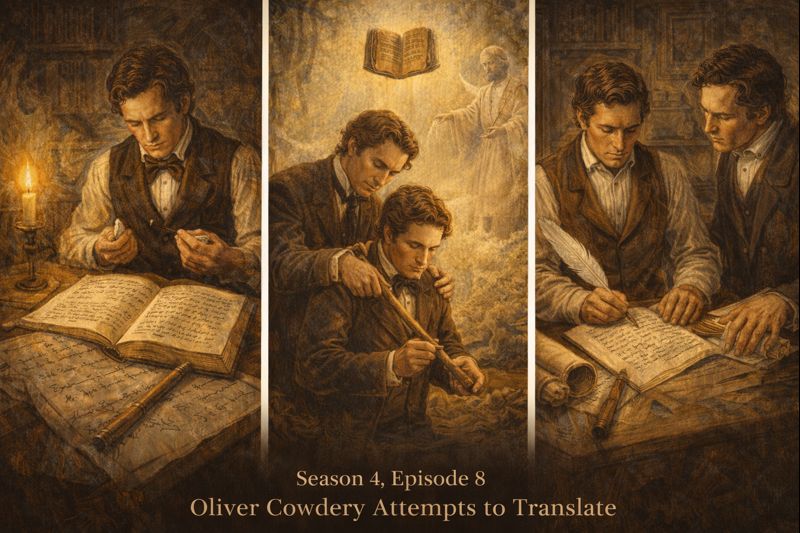
The story of Oliver Cowdery’s attempt to translate opens a window into a rare and intimate moment in the early Restoration. It unfolds while Joseph Smith is working through multiple ancient records, while Church organization is still taking shape, and while God is teaching His servants how revelation actually operates. Oliver, eager to take part in the sacred process he witnessed daily, asked for the gift to translate—and the Lord granted him the opportunity, though the outcome was not what he expected.
A Question About Pittsburgh and the Early Church Units
A listener’s question led the hosts to clarify a necessary historical point: was the “Pittsburgh Second Ward” the oldest ward east of the Mississippi, possibly founded by Sidney Rigdon?
The answer requires remembering that wards did not exist in Joseph Smith’s time. Throughout the 1830s and early 1840s, local congregations were called branches. The word ward was first used in Nauvoo, where the growing settlement was divided into districts—initially Upper, Middle, and Lower Wards, and later First, Second, and Third Wards, eventually reaching eleven.
Thus, Pittsburgh in the 1830s and 1840s had branches, not wards. Sidney Rigdon did preach in the region and later organized his own post-excommunication church in Pennsylvania, but he did not establish a Latter-day Saint ward.
What Was Oliver Supposed to ‘Study Out in His Mind’?
A listener trained in neuroscience raised a deeper question:
If Oliver was commanded to “study it out in [his] mind,” what material was he supposed to work with? What method was he supposed to use—seer stone, interpreters, or something else? And how could he study something he had never seen?
To answer, one must look closely at Doctrine and Covenants 8 and 9, remembering that Joseph at the time was also translating another record—the one now known as Doctrine and Covenants 7.
Oliver’s Gifts in Doctrine and Covenants 8
When Oliver arrived at Harmony and became Joseph’s scribe, he quickly desired to translate himself. The Lord answered by revealing that Oliver possessed two specific gifts:
a gift of revelation through the Holy Ghost, and
what Joseph’s later editing called “the gift of Aaron.”
But in the earliest manuscript—the Book of Commandments and Revelations—the phrase was very different. There, the Lord described it as “the gift of working with the sprout,” an “object of nature” that would be in Oliver’s hands. The language unmistakably points to what early Americans called a divining rod or dowsing rod, used for finding water, lost items, or even answering yes-or-no questions.
Far from being strange in its time, this was part of the cultural world that shaped both Joseph and Oliver. Revelation often comes through the symbols and vocabulary already familiar to the recipient. Joseph later revised the wording to “the gift of Aaron,” a more biblical expression, but the original text helps us understand how the Lord met Oliver where he was.
This gift has no connection to the Aaronic Priesthood—it predates its restoration and refers instead to Oliver’s spiritual sensitivity.
Doctrine and Covenants 7 and the Presence of Other Records
Understanding Oliver’s instructions becomes clearer when remembering that in April 1829 Joseph translated another ancient text: the parchment written by the Apostle John, now found in Doctrine and Covenants 7.
This means that when the Lord spoke of “engravings of old records” and of “other records” Oliver might translate in the future, He was not limiting His meaning to the gold plates alone.
Why Oliver Did Not Succeed in Translating
When Oliver finally attempted to translate, he expected the process to flow as easily for him as it did for Joseph. But the Lord rebuked him gently, explaining that Oliver had “taken no thought save it was to ask.” Translation required spiritual and mental labor—pondering, reasoning, seeking the Spirit’s confirmation.
Oliver feared, hesitated, and did not prepare his mind.
The Lord told him plainly:
Had you understood this principle, you could have translated.
The revelation distinguishes “this record”—the Book of Mormon—from “other records” Oliver might translate later, reinforcing again that God’s instruction was broader than a single manuscript.
We do not know what passage Oliver tried or how far he got. There is no evidence that he ever produced a translated line. A small portion of the original manuscript is in Joseph’s handwriting, but this almost certainly means only that Oliver briefly stepped away, not that Oliver translated and Joseph corrected.
Joseph’s Method vs. Oliver’s Preparation
Joseph had years of experience learning to recognize the voice of revelation. Whether using the interpreters or his seer stone placed in a hat to block out external light, Joseph operated within a spiritual gift he had long been developing.
Oliver, by contrast, assumed that revelation would be automatic. He learned instead that revelation respects agency, effort, and preparation. The process was not mechanical; it was relational and spiritual.
The Essential Conclusion
Doctrine and Covenants 8 and 9 were never meant to explain Joseph’s method of translation. They explain Oliver’s failure, not Joseph’s process.
We cannot reconstruct what Oliver “studied,” what he attempted, or what he envisioned. The Lord’s instruction was personal, tailored, and partly hidden from our view.
But the principle endures: revelation requires work. It demands that the mind and heart move toward God before God confirms the direction. Oliver did not become a translator, but he became something far more enduring—the chief scribe of the Book of Mormon and one of the Three Witnesses, a testimony he never denied.
Listen to the full podcast here:
https://www.youtube.com/@standardoftruthpodcastllc
Season 4, Episode 8 – Oliver Cowdery Attempts to Translate