
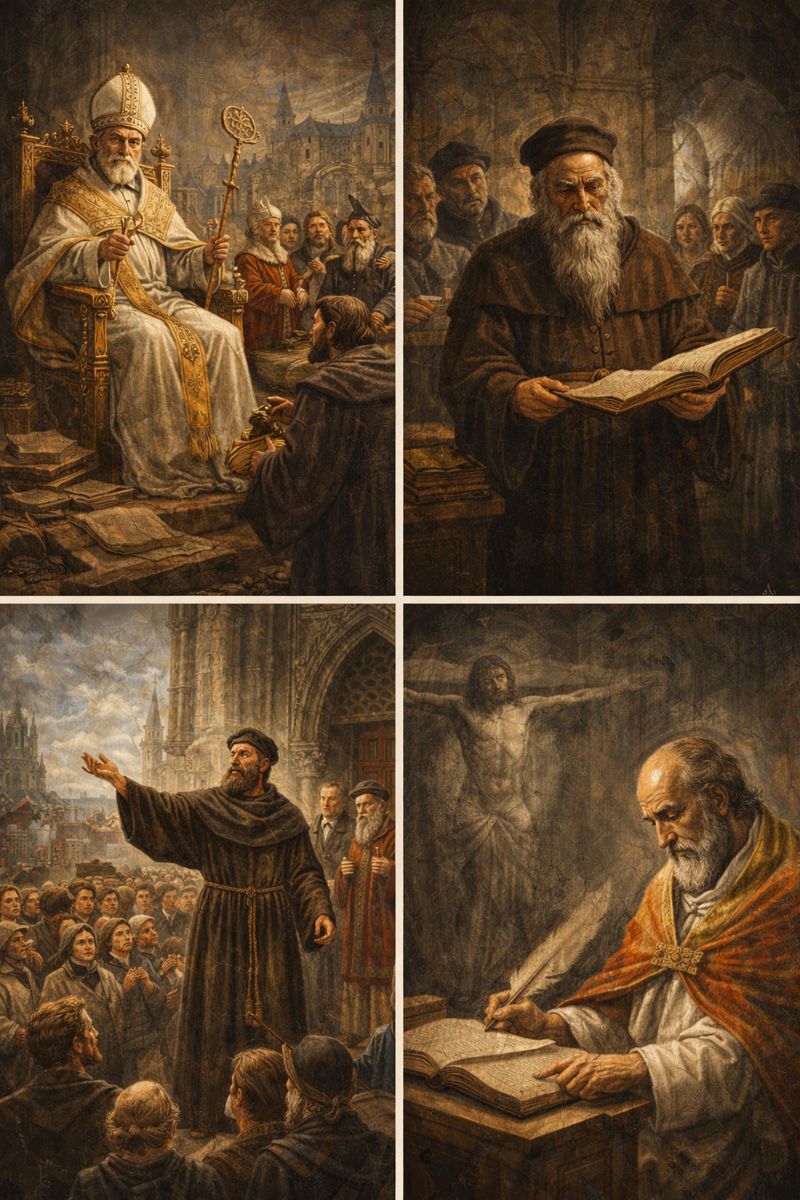
Context of the Pre-Reformation Catholic Church
In the late Middle Ages and early Renaissance (1300s–1500s), the Catholic Church was simultaneously expanding worldwide and experiencing significant internal tensions.
Historically:
- The Church was rapidly growing through Spanish and Portuguese expansion into the Americas, Africa, and Asia.
- Literacy rates in Europe were low; the Bible existed only in Latin (the Vulgate), meaning the average Christian could not read scripture directly.
- Ordinary believers depended entirely on priests for biblical interpretation.
Internal problems included:
- Corruption and absenteeism, with bishops often holding office for political or financial gain while delegating spiritual responsibilities to others.
- Political influence from monarchs, who often controlled ecclesiastical appointments.
- The Western Schism (1378–1417), during which multiple men claimed to be pope simultaneously.
These issues created conditions favorable for early reform movements.
John Wycliffe (c. 1320s–1384)
Wycliffe, an English theologian, became an early proponent of reform in the late 1300s.
Scripture Over Church Tradition
Wycliffe taught:
- Scripture—not ecclesiastical hierarchy or tradition—should be the foundation of Christian doctrine.
- Many Church teachings lacked direct biblical support.
Critique of Clerical Authority
Wycliffe opposed:
- The idea that salvation required priestly mediation or sacramental administration.
- The institutional Church as the only expression of the true “church.”
He instead proposed the concept of an “invisible church” composed of believers predestined for salvation.
Rejection of Transubstantiation
Wycliffe denied the doctrine that the Eucharistic bread and wine literally became the body and blood of Christ, advocating a symbolic interpretation.
Bible Translation into English
He inspired the first major English translation of the Bible, challenging Church restrictions on vernacular scripture.
Impact:
Wycliffe’s followers, the Lollards, formed an underground reform movement that periodically faced persecution in England.
Jan Hus (c. 1372–1415)
A Czech priest and scholar, Jan Hus drew heavily from Wycliffe’s writings.
He taught:
- Scripture holds greater authority than Church tradition.
- Clerical immorality undermines spiritual authority.
- Salvation comes through Christ, not dependence on priesthood hierarchy.
- Transubstantiation was questionable.
Hus sought reform within the Catholic Church rather than secession.
Condemnation at the Council of Constance
Hus traveled to the Council of Constance under a guarantee of safe conduct. Upon arrival, he was:
- Imprisoned
- Tried for heresy
- Strangled and burned in 1415
His execution sparked unrest throughout Bohemia.
The Hussite Movement
After Hus’s death:
- Hussites formed a widespread reform movement.
- Events such as the Defenestration of Prague (1419) revealed rising conflict with Church authorities.
- The movement was eventually suppressed by the Holy Roman Empire, but Hus’s theological influence endured.
Augustine of Hippo and Doctrinal Foundations
The early Church Father Augustine (354–430) deeply shaped later reform theology.
He emphasized:
- Salvation is possible only through divine grace.
- Humans cannot earn salvation through works.
- God’s foreknowledge includes who will ultimately be saved.
Augustine’s writings on grace and predestination significantly influenced both:
- Catholic theologians defending sacramental and ecclesiastical authority.
- Protestant reformers such as Martin Luther and John Calvin.
Conditions That Set the Stage for the Reformation
By the early 1500s, several long-developing pressures converged:
- The Church remained powerful but faced significant internal strain.
- Theological disagreements persisted regarding:
- Vernacular Bible translations were prohibited, keeping laypeople dependent on clergy.
- Reform movements such as the Lollards and Hussites had already challenged Church authority.
- Political conflicts between monarchs and church leaders added instability.
Into this already complex religious climate came Martin Luther in 1517, whose critiques of indulgences and insistence on scriptural primacy initiated the Protestant Reformation.
Listen to the full podcast here:
Season 5, Episode 26 – Prelude to the Reformation (formerly premium content from JSR)