Questions Addressed in the Episode
This episode responds to two main issues:
Early documents mentioned by President Gordon B. Hinckley in a 1985 Ensign article, including:
A letter attributed to Joseph Smith to Josiah Stowell (1825)
A letter attributed to Martin Harris to W. W. Phelps (1830)
Concerns about:
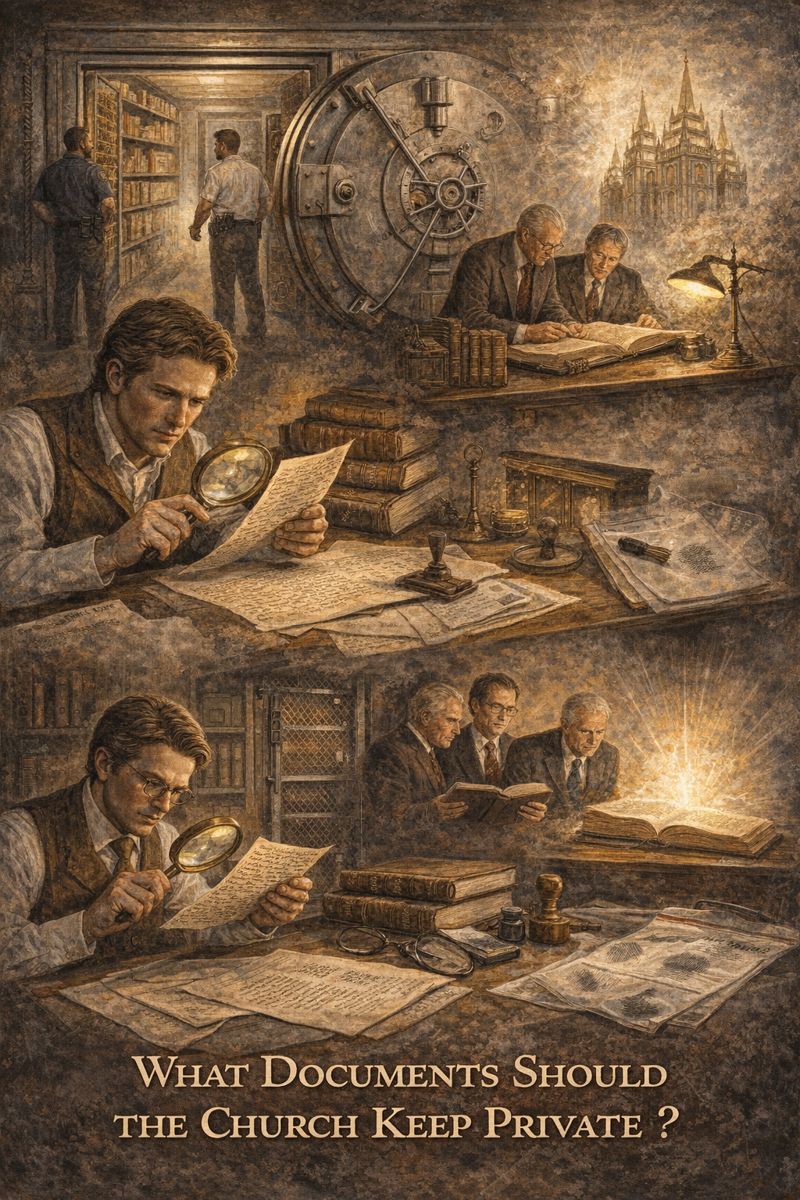
“Secret archives”
Supposedly hidden Church documents
Why some records are not (or were not) publicly available
It also explains how the Church History Library, professional archivists, and the Joseph Smith Papers Project function.
What Archives Are and How They Work
All serious archives—religious, governmental, academic, corporate—contain a mix of:
Open-access materials (freely available to researchers)
Restricted materials (limited because of privacy, sacred content, or fragility)
Unprocessed collections (not yet cataloged, sorted, or fully understood)
Items under evaluation (authenticity and provenance still being verified)
Important realities
In the 19th century, the Church did not have a modern archival system.
Documents were kept in homes, trunks, barns, desks, and Church offices.
This mirrors other institutions: professional archives usually develop decades later.
Ethical archives restrict access to
Personal confessions
Temple-related descriptions copied into diaries
Private financial information
Disciplinary cases
Sensitive family matters
These restrictions exist to protect privacy and sacred things—not as part of a conspiracy.
Protection Against Theft and Forgery
Historical manuscripts can be highly valuable. Because of this:
Archives must secure collections against theft.
They must also guard against forged documents, especially in areas like religious history where forged letters can cause confusion or scandal.
This context is essential for understanding why the Church takes serious precautions with access and authentication.
Why So Many Documents Have Appeared in Recent Decades
The large increase in published early Latter-day Saint documents in the last 20+ years reflects:
Professionalization of Church History
Creation of the Church History Library (opened 2009)
Hiring trained archivists, historians, conservators
Major financial support for large-scale projects
Technological advances
Digitization, high-resolution imaging
Online databases enabling global access
Rising scholarly interest
More historians and researchers asking questions about early Church history
Greater demand for primary sources
In other words, greater openness and publishing capacity are the result of development and investment, not proof that earlier generations were deliberately hiding material.
The Joseph Smith Papers: Gathering and Verifying Documents
The Joseph Smith Papers Project has drawn on:
Documents long in Church custody (sometimes uncatalogued or misfiled)
Items from private family collections
Records in historical societies, university archives, and government repositories
Verification involves
Comparing handwriting with known samples
Examining ink and paper using forensic methods
Checking historical context (dates, events, locations)
Tracing the chain of ownership (provenance)
Publishing a single document typically requires
Careful transcription of sometimes difficult handwriting
Standardization of spelling without altering meaning
Footnotes identifying people, places, sources, and textual issues
Multiple layers of scholarly review and checking
This explains why the publication process is slow and meticulous.
Mark Hofmann’s Forgeries and President Hinckley’s 1985 References
Two items President Hinckley cautiously discussed in 1985:
A supposed 1825 letter from Joseph Smith to Josiah Stowell
A supposed 1830 letter from Martin Harris to W. W. Phelps
were later exposed as forgeries created by Mark Hofmann.
Key points
President Hinckley did not declare these letters to be unquestionably genuine; he spoke conditionally, noting that if authentic, they would be significant.
Hofmann’s methods
Use of genuine period paper and ink formulas
Skilled imitation of handwriting
Clever use of accurate historical details mixed with subtle inventions
After Hofmann’s bombings and confession in 1985–86:
Archives worldwide—including the Church—dramatically tightened their authentication processes.
The Church implemented advanced forensic techniques and training from experts, including those who exposed Hofmann’s forgeries.
Example of a Recently Evaluated Suspected Forgery
The episode mentions a July 1831 letter that:
Describes a “Mormonite” preacher
Mentions a “shining stone”
Discusses early missionary activity
At first glance, it seemed historically accurate. But deeper analysis found:
Inconsistent spelling and style compared to genuine documents of that time
A suspicious chain of custody
Structural similarities to methods used by Hofmann
Scholars judged the letter highly questionable—likely a forgery or at least unreliable. This illustrates why cautious, professional review is essential.
Why Some Documents Remain Restricted
Even with a strong trend toward openness, some records cannot be released in full:
Personal confessions or sensitive spiritual experiences recorded by leaders
Notes of disciplinary councils
Temple descriptions copied into private journals
Financial details of specific individuals
Intimate family matters
In many cases, the Church now publishes redacted versions: the historical core is available, while sacred or confidential details are removed.
Responding to Claims of “Hidden” History
Critics sometimes argue—especially in movements like Denver Snuffer’s—that:
The Church concealed documents in its “vault”
Records were only released under pressure
Leaders intentionally suppressed evidence
Historical context suggests otherwise
All serious archives restrict items for non-conspiratorial reasons.
Large numbers of early documents were never cataloged, not deliberately hidden.
Processing, authenticating, and publishing takes years, especially with small staffs.
Many newly published documents were not previously known, even to Church historians.
The Joseph Smith Papers represents one of the most transparent documentary projects ever undertaken by a religious organization.
History, Archives, and Spiritual Knowledge
Even perfect access to every document would not by itself prove or disprove prophetic authority. For Latter-day Saints:
Historical documents help illuminate context.
Testimony ultimately rests on:
The Book of Mormon
The witness of the Holy Ghost
Trust in living prophets and ongoing revelation
Historical work is valuable and faith-strengthening, but spiritual truth depends on revelation, not on exhaustive archival completeness.