
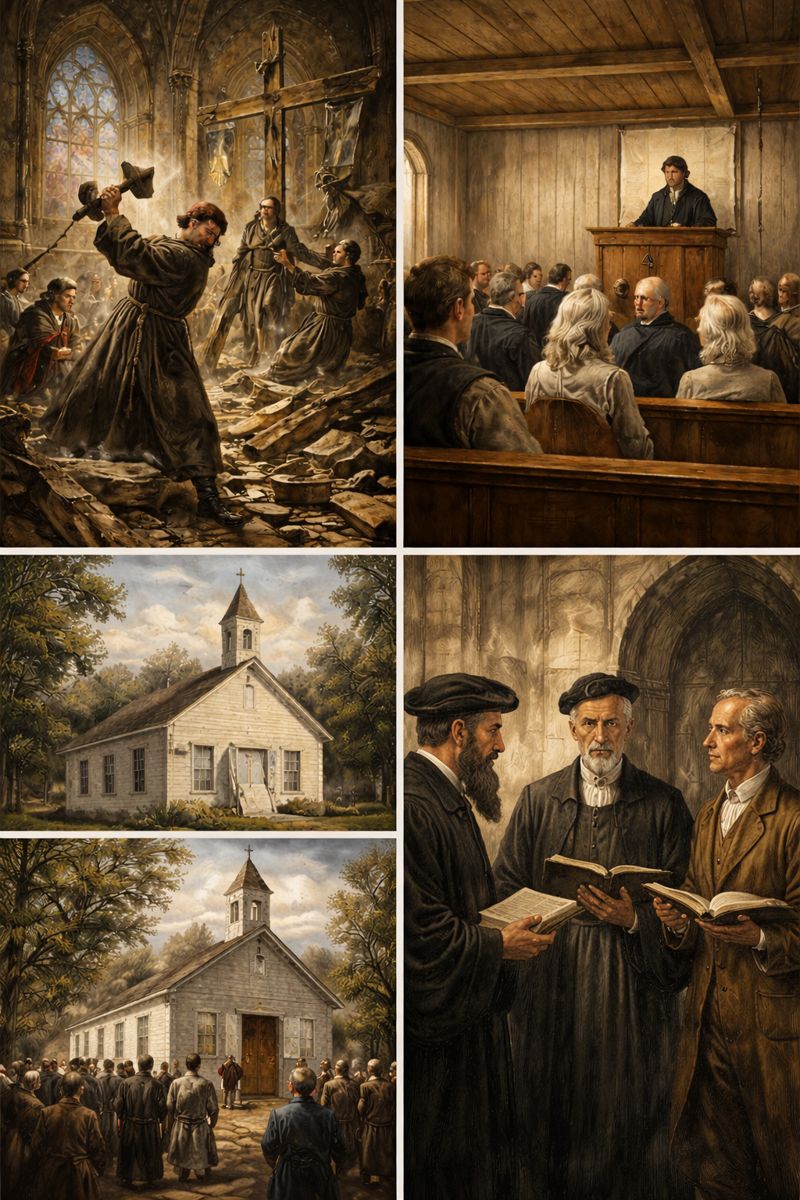
The Reformation’s Suspicion Toward Crosses and Religious Images
In the centuries following the Protestant Reformation, many Protestant groups viewed crosses, crucifixes, icons, and religious statues with deep suspicion. Reformers believed the medieval Catholic tradition of venerating images violated the Second Commandment, and that centuries of devotion to saints, relics, and symbols had drifted into idolatry. In regions influenced by the Reformation, some congregations removed crosses from churches, while others destroyed them entirely in waves of iconoclastic fervor.
Martin Luther took a more moderate position. He did not object to crosses as objects of remembrance but firmly opposed their veneration. John Calvin and the Calvinist movements that followed him rejected religious images completely, teaching that even a simple cross could become a step toward idolatry. As a result, Presbyterian, Baptist, Methodist, and Anglican worship spaces throughout the 17th to 19th centuries were plain and undecorated, reflecting the belief that worship should be focused entirely on Christ rather than physical objects.
American Protestant Churches in the Early Republic
The Protestant culture of early America, shaped heavily by Calvinist theology, inherited this suspicion toward religious symbols. During Joseph Smith’s lifetime in the early 1800s, most church buildings in the United States featured no crosses at all. The wearing of crosses as personal jewelry was also uncommon among Protestants, and in some circles was viewed as a Catholic practice inappropriate for Bible-believing Christians. Only a few Lutheran congregations used crosses consistently, and they represented a small minority of American religious life.
A Gradual Shift Toward the Cross in Protestant Worship
The symbol that would eventually become the central emblem of modern Christianity did not gain broad acceptance among Protestants until the mid-to-late 19th century. As Catholic immigration increased dramatically after the 1840s, many Protestant denominations found themselves ministering in religious environments where Catholic identity was increasingly visible. Over time, crosses began appearing on Protestant meetinghouses and in personal devotion, partly to signal Christian identity in a diversifying nation.
By the 20th century, what had once been rejected by many Protestant communities became widely embraced. The cross became the universal Christian emblem, even within denominations that had originally opposed it.
Historical Protestant Voices Against the Cross
Long before these shifts, prominent Protestant leaders wrote vigorously against using the cross as a religious emblem. John Wesley criticized the use of crosses and images on the grounds that the practice lacked biblical mandate. In the 19th century, Henry Dana Ward published a detailed work tracing the symbol of the cross through ancient cultures, arguing that its widespread use in antiquity suggested pagan rather than Christian origins. Many theologians of the 1700s and 1800s shared similar concerns, insisting that Christian worship should remain free from symbolic objects that might distract from the centrality of Christ.
Latter-day Saint Worship in Its Original Protestant Context
When the Church of Jesus Christ of Latter-day Saints emerged in 1830, it did so in a world where the cross was not used in Protestant worship spaces. The Saints naturally inherited the plain, non-iconic church culture familiar to the Protestants around them. Meetinghouses were simple, focusing on preaching, sacrament, and community rather than visible symbols. Early Saints therefore never adopted the cross as a liturgical emblem—not as a rejection of Christ’s crucifixion, but because the religious world around them regarded crosses as Catholic objects.
Shifting Worship Practices in Later Protestantism
While early Protestants resisted ornate worship, instruments, and religious art, the later 19th and 20th centuries saw rapid change. Church architecture grew more decorative. Instruments, choirs, and eventually worship bands became common. Symbols once rejected—including the cross—became central parts of Protestant identity. Yet some religious groups that emerged from similar restorationist movements, such as Seventh-day Adventists and Jehovah’s Witnesses, preserved the earlier Protestant avoidance of the cross, echoing the religious atmosphere of the early United States.