
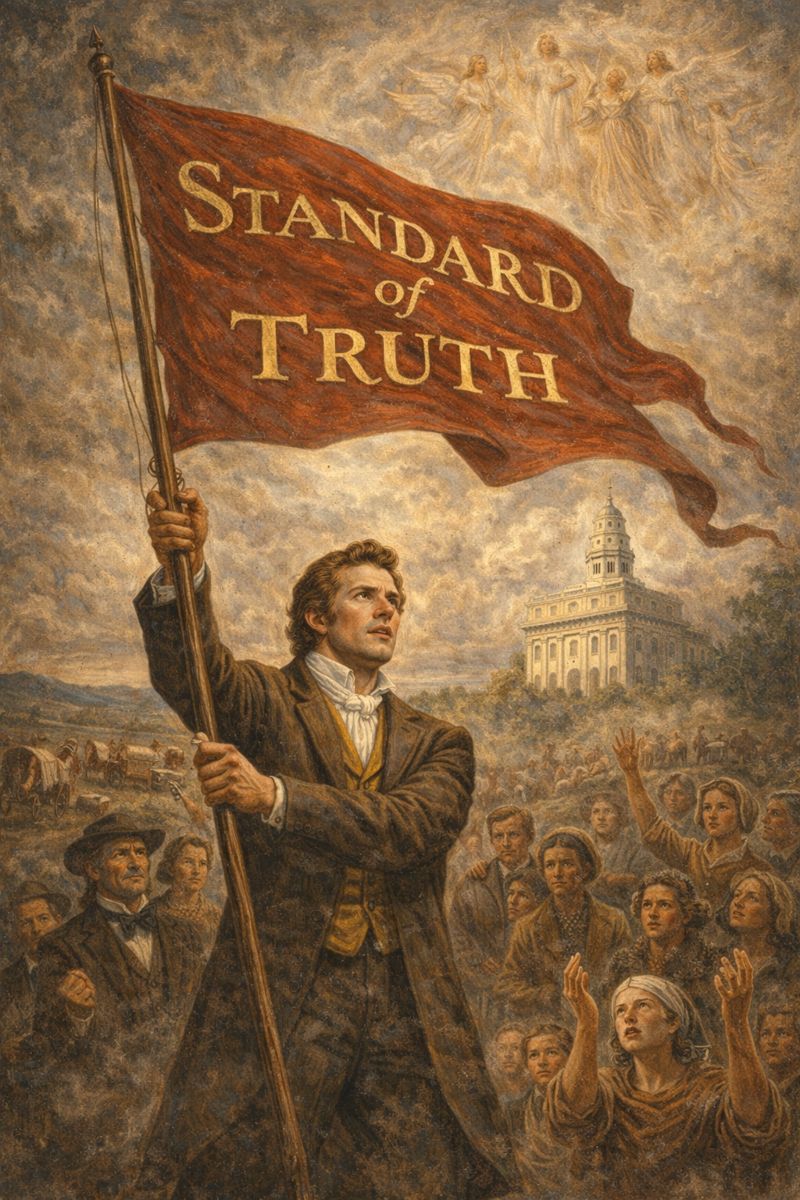
The Question Being Answered
A listener asks about the context and setting in which Joseph Smith gave the famous “Standard of Truth” statement. They want to know whether it came from a sermon, a revelation, or perhaps a response to a newspaper inquiry, and where and when the declaration was first delivered. The episode explains that the well-known missionary passage beginning with “The Standard of Truth has been erected…” actually originates from Joseph Smith’s 1842 “Wentworth Letter.”
Scriptural Background: The Imagery of an Ensign or Standard
The idea of a standard or ensign raised by God to gather His people is deeply rooted in scripture, especially in Isaiah as highlighted throughout the Book of Mormon. In 2 Nephi 15 (Isaiah 5), the prophet describes the Lord lifting an ensign to the nations, calling them from distant lands with power and swiftness. This passage is connected to the last-days gathering of Israel. In 2 Nephi 21 (Isaiah 11), Isaiah speaks of a “rod out of the stem of Jesse” and a “branch” associated with messianic and latter-day imagery, followed by the prophecy of millennial peace. Verses 10–12 describe a “root of Jesse” raised as an ensign to the people, with the Lord setting His hand again the second time to recover His people and gather Israel from the four corners of the earth. Latter-day Saints interpret these passages as prophecies of the Restoration and the global missionary effort.
The Doctrine and Covenants reinforces this reading. Section 113 explains that the “root of Jesse” is a latter-day descendant of Jesse and Joseph who holds the priesthood and the keys of the kingdom, and is appointed to raise the ensign for the gathering of Israel. Scripture therefore establishes a doctrinal connection between priesthood keys, a latter-day servant, the standard or ensign, and the divine gathering of God’s people.
“Terrible as an Army with Banners” — D&C 5
The same imagery appears in the Doctrine and Covenants. In section 5, the Lord describes the beginning of His Church rising out of the wilderness, becoming “clear as the moon, fair as the sun, and terrible as an army with banners.” The language reflects biblical symbolism and contributes to the broader doctrinal theme: that the restored Church is an ensign, a standard raised by God Himself in the last days—one that will march forward under divine protection and authority.
Early Usage of the Phrase “Standard of Truth”
The expression “Standard of Truth” did not originate in the Wentworth Letter. Early Church leaders were already using the phrase in missionary contexts. Joseph Smith, writing as editor of the Elders’ Journal, published excerpts from Heber C. Kimball’s letters from England, adding editorial comments that “the Standard of Truth is hoisted on the Eastern Continent.” Kimball himself wrote that “the Standard of Truth is reared on the other side of the great waters,” and that hundreds were gathering beneath its banner. This phrase became a symbol of missionary expansion and the gathering of Israel.
John Taylor, writing from Ireland during his mission, declared that he had “planted the Standard of Truth in that nation,” marking the beginning of the Church’s work there. Times and Seasons would later report that multitudes were “flocking to the Standard of Truth” as the gospel spread across Europe and the United States. Thus, before Joseph penned the Wentworth Letter, the term “Standard of Truth” was already understood among the Saints as a metaphor for missionary labor and the global spread of the restored gospel.
The Wentworth Letter: The Full Context of the “Standard of Truth” Passage
The famous declaration appears in Joseph Smith’s 1842 letter to John Wentworth, editor of the Chicago Democrat, who had requested a concise history of the Church for a publication about Illinois. Joseph responded with a document summarizing the Church’s origins, persecutions, growth, and beliefs. Although the letter was never used in the book, it was published in Times and Seasons and became a foundational statement of Latter-day Saint identity. This letter also contains what would later be known as the Articles of Faith.
In the Wentworth Letter, Joseph recounts the organization of the Church, its early expansion in the eastern United States, and the Saints’ settlement in Jackson County, Missouri. He describes peaceful beginnings followed by severe persecutions: houses burned, members whipped and tarred, property destroyed, printing presses seized, families driven into the wilderness, and children leaving bloody footprints in the cold. He details their expulsion from multiple Missouri counties, culminating in Governor Lilburn W. Boggs’s “Extermination Order,” which empowered militias to drive Latter-day Saints from the state by force. Joseph describes the plundering of property, the violation of women, the imprisonment and threats against men, and the forced winter expulsion of 12,000 to 15,000 Saints, many of whom died from exposure and disease.
After fleeing to Illinois, the Saints found refuge among hospitable citizens, built Nauvoo, and continued to grow. By this time, the Church numbered in the thousands in Illinois and thousands more abroad. They received a charter, organized the Nauvoo Legion, and established educational and civic institutions.
Just before the “Standard of Truth” paragraph, Joseph states that persecution has not hindered the progress of God’s work but has instead fueled its spread. Elders have gone forth preaching in nearly every state of the Union, and the gospel has entered major cities and villages. It has spread to England, Ireland, Scotland, and Wales, where about 5,000 converts had already joined the Church. Missionaries had also departed for Germany, Palestine, New Holland (Australia), and the East Indies. The immediate backdrop, therefore, is a Church simultaneously persecuted and triumphant—pressed down but expanding across continents.
Against this vivid historical background comes Joseph Smith’s prophetic affirmation known today as the “Standard of Truth,” declaring that no unhallowed hand will stop the work of God from progressing, despite persecution, mobs, armies, and defamation. The truth will go forth boldly, nobly, and independently until it reaches every continent, every climate, every country, and every ear, and until God Himself declares the work completed.
Doctrinal Meaning and Conclusion
The “Standard of Truth” is not an isolated inspirational slogan. It is deeply rooted in scriptural prophecy about the latter-day ensign, reinforced by the Doctrine and Covenants, reflected in early missionary language, and framed by the lived experience of severe persecution and unstoppable growth. The Wentworth Letter shows that the phrase is both historical and prophetic. It expresses Joseph Smith’s conviction that the restored gospel would fill the earth, gather Israel from the four corners of the world, and continue forward with divine power until the purposes of God are entirely fulfilled. The answer to the listener’s question is therefore clear: the “Standard of Truth” passage originates in Joseph Smith’s 1842 Wentworth Letter, written as a public explanation of the Church’s history and beliefs, and draws deeply upon scriptural imagery and early missionary experience.