Three Witnesses, Book of Abraham
The episode opens by drawing together several complex historical threads: surviving characters copied from the gold plates, early discussions surrounding the Book of Abraham, and the events that led to the formal calling of the Three Witnesses. The hosts explore what documentation survives, what has been lost, and how Joseph Smith’s 1838/39 history preserves one of the most detailed accounts of the witnesses’ visionary experience. By retracing each step, the narrative reveals how the testimonies of the Three Witnesses emerged at a moment of intense spiritual anticipation.
Book of Abraham Background: Papyri, Preservation, and Translation
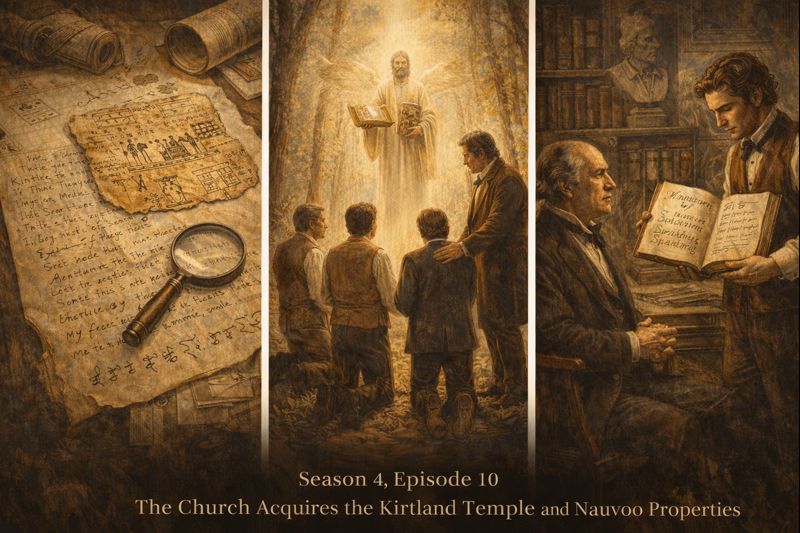
Very little firsthand documentation survives to explain the precise method Joseph Smith used to produce the Book of Abraham. Much of the papyrus collection was destroyed in the 1871 Chicago fire, and only fragments remain today. These surviving pieces tell part of their own story: to stabilize the fragile papyrus, they were backed with paper that had been cut from original architectural drawings of the Kirtland Temple. The reverse sides of the fragments preserve pieces of those temple plans, a tangible intersection of Egyptian antiquity and early Latter-day Saint sacred architecture.
As for the translation method, some accounts—such as Wilford Woodruff’s—mention Joseph using a seer stone at certain points. Yet the translation occurred intermittently over several years, and the sparse surviving sources make any technical explanation incomplete. The Church’s Gospel Topics Essay reflects this uncertainty: some scholars emphasize an ancient relationship between the papyri and the text of the Book of Abraham, while others propose revelation independent of the extant fragments. The historical record cannot fully answer “how,” only that Joseph declared the translation was given by revelation.
The Early “Characters Documents” and Questions About Publication
The episode turns to the characters copied from the plates. No surviving newspaper from Joseph Smith’s era contains printed characters from the gold plates. Because many local papers from Palmyra and nearby towns have not survived, it is impossible to know for certain whether none ever printed such characters. But among extant issues, none do.
One early copy traces back to Lucy Harris, who enlisted her daughter to reproduce characters that Martin Harris had previously obtained. Lucy used these as leverage in her escalating conflict with Joseph. Publishing them openly would have diminished their usefulness to her, making publication unlikely.
The most substantial early characters document is the so-called “Caractors Document,” written in John Whitmer’s handwriting around 1830–1831. For many years it was mistakenly thought to be the Anthon Transcript. Handwriting analysis disproved this: the Whitmers did not even meet Joseph Smith until 1829, long after Martin Harris’s visit to Professor Anthon in early 1828. The Whitmer document appears instead to have accompanied John Whitmer as he carried copies of revelations to Ohio in 1831.
Background to Doctrine and Covenants 17: The Desire for Witnesses
In June 1829, as Joseph, Oliver Cowdery, and David Whitmer neared the end of the Book of Mormon translation, they encountered passages describing that the Lord would appoint three special witnesses who would behold the plates and other sacred artifacts. These prophecies—now familiar to all readers of 2 Nephi and Ether—were read by Joseph for the first time during translation, revealing that witnesses would someday assist in establishing the truth of the record.
Moved by these passages, Oliver, David, and Martin Harris approached Joseph to ask whether they could be the men described. They persisted, and Joseph finally inquired of the Lord, receiving Doctrine and Covenants 17 through the seer stone. The revelation promised that if they exercised faith, they would behold the plates, the breastplate, the sword of Laban, the interpreters given to the brother of Jared, and the Liahona. Their testimony, the Lord explained, would shield Joseph and confirm the authenticity of the work.
The Vision of the Three Witnesses
Joseph Smith’s 1838/39 history preserves the fullest account of the event. The four men—Joseph, Oliver, David, and Martin—went into the woods near Peter Whitmer Sr.’s farmhouse at Fayette, New York.
They knelt together and prayed in turn, yet no manifestation came. Distressed, Martin Harris confessed he feared he was the obstacle and asked permission to withdraw. Joseph recorded that Martin moved off a distance to pray alone.
After Martin departed, Joseph, Oliver, and David knelt again. Suddenly, a brilliant light appeared above them. An angel stood before them holding the plates, turning the leaves and revealing the engravings. David Whitmer heard the angel address him directly with a blessing upon those who keep the commandments. Then a heavenly voice—later identified by Joseph as the voice of the Lord—declared that the translation was correct and that the witnesses were commanded to bear testimony.
Joseph then went in search of Martin, who was praying fervently and had not yet received an answer. Joseph knelt with him, and the vision opened again. Overcome, Martin exclaimed, “’Tis enough; mine eyes have beheld!” His relief reflected the scriptural tension between belief and doubt embodied in the plea: “Lord, I believe; help thou mine unbelief.”
Aftermath and Enduring Testimony
Following the experience, the men prepared their written testimony, now published at the front of every edition of the Book of Mormon. Although all three witnesses later distanced themselves from Joseph Smith or the Church for varying periods, none—despite persecution, political conflict, and doctrinal disagreements—ever denied the truth of what they saw. Their testimonies remained steadfast until their deaths.
Listen to the full podcast here:
https://www.youtube.com/@standardoftruthpodcastllc
Season 4, Episode 10 – The Church Acquires the Kirtland Temple and Nauvoo Properties