
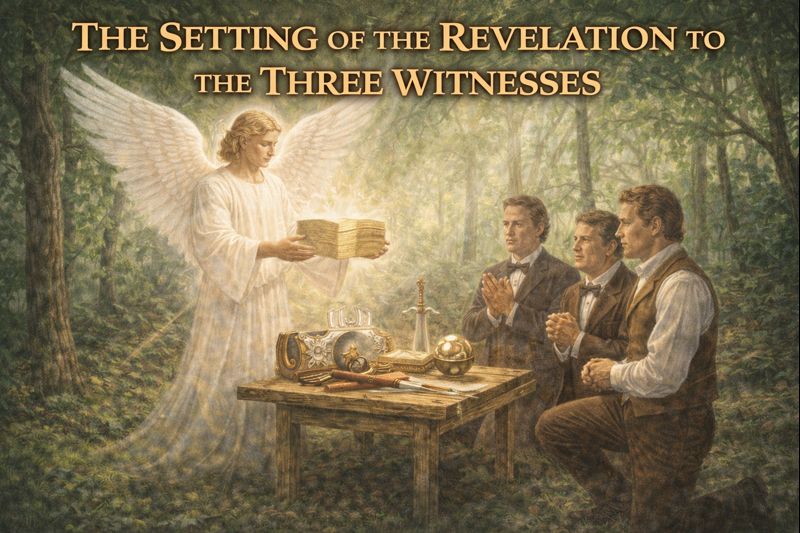
The Setting of the Revelation to the Three Witnesses
Doctrine and Covenants 17 arises during the final phase of the Book of Mormon translation in 1829, a moment when Oliver Cowdery, David Whitmer, and Martin Harris longed to fulfill the ancient prophecy recorded in Ether 5. Joseph Smith used the interpreters—later called the Urim and Thummim—to receive a revelation granting them the right to become the promised witnesses. The revelation assured them they would behold the gold plates, the breastplate, the Sword of Laban, the interpreters, and the directors or Liahona.
The earliest surviving manuscript copies of this section date from after 1834, meaning the phrase “Urim and Thummim” likely reflects Joseph’s 1835 adoption of biblical terminology to describe seer stones used in the translation.
Joseph Smith’s Record of the Three Witnesses’ Petition
Joseph Smith later wrote that Oliver, David, and Martin requested repeatedly that he inquire of the Lord whether they might see the plates. After Joseph prayed through the interpreters, the revelation now preserved as D&C 17 was received.
Joseph also described the events surrounding the actual manifestation. The four men entered the woods near the Whitmer home in Fayette, New York, and knelt in prayer. Martin Harris soon withdrew, fearing his lack of worthiness was preventing the vision. When Joseph, Oliver, and David continued praying, a heavenly light appeared, and an angel stood before them. The angel held the plates, turned their leaves, and displayed them openly. They heard the voice of God declaring the translation correct and commanding them to bear testimony.
Joseph then rejoined Martin Harris, prayed again, and Martin likewise witnessed the angel, the plates, and the voice of God.
Independent Government Documentation in 1831
An important external historical source comes from a February 1831 letter written by Indian agent Richard Cummins to General William Clark. Cummins reported that Latter-day Saint missionaries told Native Americans they possessed a divine revelation and that “an angel had appeared to one of their number and two others.” This early document—written by a government official with no connection to the Church—confirms that the story of three angelic witnesses was public knowledge within months of the Book of Mormon’s publication.
David Whitmer’s Consistent Testimony Through the Years
David Whitmer, interviewed many times from the 1850s through the 1880s, consistently repeated the same core elements of the vision. He recalled receiving a revelation while plowing, which instructed him that he must serve as one of the witnesses. He, Oliver, and Joseph prayed together in the woods when a glorious light descended. He saw an angel and a table upon which lay the gold plates, the brass plates, the Sword of Laban, the Liahona, the interpreters, and additional plates not further identified.
David reported that the angel turned the leaves of the plates and that he heard the voice of God declaring the translation true. His testimony never wavered: he saw, he heard, and he knew. Even after he separated from the main body of the Church years later, he never denied this experience.
Whitmer’s Observations About Joseph Smith and the Translation
Whitmer’s interviews offer insights into Joseph Smith’s character and spiritual dependence. He described Joseph as humble, sincere, and unable to translate unless spiritually prepared. On one occasion, after a disagreement with Emma, Joseph was unable to translate until he reconciled and prayed. Whitmer also stated he had seen the place where the plates were hidden and recounted that his mother once encountered the heavenly messenger—whom the Whitmers always called the “Nephite”—carrying the plates.
Whitmer and the Printer’s Manuscript
Another significant contribution David Whitmer made to Latter-day Saint history was safeguarding the printer’s manuscript of the Book of Mormon. For decades he allowed scholars and visitors to examine it, preserving a critical textual witness. Though he later disagreed with some developments in the Church after 1835, he never renounced the divine origin of the Book of Mormon or the manifestation he experienced.
Edward Stevenson’s 1870s Interviews with David Whitmer
In the 1870s, Edward Stevenson—one of the Seventy—spent extensive time interviewing David Whitmer. Whitmer reaffirmed every detail: the angelic visitation, the table with sacred artifacts, the voice of God, and the turning of the plates. Stevenson also recorded Whitmer’s statement that the translation began with the Nephite interpreters and later continued using a seer stone, harmonizing with many other independent accounts.
Listen to the full podcast here:
Season 5, Episode 12 – D&C 17 (formerly premium content from STC)